




Roland Michel Tremblay is a French Canadian author, poet, scriptwriter, development producer and science-fiction consultant. See his website here: http://www.themarginal.com/
More articles by Roland Michel Tremblay
Breakthrough in Faster-Than-Light Travel and Communication, and the Search for Extraterrestrial Intelligence (SETI)
Expansion Theory – Our Best Candidate for a Final Theory of Everything
Gravity is one of the most familiar everyday phenomena, yet it has mystified scientists and laymen for centuries. Even today, although the current official position on gravity is a continual “space-time warping” around objects – a claim from Einstein’s General Relativity theory, it is also still widely considered an endless attracting force emanating from objects, as claimed in Newton’s gravitational theory. Setting aside the troubling implications of two different physical descriptions of gravity in our science for the moment, it turns out that the behavior of a simple spring may hold the final answer to this age-old mystery.
Consider what happens when a loosely coiled spring is stretched apart from both ends while laying on a tabletop, as shown below in the left-hand frame. The opposing forces spread equally across the spring, causing an equal coil spacing across the spring, which also occurs whether either force pulls fully from the very end or is divided to pull directly on each coil:

However, with only a single continual pulling force on one end, shown on the right, the coils stretch more at the leading end as they strain to continually accelerate the ongoing resisting inertia of the rest of the spring. In this case, there is successively less stretch toward the trailing end as there is successively less trailing-coil mass to cause inertial drag.
This deceptively simple experiment has enormous implications for both Newton’s gravitational force and Einstein’s ‘warped space-time’ theory of gravity – and for understanding the true physical nature of gravity itself. The first important point is that it highlights a widely overlooked but critical error surrounding Einstein’s famous “space elevator” thought experiment, which forms the foundation of his Principle of Equivalence and his later associated General Relativity theory of gravity.
The Erroneous “Principle of Equivalence”
Einstein claimed that all experiences and experiments occurring inside a constantly accelerating elevator moving upward in deep space – far from any gravitational influence – would be indistinguishable from them occurring under the influence of Newtonian gravity on Earth. This claim is known as the Principle of Equivalence, and forms the cornerstone of gravitational physics in today’s science; however, the simple spring experiments just discussed can be used to show that this is an erroneous claim, with enormous implications for our understanding of gravity.
Similar to the left-frame tabletop experiment above, a hanging spring on Earth should have two opposing forces distributed across it, equally spreading its coils – the force of gravity pulling downward and the restraining force that effectively pulls upward. However, as in the right-frame of the above tabletop experiment, a spring attached to the ceiling of Einstein’s continually accelerating deep-space elevator, far from Earthly gravity, should exhibit the unequal coil distribution of a spring pulled from only one end:
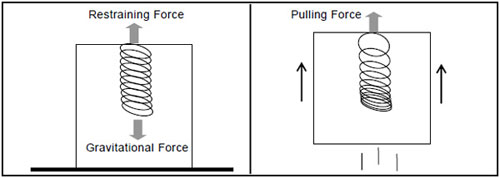
So, this shows that Einstein’s claimed “Principle of Equivalence” between Newtonian gravity and pure acceleration in deep space must be wrong – the effect of being accelerated upward in space must differ from an attracting force emanating from a planet. If Einstein had remained faithful to his original “space elevator” inspiration, rather than developing his General Relativity theory for equivalence to Newton, he would have produced a new understanding of gravitational physics that clearly differed from Newton’s, and which could be easily tested by a simple hanging spring experiment. Instead, Einstein effectively abandoned his space-elevator inspiration in favor of a mistaken “Principle of Equivalence” to Newton, and a related “warped space-time” proposal for the physics of gravity in his General Relativity theory.
A Verifiable Revolution in our Understanding of Gravity
But why concern ourselves with this hanging spring issue in a deep-space elevator, especially if we already know that Einstein’s Principle of Equivalence and General Relativity theory are widely accepted today, and supposedly even proven by highly sophisticated experiments? The reason is because this very same hanging spring experiment can be performed by anyone – by simply suspending a well-known spring toy from one end, showing that gravity on Earth behaves precisely as in Einstein’s original space-elevator inspiration, and not as in either Newton’s “gravitational force” theory or Einstein’s equivalent “warped space-time” General Relativity theory. This simple experiment shows a hanging spring with an unequal distribution – here on Earth – which could only occur if it were continually accelerated upward from its suspended end, and not stretched uniformly by an attracting “gravitational force” or equivalent “space-time warping”.
This further shows why no solid scientific explanation for the operation of Newton’s proposed attracting force has ever been settled upon, and nor has its apparently endless power source ever been identified or explained. This also means that Einstein’s efforts to mirror Newtonian gravitational theory in his General Relativity theory are equally verifiably in error, and that the experiments presented as proof were conceived and designed such that their claimed “success” actually constitutes no particularly meaningful result at all.
Could the Evidence Still Support Today’s Gravitational Theories?
The preceding discussion shows that Newton’s theory of an attracting gravitational force is readily disproven by a simple hanging spring, as is Einstein’s ‘warped space-time’ General Relativity theory, which was deliberately designed to be functionally equivalent. But before addressing what all of this means, it can still be tempting to dismiss the above discussion with intuitive support for today’s gravitational theories, such as the following:
‘The coils at the top of a hanging spring simply bear the weight of the rest of the spring hanging below. And those further down have fewer coils below them, thus less weight to bear, stretching successively less, resulting in more stretch at the top and successively less toward the bottom – a non-uniform hanging spring.’
This may initially sound reasonable enough, but the first hint of a flaw in this logic is that it is at odds with the earlier tabletop experiment showing that two opposing forces (such as gravity pulling down and a restraining force pulling up) should result in uniform coil spacing. So, what is the logical flaw in the above reasoning? It is the presumption that the strain caused by weight is solely due to a downward pull from gravity, and that this strain accumulates, with the weight of the lower coils adding to greatly stretch the upper ones.
The error in this logic is shown in the first frame of the diagram below, where an object’s weight is shown as solely due to a downward pull from gravity. If it were literally true that there is nothing but a downward force on the object, then the object would not rest as a weight in our hand, but would be in a weightless free-fall, as shown in the second frame. The very reason the object is not in a weightless free-fall, but sits instead as a weight in our hand, is because there is an opposing force – in this case from our muscles – holding it in place, as shown in the last frame:
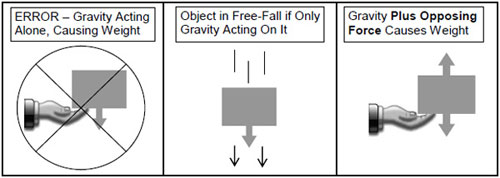
Similarly, the error of both logic and physics in the weight-based reasoning for the non-uniform hanging spring is the suggestion that the weight of each coil is solely due to a gravitational force (frame 1 below), with downward weight accumulating along the spring. In actuality, a scenario with only a downward gravitational force would produce a spring in weightless free-fall (frame 2 below), which would accelerate toward the ground with no stretching at all, in the absence of an opposing upward force. A statically hanging spring (last frame), however, actually has two opposing forces distributed throughout it – according to today’s gravitational theory (gravity acting downward and the restraining force acting upward), which, again, should equally spread its coils.
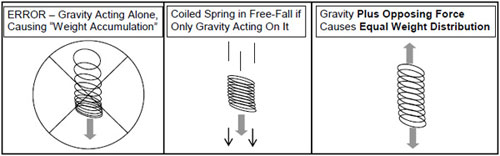
There can be no such thing as ‘accumulating coil weights’ in a hanging spring, caused by a lone gravitational force pulling them downward and adding up to cause a non-uniform distribution, but only equally stretched coils from two opposing forces. There remains no viable explanation for the observed non-uniform distribution of a simple hanging spring in today’s science – experimentally disproving all current gravitational theory.
The True Nature of Gravity Finally Revealed
So then, what does all of this mean? If a simple hanging spring experimentally disproves both Newton’s attracting-force suggestion and Einstein’s warped space-time proposal, what does it mean when the experiment mirrors Einstein’s upwardly accelerating space elevator? A strong hint is that this experimental result is completely in line with a compelling new theory of gravity, known as Expansion Theory.
This new theory states that all atoms – and, by extension, all objects composed of atoms – are slowly and continually expanding, by roughly one-millionth their size each second. This underlying expansion is unseen directly, as everything expands equally, but is felt as a force beneath us from our huge expanding planet, and is seen indirectly as all objects, regardless of mass, appear to fall equally to the ground (which actually rises to meet them all equally).
This explains why Einstein’s space elevator correctly captures the observed behavior of a hanging spring on Earth, since our planet’s constant expansion effectively acts as an elevator constantly accelerating us upward.
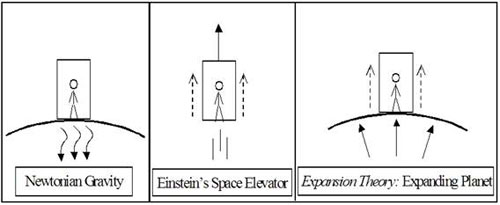
In this case, a suspended spring on Earth effectively hangs in the “elevator”, with a singular continual upward pulling force as we hold it suspended. Here, the accumulated ongoing resisting inertia of the lower coils would indeed cause greater stretching in the upper coils and the non-uniform distribution observed in the hanging spring.
This also explains why the spring’s behavior does not match either Newton’s or Einstein’s demonstrably flawed downward-pulling theories of gravity, which could only cause equal coil distribution. And, according to the formal Scientific Method, any single solid contrary experimental result definitively disproves any theory – regardless of how well it may otherwise match or model observations.
The only viable conclusion from this discussion, and from both experiment and our understanding of physics, is that the effect we call ‘gravity’ arises from a universe of actively expanding matter, rather than one of separate inert matter and active “gravitational energy” with no known, and necessarily draining, power source. Ultimately, in Expansion Theory, all forms of “energy” turn out to be various forms of actively expanding atomic or subatomic matter, with “energy” being a mere misunderstanding of a universe where all matter actively expands by its very nature of existence.
For more information about this new revolution in science, read my previous articles:
Expansion Theory – Our Best Candidate for a Final Theory of Everything”
Breakthrough in Faster-Than-Light Travel and Communication, and the Search for Extraterrestrial Intelligence (SETI)
Mark McCutcheon is author of “The Final Theory: Rethinking Our Scientific Legacy”. For more information and further reading on Expansion Theory, visit http://www.thefinaltheory.com
Roland Michel Tremblay