




Roland Michel Tremblay is a French Canadian author, poet, scriptwriter, development producer and science-fiction consultant. See his website here: http://www.themarginal.com/
More articles by Roland Michel Tremblay
Breakthrough in Faster-Than-Light Travel and Communication, and the Search for Extraterrestrial Intelligence (SETI)
Gravity Breakthrough: Springing into a Gravitational Revolution
On 4 March 2010, New Scientist magazine published an article entitled “Knowing the mind of God: Seven theories of everything”, where Michael Marshall reviewed the most promising candidates for the Theory of Everything, the Holy Grail of theoretical physics. In the end, there was no solid conclusion as to which, if any, may lead to this final theory. Each is quite different from the others, demonstrating that there is still no fundamental physical or theoretical agreement on the operation of our universe, and all still fall under the general umbrella of our known scientific paradigm, or Standard Theory.
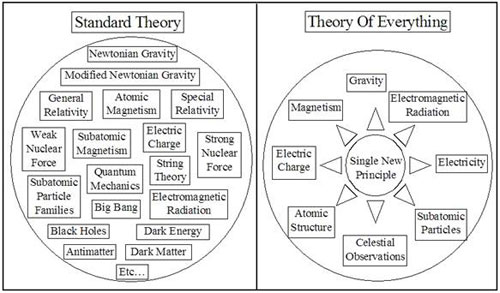
Yet, this grand final theory is expected to provide a clarifying simplicity and understanding that is unknown today, implying that it may even lie outside our Standard-Theory umbrella. What if the answer is much simpler and more straightforward than any of the current proposals, perhaps even lying right underfoot?
This final theory should unite all four fundamental forces (gravity, electromagnetism, and both strong and weak nuclear forces); identify a fundamental principle or particle that does this and you are well on your way. According to Mark McCutcheon, a Canadian-born electrical engineer and science author, the stable and ubiquitous electron is just such a particle – provided that it operates on a fundamental principle of constant subatomic expansion rather than today’s endless, unchanging“charge”.
This switch from “charge” to “expansion”, termed Expansion Theory, has surprisingly far-reaching implications, not only for electric charge itself, but also for the nature of the atom and subatomic particles, atomic bonds, magnetism, electromagnetic radiation and gravity. As such, this singular new concept offers potential scientific explanations for all known forms of matter and energy, offering further solutions to the puzzling mysteries and paradoxes inherent in such theories as Quantum Mechanics and Special/General Relativity – the very reason we seek a final Theory of Everything. This certainly qualifies as thinking outside of known science, as may ultimately be required for a final theory, but is it science? To sincerely answer this question we must equally apply it to today’s theories as well; there must be no free passes on such important issues.
Consider gravity, simultaneously one of the most common yet mysterious phenomena in our science. Is it a force, as Newton claimed, with no clear reason why it should attract rather than repel, no known power source, and which still puzzles scientists searching for speculative “graviton particles” presumed to mediate its force? Or, despite this most widespread conceptualization both taught and used today, even in our space programs, is it instead Einstein’s “warped space-time” – an entirely different physical explanation spawning its own puzzles and searches for equally speculative “gravity waves”? Even the very concept of “dark matter” arose to address a tenfold discrepancy between current gravitational theory and cosmic observations – mysterious invisible matter that neither emits, absorbs, blocks or reflects any type of radiation, yet is now presumed to be the dominant component and gravitational influence in the universe.
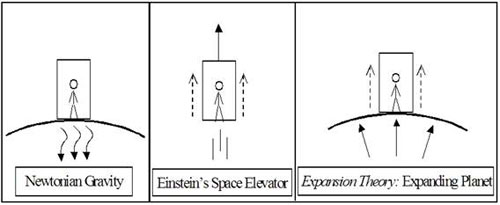
But if we consider the expanding-electron concept, which in turn leads to equally expanding atoms, a new gravitational theory emerges that actually mirrors Einstein’s famous elevator-in-space thought experiment where standing on Earth is entirely equivalent to being accelerated upward in space. The force we feel underfoot is then due to our resulting expanding planet, with dropped objects all equally approached by the ground rather than the other way around, while the underlying expansion is unseen as everything expands equally, maintaining constant (relative) sizes. This would create the appearance of a force somehow holding us to the ground and pulling all objects equally downward regardless of mass, just as Newton proposed. And while Einstein opted for “warped space-time”, atomic expansion suggests this far simpler and more literal possibility.
Intriguing perhaps, and while Expansion Theory does provide compelling parallel explanations for many observations, are there any cutting experiments that might set it apart for validation purposes? Consider holding one object while another of equal mass hangs from it by an elastic band, then letting go. According to Newton, a gravitational force acts equally on all components, accelerating the entire balanced system of two objects and a stretched elastic downward.
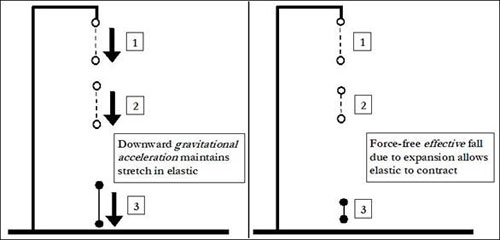
Letting go does not free the elastic to contract, but instead frees the entire system to accelerate, with the bottom mass pulled downward and the resisting inertial mass of the top object now in tow, maintaining the stretch in the elastic caused by the earlier hanging mass. The gravitational pull also on the top object merely matches that on the bottom object to ensure its mass can also attain the same acceleration rather than slowing the fall of the overall system, with the stretched elastic then still remaining.
But this is not what happens. The elastic actually contracts during the fall, pulling the objects together. Yet this should not occur according to either Newton’s gravitational force or Einstein’s “warped space-time”. However, it should occur if the planet’s expansion was initially pushing the held object upward, forcefully stretching the elastic before the drop – an influence that would vanish during free-fall, which allows the elastic to contract as everything floats free while the ground approaches. This simple cutting experiment would appear to seriously challenge both Newton and Einstein, according to the Scientific Method where even a single negative result disproves any theory, while supporting the expanding-atom concept of gravity.
But this would also appear to raise serious questions about Einstein’s theories of relativity, since Einstein’s “warped space-time” concept of gravity hails from his General Relativity theory, which in turn follows on from his earlier Special Relativity theory. Is this really possible? Consider the famous “Twin Paradox” thought experiment, where a speeding astronaut returns to Earth to discover he is much younger than his Earthbound twin. A logical flaw in this paradox claim has been reluctantly but increasingly acknowledged over the years, since “everything is relative” in Special Relativity theory, so either twin could be considered speeding or stationary, removing any absolute age difference. But, should this flaw be pointed out, focus is invariably switched away from Special Relativity since only the astronaut underwent actual physical acceleration in his travels, which is instead the realm of General Relativity. This switch is generally presented as a resolution to the issue – but is it?
First, this switch to General Relativity invalidates the still often-claimed support for Special Relativity from both this famous thought experiment and from all related physical experiments, such as speeding particles in accelerators, or atomic clocks on circling airplanes or satellites. Yet this fact is typically neither discussed nor even acknowledged, leaving many with the impression that the Twin Paradox and related physical experiments still fully apply to and support Special Relativity theory.
Second, even the switch to General Relativity appears to be a flawed solution to this issue. One of the cornerstones of General Relativity is the Principle of Equivalence, which states that the acceleration due to gravity on Earth is entirely equivalent to being accelerated through space at an equivalent rate – no experiment should be able to discern any difference. This means that even though this acceleration would produce near-light speeds within months, there should still be no physical difference between this scenario and that of standing on Earth the whole while.
So, according to both the “everything is relative” aspect of Special Relativity and the Principle of Equivalence in General Relativity there would appear to be no such phenomenon as “relativistic time dilation”, despite widespread citation of iconic theoretical and experimental claims to the contrary. Not only would this seem to question some central claims of Special Relativity, but doubly so for General Relativity considering the earlier drop test as well. And notably, the expanding matter concept differs not only with the drop-test prediction of both General Relativity and Newtonian gravity, but also with the time dilation claims related to Special and General Relativity, providing very different explanations of these scenarios.
Interestingly, another test of this new concept of gravity would be to weigh an object directly on the surface of the far side of the Moon. Since the Moon is about a quarter the size of Earth, its expansion-based surface gravity would be one quarter as well, which is also calculated by Newton’s mass-based gravitational equations before revising lunar mass assumptions to match direct surface measurements from our space programs. And while the actual one-sixth surface gravity – only directly measured on the near side and presumed to extend around the lunar surface – is currently explained by assuming a less dense lunar composition throughout, there is now another possible explanation.
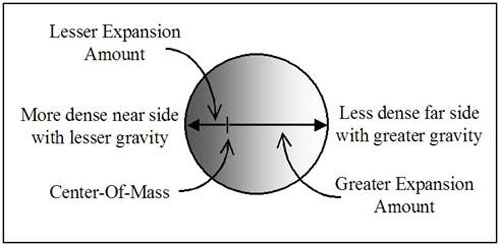
Expansion Theory suggests a varying density, from most dense on the near side to least dense on the far side, which is also in keeping with one of the commonly proposed lunar creation scenarios. In this case, since the expansion of objects would proceed from their center of mass, there would be less expansion force on the near side and more on the far side due to the resulting off-center expansion. This suggests double the surface gravity on the far side to average to the one-quarter gravity suggested by the Moon’s size – a fact that would not affect either the Moon’s shape or any orbits about it, but could only be determined by direct surface contact.
Atomic expansion also means that ocean tides cannot arise from a lunar influence, but only from internal dynamics within Earth – an inner wobble that in fact must exist according to classical physics, since the center of mass of the overall Earth-Moon rotational system lies off-center within our planet. This view suggests why the passing Moon coincides with rising tides, roughly speaking, but for purely internal reasons that follow from the creation, evolution and ongoing dynamics of the Earth-Moon system.
One of the most celebrated successes of Newton’s gravitational-force theory, and a milestone in our science, is the extension of Earth’s surface gravity to a forceful “action-at-a-distance” quality that Newton claimed reaches out into space, holding the Moon in orbit. But this proposal not only still has no solid physical explanation for how it might operate – 300 years later, but also offers no explanation for the immense and endless power source that must exist to support such a powerful undiminishing force. We have developed conceptual abstractions to address this issue in the absence of solid physical explanations, but this has left us with an array of speculative gravitational theories and physical explanations.
In contrast, the expanding atom concept explains orbits at a distance as an inescapable geometric consequence of surface gravity. It is easy to see, for example, how dropped objects would effectively fall due to planetary expansion alone, and how horizontally tossed objects would similarly curve and plummet toward the ground. Such dramatic momentum change solely due to the geometry of expansion demonstrates that gentler curving trajectories traversing increasing fractions of Earth’s circumference would result with greater horizontal speed. Unlike the absolute straight-line momentum suggested by Newton’s first law, there is actually no reason such an object would not travel one-third, one-half, and eventually a full orbital circumference about an expanding planet as its speed increased.
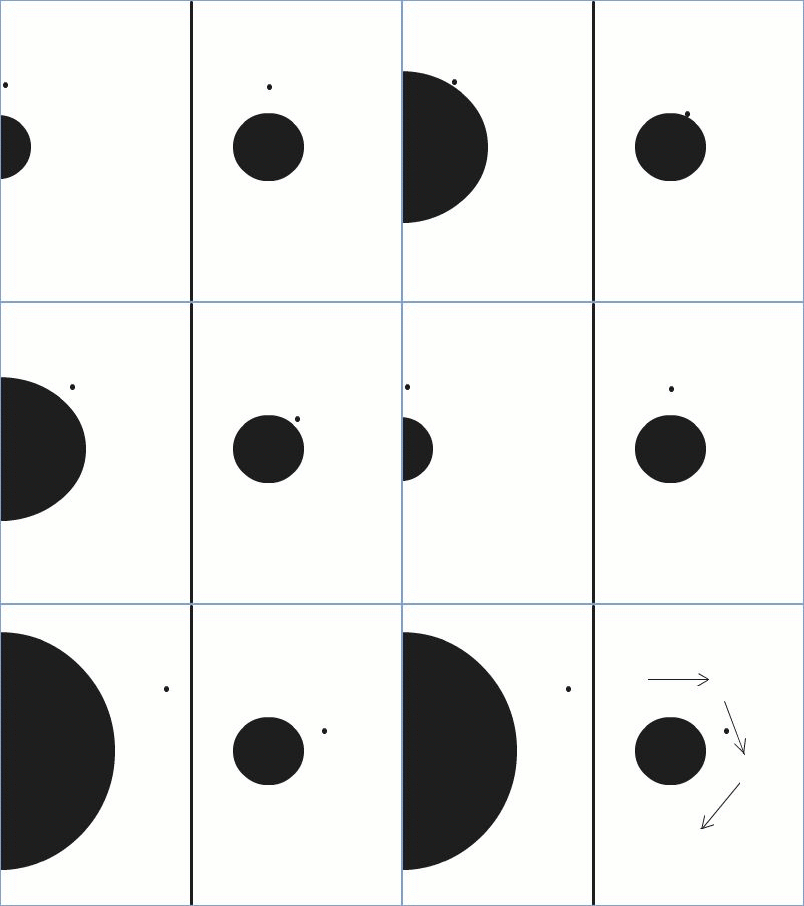
Atomic expansion suggests additional explanations for observations throughout our solar system, such as planetary orbits and interplanetary space travel. Consider two planets passing each other while their expansion closes the gap between them. We would never actually see such expansion directly as a size change if we and all other objects expand equally, maintaining constant (relative) sizes, so the closing gap between the objects could only manifest as unchanging planets curving toward each other for some reason while passing. Newton suggested the reason is a still-unexplained attracting force, while Einstein instead proposed four-dimensional warped space-time. However, curves and orbits would also follow quite naturally and unavoidably from the pure geometry of expanding matter alone.
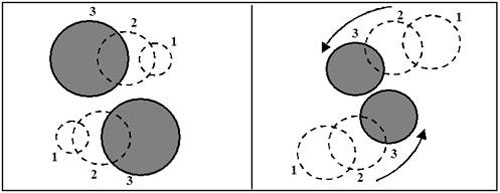
The dynamics of orbiting, expanding moons and planets would also result in the entire solar system and all of its contained orbits expanding as well. This can be shown to explain such occurrences as gravity assist maneuvers that accelerate spaceships as they pass planets – and where there are no known g-forces in the process – an otherwise mysterious maneuver that lacks proper explanation today upon closer examination. And, at the level of the overall solar system, this expansion addresses widely known puzzling anomalies with the Pioneer space probes and other spacecraft as they travel through the solar system and beyond. These deviations from predicted trajectories can now be considered as possible artifacts of our Newtonian gravitational models, based on a force emanating from a given mass rather than the geometry of expansion.
And, much as expanding atoms replace the notion of “gravitational energy”, expanding subatomic particles replace the energies of “electric charge” and “strong and weak nuclear forces”. These separate energy concepts similarly become unnecessary abstractions in an atomic model where neutrons and protons are not true particles, but clusters of expanding (not “charged”) electrons, and where “orbiting” electrons instead bounce repeatedly off the resultant continually expanding nucleus.
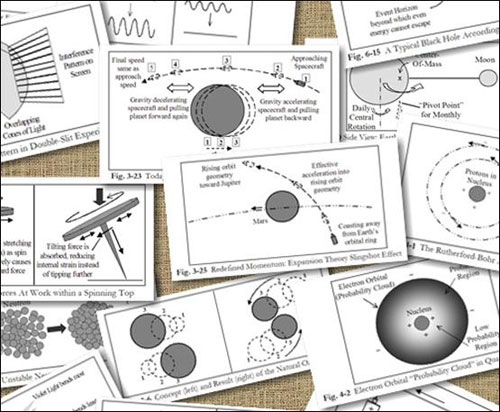
Today’s “strong nuclear force” holding the powerfully repelling “positively charged” nuclear protons together (whose required power sources are both oddly absent), is replaced by the crushing force of rapidly expanding protons and neutrons against each other. And the “weak nuclear force” causing occasional nuclear decay further suggests the characterization of neutrons as less stable clusters of active expanding electrons that occasionally eject an electron to become a more stable proton cluster in a more straightforward proposal for this nuclear “decay” process. This concept extends further to chemical bonds, currently attributed to endless electric-charge or electromagnetic energy, and even beyond as external clouds of expanding electrons that we call electric and magnetic fields. Even electromagnetic energy such as heat and light becomes clusters of freely expanding electrons pushing one another through space, while electricity is expanding electrons pushing each other through wires and extending outward as a surrounding magnetic field.
In the end, all known forms of matter and energy become manifestations of the singular unifying phenomenon of expanding matter. Although easy dismissals are tempting with most alternate theories, a closer look may well show Expansion Theory to be much more scientifically viable, comprehensible and verifiable than the other seven “theory of everything” candidates. In fact, such a comparison could be very eye opening indeed.
Mark McCutcheon is author of “The Final Theory: Rethinking Our Scientific Legacy”. For more information and further reading on Expansion Theory, visit http://www.thefinaltheory.com
Roland Michel Tremblay