




Books by Robert Bauval & Thomas Brophy
|
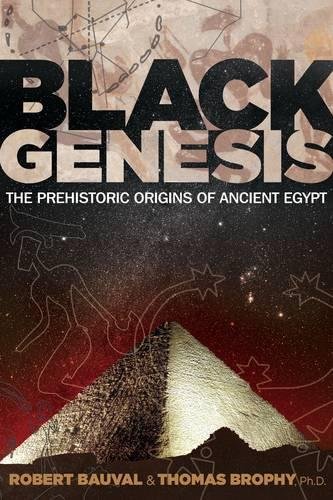
Black Genesis |
|
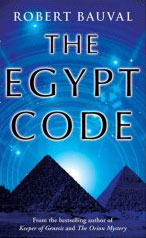
The Egypt Code |
|
The Origin Map: Discovery of a Prehistoric, Megalithic, Astrophysical Map and Sculpture of the Universe |
|
The Message of the Sphinx: A Quest for the Hidden Legacy of Mankind (aka Keeper of Genesis) |
By Robert Bauval & Thomas Brophy

For May 2011 Author of the Month we are both pleased and honored to welcome as Co-Authors of the Month, Robert Bauval and Thomas Brophy, presenting excerpts from their recently published work Black Genesis: The Prehistoric Origins of Ancient Egypt.
http://www.innertraditions.com/
See Robert Bauval’s last AoM article for his book, ‘The Egypt Code’ here:
http://www.grahamhancock.com/forum/BauvalR5.php
Relegated to the realm of archaeological heresy, despite a wealth of hard scientific evidence, the theory that an advanced civilization of black Africans settled in the Sahara long before Pharaonic Egypt existed has been dismissed and even condemned by conventional Egyptologists, archaeologists, and the Egyptian government. Uncovering compelling new evidence, Egyptologist Robert Bauval and astrophysicist Thomas Brophy present the anthropological, climatological, archaeological, geological, and genetic research supporting this hugely debated theory of the black African origin of Egyptian civilization.
Building upon extensive studies from the past four decades and their own archaeoastronomical and hieroglyphic research, the authors show how the early black culture known as the Cattle People not only domesticated cattle but also had a sophisticated grasp of astronomy; created plentiful rock art at Gilf Kebir and Gebel Uwainat; had trade routes to the Mediterranean coast, central Africa, and the Sinai; held spiritual and occult ceremonies; and constructed a stone calendar circle and megaliths at the ceremonial site of Nabta Playa reminiscent of Stonehenge, yet much older. Revealing these “Star People” as the true founders of ancient Egyptian civilization, this book completely rewrites the history of world civilization, placing black Africa back in its rightful place at the center of mankind’s origins.
From Robert and Thomas:
We are very happy to participate as “authors of the month” for grahamhancock.com. Following we have excerpted some key passages from Black Genesis that we think may generate discussion here.
From the Introduction:
This book is the product of a deep and strong desire to use the best of our intellect, knowledge, and abilities to put right an issue that has long beleaguered historians and pre-historians alike: the vexed question of the Black African origins of the ancient Egyptian civilization. In spite of many clues that have been in place in the past few decades, which strongly favor a Black African origin for the pharaohs, many scholars and especially Egyptologists have either ignored them, confused them, or, worst of all, derided or scorned those who entertained them. It is not our business to know whether such an attitude is a form of academic racism or simply the blinded way of looking at evidence to which some modern Egyptology has become accustomed, but whatever the cause, this issue has remained largely unresolved.
We first came across this inherent bias and prejudice against African origins of the Egyptian civilization in the debate—more of an auto-dafé really—against the Black African professor Cheikh Anta Diop, who, in 1954, published his thesis Nation Négre et Culture, which argued
a Black African origin for the Egyptian civilization. Anta Diop was both an eminent anthropologist and a highly respected physicist, and as such, he was armed with an arsenal of cutting-edge science as well as the use of the latest technology in radiocarbon dating and biochemistry to determine the skin color of ancient mummies and corpses by analyzing their content of melanin, a natural polymer that regulates pigmentation in humans. Yet in spite of his careful scientific approach, the Egyptian authorities refused to provide Anta Diop with skin samples of royal mummies, even though only minute quantities were required, and they pilloried and shunned him at a landmark symposium in Cairo in 1974 on the origins of ancient Egyptians. Diop died in 1986, his mission not fully accomplished. Fortunately, however, the debate on African origins was quickly taken up by Professor Martin Bernal, who, in 1987, published a three-volume opus, Black Athena, that flared even further the already-heated debate. Bernal, a professor emeritus of Near Eastern studies at Cornell University, was the grandson of the eminent Egyptologist Sir Alan Gardiner, yet this did not prevent Egyptologists from attacking him with even more vehemence than they had his Black African predecessor Anta Diop.
Even though there is still much controversy surrounding the origins of the ancient Egyptian civilization, we can now say with much evidence driven conviction that its origins have their genesis with a Black African people who inhabited the Sahara thousands of years before the rise of the pharaonic civilization. In this book we present hard scientific evidence and cogent arguments that have been culled from the latest findings and discoveries made in the Egyptian Sahara during the past four decades. We have consulted the publications of eminent anthropologists, paleoanthropologists, paleoclimatologists, paleopathologists, genetic scientists,
archaeologists, archaeoastronomers, geologists, and even reports from daring desert explorers such as Mark Borda, Carlo Bergmann, and Mahmoud Marai, who have all contributed to showing that this specific region of the world was the crucible of the ancient Egyptian civilization. In researching this book, we have used the best and latest research accredited to experts and scholars, and we have also provided extensive notes in order for the reader to trace this source material for further reading. In addition, we have specifically used our own tool kit and method, which entails the application of the science of astronomy to interpret the alignments of complex megalithic structures, pyramids, and temples, as well as extracting the astronomical content in ancient Egyptian texts and tomb drawings. To phrase it another way, we have coaxed the silent, ancient stones to reveal their secrets with the universal language of the sky…
From Chapter I, section In Comes Archaeoastronomy:
…In the past forty years or so there has been a growing interest in the new scientific field of archaeoastronomy, which, according to one school of thought, is defined as the study of the astronomies, astrologies, and cosmologies, as well as the alignments of monuments and buildings of ancient cultures. ..
… A sort of stillborn precursor of modern archaeoastronomy can be found in the turbulent intellectual milieu that swirled through the French intelligentsia at the turn of the nineteenth century after Napoleon, in 1799, took a cadre of top scientists and scholars along with his army on their adventurous military campaigns through Egypt. Napoleon also took along artists to record the journeys in sketches. One such artist, Vivant Denon, was fascinated by a zodiac sculpted onto the ceiling of a temple at Dendera. In Paris, Denon published as a book his sketch of the Dendera zodiac along with an account of his travels, and it became a huge bestseller in both France and England. In the important scientific and scholarly societies of Paris there arose a protracted and very active debate focusing on attempts to date the Dendera zodiac. One camp was composed of scientific luminaries of the time, many of whose names are familiar to any student of science today. These scientists often gathered at the home of the Marquis de LaPlace. Particularly active in the Dendera zodiac debate were physicists Jean-Baptiste Biot and Joseph Fourier, astronomer Johan Karl Burckhardt, and his engineer partner Jean-Baptiste Coraboeuf. The approach that all in this camp followed in order to attempt to date the zodiac was to match calculations of the astronomical precession of the equinoxes with the images of constellations on the Dendera zodiac. They followed the reasoning of pre–French Revolutionary scholar Charles Dupuis, who had based his study of the origins of religion on interpreting religious mythologies in astronomical terms….
… Stirring even more the turbulence of the debate was that many French intellectuals, such as Dupuis, had little use for biblical fundamentalism, while others believed all scholarship should be firmly based on interpreting biblical Mosaic (emphasizing the Books of Moses) chronology. One of these was the young Jean-Francois Champollion.
Meanwhile, a French antiquities collector named Saulnier had dispatched a master stonemason named Lelorrain on an expedition to Dendera to steal the zodiac. After using stone saws and chisels and finally dynamite, Lelorrain managed to cart the remains of the temple ceiling back to Paris. These remains, however, did not include the parts of the ceiling that ended up winning the Dendera zodiac debates. In September 1822, Champollion, after years of poverty-stricken excruciating efforts,9 finally cracked the code for how to decipher hieroglyphs. Champollion first deciphered the cartouches that contain royal names. (A cartouche is an oval enclosure in which the name of a pharaoh is inscribed. Only a king’s name can be written within a cartouche.)
Among the first cartouches he deciphered were those next to the Dendera zodiac. There he read the ancient Greek word for “ruler,” thus dating the construction of the zodiac ceiling to the Ptolemaic period and winning the debate for the side of the philologists, who could happily boot the physicists and astronomers out of the circle of those considered able to offer legitimate authority about antiquity.
Yet in what must be one of the great ironies of history, in 1828, when Champollion had the resources finally to mount his own expedition and he arrived at Dendera to see his famous cartouches, he was horrified to find them empty. They never had contained any hieroglyphs, no royal names at all…
… Before we go into this, however, we must understand better why the CPE made the mistake of leaving out of their research and investigation the regions of Gilf Kebir and Jebel Uwainat, for even with the problem of their great distance from Nabta Playa, it should have been obvious that they were in some way related to the ancient people who developed Nabta Playa. Let us review, then, where and when this intriguing story of the Egyptian Sahara really began. Surprisingly, it was not in Egypt but in the dimly lit corridors of Balliol College, Oxford, England.
From Chapter Two, section Oxford Gentleman, Queen’s Lover, and Deep Desert Explorer:
When we think of the Arabian deserts and their rolling landscape of golden dunes, for most of us what comes to mind are romantic figures such as Lawrence of Arabia, Omar Sharif, or even Rudolf Valentino. Few will think of Ahmed Hassanein Bey* or even know who he was. It may come as a surprise to many, then, that according to the Royal Geographical Society of London, Hassanein Bey is ranked as the greatest desert explorer of all times, so much so that the director of the desert survey of Egypt at that time referred to Hassanein’s desert exploration as “an almost unique achievement in the annals of geographic exploration.”
So who really was Ahmed Hassanein Bey, and why is he important to our investigation into the origins of the pharaohs? Ahmed Hassanein was born in Cairo in 1889. He was educated at an English private school, as was then customary for well-to-do families in Egypt. As a young man, he was sent to England to complete his gentleman’s education at Balliol College, one of the most prestigious institutions of Oxford University. The very stiff-upper-lip education that he received there would serve Hassanein well for the diplomatic career he was destined to pursue in Egypt. Described by his peers and biographers as an exotic blend of court official, diplomat, Olympic champion (he represented Egypt in Brussels in the 1920 Olympics and in Paris in 1924), photographer, writer, politician, royal tutor (to the future King Farouk) and an incurable romantic (among his amorous conquests was the lovely Queen Nazli), Hassanein was the last of the great desert explorers. He also had an excellent family pedigree: he was the son of an eminent scholar of Al Azhar Islamic University as well as the grandson of Egypt’s last admiral and naval hero. Endowed with such impeccable breeding and education, as well as having wit, charm, and panache, Ahmed Hassanein was to become one of the most influential figures in Egypt, holding no less than the high ranks of chief of the Diwan and chamberlain to King Farouk. It is said that the young king was so dependent on Hassanein that the latter’s untimely death in 1946 triggered the demise of King Farouk, which finally led to his abdication and exile in 1952. Tall, slender, romantic, charming, polite, *[Bey is a Turkish title for “chieftain.” —Ed.] and dashingly handsome, Hassanein’s true passion, however, was not politics or glamorous women but the open desert or, to be more specific, the great Egyptian Sahara. This passion would eventually drive him to undertake the most daring of desert expeditions and to discover one of the most mysterious places on earth…
About the bombshell 2007 discovery at Jebel Uwainat, section Pharaonic Inscriptions!
A Cartouche of a King!:
By November 27, Marai and Borda had already been walking and searching for nine days. On that day, just as they were about to arrive back at camp for lunch, Borda scanned with his powerful binoculars the last remaining section of boulders that lay strewn on a slope. They were in a region at the southern rim of Jebel Uwainat—which is some 50 kilometers (about 31 miles) into Sudanese territory—an area into which it is dangerous to venture. (In September 2008 a group of Italian tourists was kidnapped at Jebel Uwainat by rebels, and they endured a two-week ordeal before they were freed after a gunfight between the rebels and the Egyptian military.) As Borda panned with his binoculars, he suddenly saw an unmistakable shape on the surface of one of the larger boulders some 100 meters (about 328 feet) from where he stood. It was a shape that he had seen many times before—but only hundreds of kilometers from Jebel Uwainat.
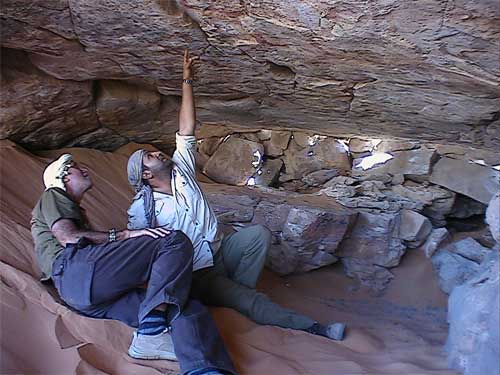
Bauval and Marai examine newly discovered cave art in April 2008, near Jebel Uwainat, the “Mark Borda Cave”. Note that the back wall of the cave appears to be constructed of megalithic blocks.
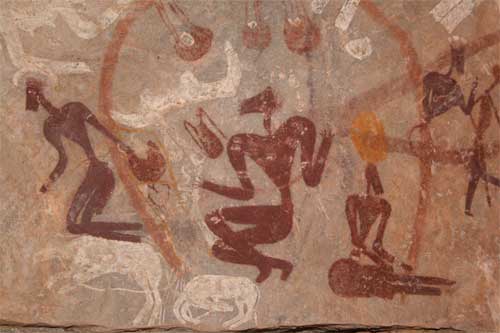
And, detail of domestic scene in the “Mark Borda Cave”.
He exclaimed to Marai in disbelief, “There is a pharaonic cartouche on that boulder!” As he moved closer, focusing his eyepiece with growing excitement, he began to see hieroglyphic inscriptions inside and outside the cartouche (see plate 3). The two men could barely contain their excitement, for there it was, after decades of speculation, incontestable evidence that the ancient Egyptians managed to reach this remote place after all! The whole geography of ancient Egypt suddenly changed before their eyes…
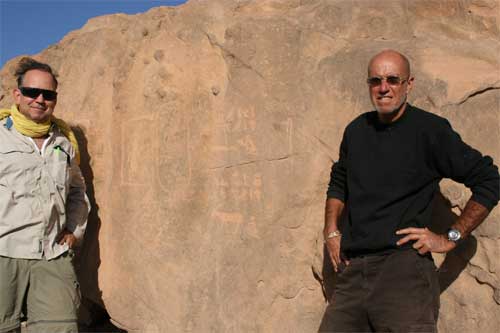
Thomas Brophy (left) and Robert Bauval at the Uwainat Inscriptions, April 2008.
From Chapter 4, Section Sirius, the Circumpolar Stars, and Orion:
We now felt that we were in a good position to integrate our and the CPE’s field findings and derive from them the most robust interpretation that fits the context of Nabta Playa. The findings that emerge from this integrated analysis are:
1. There are at least nine megaliths that form the three lines—A1, A2, and A3—that point north. These track the star Dubhe in the Big Dipper over a considerable period of time.
2. There are at least six megaliths that form lines B1 and B2 pointing southeast. These track the bright star Sirius at two epochs.
3. Sirius also coordinated simultaneously with the star Dubhe in the Big Dipper so that their alignments formed an approximate 90-degree angle. (This curious connection also had been noted by Wendorf and Malville; they commented that the megalith builders of Nabta Playa had “a fascination with right angles.”)
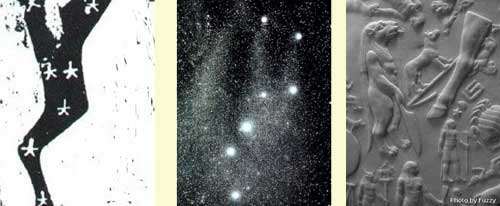
Left, ancient Egyptian depiction of the Big Dipper as the Bull’s Thigh; middle, photo of constellation; right, constellation as sculpted on the Denderah zodiac ceiling.
This possible simultaneous observation of Sirius in the east and the star Dubhe in the north was of particular interest, because we know from our studies of ancient Egypt that the very same simultaneous observation of Sirius and Dubhe was performed in the alignment rituals of pyramids and temples since the beginning of the pharaonic civilization. This encouraged us to test for the simultaneous observation of Sirius and Dubhe at Nabta Playa, where we found a remarkably accurate and consistent repetition of this pattern of observation. Indeed, an observer at Nabta Playa in about 4500 BCE would have noted immediately that the stars Dubhe and Sirius could be aligned simultaneously with megalith lines A1 and B1, for precisely when Sirius appeared to rise on the eastern horizon and was thus aligned with megalith line B1, the star Dubhe could be seen in the northern sky, directly above megalith line A1…
About our (first ever) look at the astronomy of the very remote “Bagnold’s Circle”, section Bagnold Circle:
We next headed southwest into the deep, open desert. Our destination was a mysterious stone circle discovered in 1930 by Ralph Alger Bagnold and thus known as Bagnold Circle. The stone circle was poorly documented and very little was known about it, but photographs encouraged us to suppose that it, too, like the Calendar Circle at Nabta Playa, could be some sort of prehistoric astronomical device.
It took us two days of grueling travel in some of the most desolate places we had ever seen to reach Bagnold Circle. We wondered how Ralph Bagnold, in those days with vehicles that must have been very primitive by comparison, managed to come here through this testing terrain. Bagnold, who was a veteran of trench warfare in World War I, became a pioneer of deep desert exploration—especially, of the Sahara—throughout the 1930s. During World War II he was chosen to lead the British army’s Long Range Desert Group. He was also a physicist who contributed valuable knowledge of the physics of blown sand, which is still used in planetary science research today.30 He is credited with developing, for desert exploration, a sun compass that was not affected by magnetic anomalies. Bagnold’s early expeditions in the Egyptian Sahara were in search of the fabled lost city of Zarzoura…
As we approached Bagnold Circle, we were keenly aware that no studies of its possible astronomical alignments had ever been conducted. As Wendorf, Schild, and Malville wrote in 2008, “. . . a well-known stone circle was discovered by Bagnold (1931 [sic]) in the Libyan Desert. . . . No evidence of astronomical orientations had been reported, and none is readily discernable in photographs of the circle.” Because of its incredible remoteness, few people have actually seen Bagnold Circle, let alone studied it in detail on location…
Bagnold Circle lies in a shallow basin, probably an ancient seasonal lake similar to the one at Nabta Playa. The physical features we noted first were two prominent, upright, and elongated stones (very reminiscent of the gate stones of the Calendar Circle at Nabta Playa) that defined an east–west alignment. One of these stones on the west side was white, and the stone on the eastern side was black, which may indicate a symbolic significance of some sort…[with] our GPS we took readings of this alignment as well as readings for the north–south alignment, which also had at each end a very dark-colored stone, nearly black, and a very light-colored stone, nearly white.
The conditions of the stones suggest extreme age: they have been deeply scoured by millennia of wind erosion. Some of the stones have suffered such extreme erosion that their tops have fallen off and are still on the ground where they fell. Notwithstanding this erosion, the circle is remarkably well preserved, considering its vast age. The two alignments—east–west and north–south—strongly imply an astronomical function for the Bagnold Circle. Another clue are twenty-eight stones that form the circumference of the circle, which is not only implicit of the lunar phase cycle of 29.5 days but, more important for us, also brought to our attention a clear connection to the Calendar Circle at Nabta Playa, which also had twenty-eight stones around its circumference. We also noted that north of the circle there was an elongated low hill that suggests observation of the low northern sky, possibly for marking the passage of a circumpolar constellation or star.
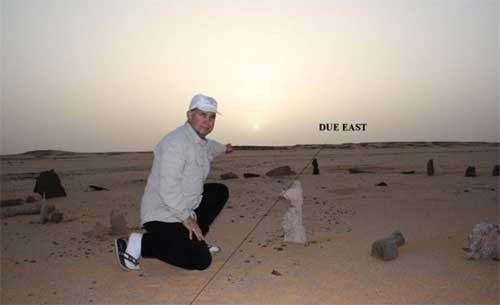
Brophy and Bauval at Bagnold Circle at sunrise.
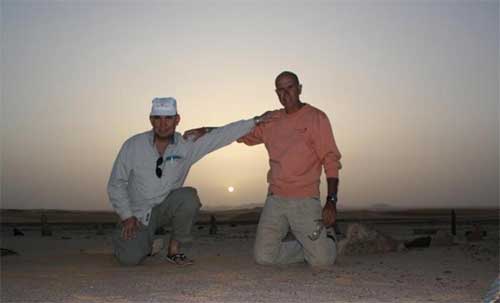
Brophy and Bauval at Bagnold Circle at sunset.
One of the most nagging questions that constantly comes to mind in this totally desolate and extremely remote place of the Egyptian Sahara is this: Why build anything here at all? What could have influenced the ancient people who roamed the deep desert to go to the trouble of constructing a stone circle in the middle of nowhere and, furthermore, to align it to the four cardinal directions? The answer, ironically enough, may actually be that they did so because of the location itself—or, to be more specific, of the latitude of the place. Today Bagnold Circle is
approximately 23.5 degrees north and just a fraction north of the Tropic of Cancer. Using the circle’s precise latitude and checking the earth’s ancient obliquity at various epochs, we found out that from 13,110 BCE to1490 BCE, the circle was located just south of the Tropic of Cancer.
This means that within that range of epochs the sun passed directly overhead exactly at the zenith a few days before and a few day after the summer solstice.
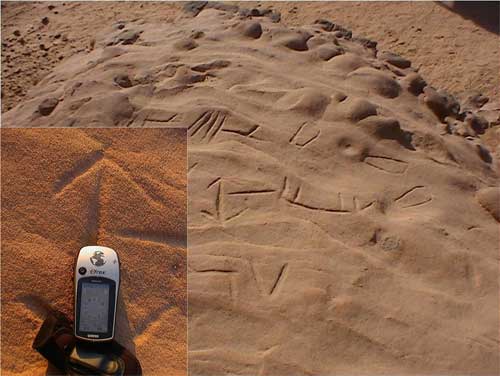
Discovery of an engraved, solstice-aligned arrow, together with possible prehistoric proto-writing, Jebel Uwainat.
This time of year was when the monsoon rains started drenching the desert and may be a reason—though perhaps not the only reason—for locating the stone circle here. We can recall from chapter 2 that in 1999 Carlo Bergmann discovered the Abu Ballas Trail, an ancient donkey trail that ran across the 500 kilometers (311 miles) of waterless desert between the Dakhla oasis and Gilf Kebir. Although anthropologists and Egyptologists have agreed that this trail was used by ancient Egyptians of the late Old Kingdom, Bergmann believes it was used as early as the Late Neolithic, about 5500–3400 BCE. Bagnold Circle is located a bit west of this trail, and it is quite possible that it served as a point for a shortcut route to Gilf Kebir, perhaps by the same Neolithic people who once populated Gilf Kebir and Jebel Uwainat…
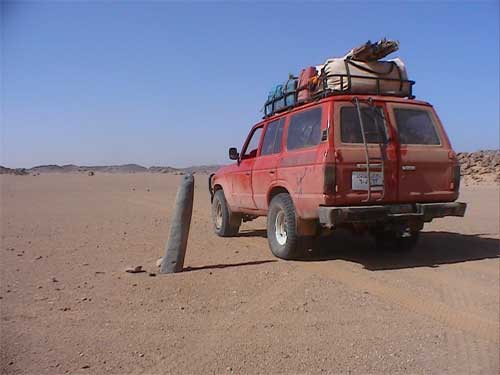
Discovery of an isolated standing stone, possibly a prehistoric gnomon, north of Jebel Uwainat.
From Chapter 5, section Ham, Son of Noah:
In Egyptology, we frequently come across the term Hamites in connection with the origins of the ancient Egyptians. As we attempt to understand why and how the Hamites are associated with the ancient Egyptians, we are often led to the Bible and the story of Noah and his sons. In the Book of Genesis, Ham is one of the sons of Noah. Ham’s children are Mizraim, Cush, Put, and Canaan, but in the Bible the names of Ham’s children are also used to denote geographical places: Egypt (Mizraim), Ethiopia (Cush), Libya (Put), and Palestine (Canaan). Many biblical scholars have proposed that the name Ham meant, in ancient Hebrew, “black” and “hot,” implying that the Land of Ham was a warm, tropical region populated by Black people. The Land of Ham is thus often said to be that part of the world we call Black Africa (what has been thought of as sub-Saharan Africa). Naturally, as has always been the case with the etymology of Hebrew words in the Bible, there is a heated debate over whether this interpretation is correct, because in Genesis 9:20–25 another story is told of how Noah, while tending his vineyard, became drunk and fell asleep naked in his tent, and then Ham did something unspeakable to him, whereupon Noah cursed Ham through Ham’s youngest son, Canaan. This so-called Curse of Ham (also known as the Curse of Canaan) has generated, as we might expect, all sorts of debate and various interpretations among fundamentalists of the Bible as well as racists. To confound the issue even further, in the Bible, the Land of Ham is also unequivocally associated with the land of the pharaohs—that is, Egypt, the traditional enemy of Israel: “Israel also came into Egypt, and Jacob dwelt in the land of Ham” (Psalm 105:23) and “They forgot God their Savior, who had done great things in Egypt, wondrous works in the land of Ham, awesome things by the Red Sea” (Psalm 106:21).
As we have just seen, in the Bible, the land of Egypt is also known as Mizraim, the name of one of Ham’s sons. By implication, then, we can see how biblical literalists might conclude that the Egyptians were the descendants of Ham. At any rate, we can see all these biblical interpretations
as fueling the neverending conflict between Israel and Egypt—a conflict that supposedly started with the Jews in captivity in Egypt at the time of Rameses II (ca. 1290 BCE) and ended in 1979 with the fragile peace treaty between Israel and Egypt—the so-called Heskem HaShalom Bein Yisrael Le Mizraim. We can note that even today Jews refer to Egypt as Mizraim. Indeed, the Egyptians themselves call Egypt Mizr, clearly a derivative of Mizraim. Of course, biblical stories are not scientific evidence…
From section, Consolidating the Evidence:
Other than the visual evidence of prehistoric rock art at Uwainat and Gilf Kebir, we will also see here and in chapter 6 that there is even more supporting evidence of a Black African origin in further analysis of the astronomical alignments at Nabta Playa and other prehistoric sites in the Egyptian Sahara…
… Michal Kobusiewicz and Romuald Schild are both renowned anthropologists who have studied Nabta Playa under the aegis of the Institute of Archaeology and Ethnology of the Polish Academy of Sciences. After pointing out that the ancient Egyptian pharaonic state was formed around 3300 BCE, they commented that “we already know that soon after this date, drought forced the [Nabta Playa] herdsmen to abandon their lands . . . and so where might they have gone, if not to the relatively close Nile Valley? They brought with them the various achievements of their culture and their belief system. Perhaps it was indeed these people who provided the crucial stimulus towards the emergence of state organization in ancient Egypt.”
Schild and Kobusiewicz also call “these people” prehistoric herdsmen, prehistoric pastoralists, Neolithic cattle herders, and sub-Saharans. The term Black, however, is clearly avoided…
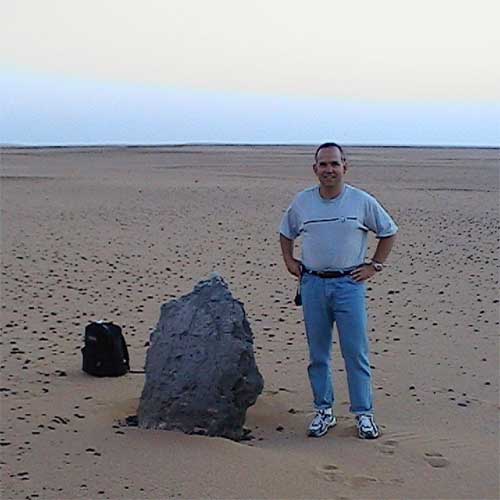
Thomas Brophy with aligned megalith AO, one of the few megaliths still standing in original position at Nabta Playa, 2003.
From Chapter 6 [Sections about Imhotep, the calendar, and Nabta Playa], The Cattle and the Star Goddesses:
We in the modern world consider the Year Zero of our calendar to be the presumed birth of Jesus, which, today, is thought to have been 2,010 years ago. This, however, is purely an arbitrary date. Indeed many other people—such as the Muslims, the Jews, the Chinese, and the Japanese—had (and some still have) other Year Zeroes for their own calendars. Usually, years are numbered from the date of a historical person, either an ancient person, as in the case of the Muslim, Jewish, and Christian calendars, or a sequence of emperors, as in ancient China or modern Japan, where legal documents are dated “year Heisei 22.” When was the Year Zero of the ancient Egyptians? How can we calculate its date? This is where we can note an interesting issue regarding study of the drift of the civil calendar relative to the heliacal rising of Sirius…
…at the reception area at Saqqara, Imhotep is given a place of honor, and there are several statues representing this Leonardo da Vinci of the ancient world. His name, titles, and functions are attested on the pedestal of a statue of King Djoser. As we have seen, it seems certain that a calendar based on the heliacal rising of Sirius was used since earliest time in Egypt and was referred to sometimes as the Sothic calendar. It also seems certain that this calendar was eventually formally adopted by the Heliopolitan priests, who pinned it to their own newly devised civil calendar, when a Sothic cycle was made to begin with the New Year’s Day of 1 Thoth. It is thus quite possible that it was Imhotep who introduced the Sothic calendar based on the cycles of Sirius, or, as we now strongly suspect, merely formalized it from an earlier calendar that was already in place with the prehistoric star people of Nabta Playa. At any rate, much evidence supports the view that a Sothic calendar ran parallel to a civil calendar so that they both resynchronized every 1,460 years—that is, every Sothic cycle. According to the science historian
Gerald J. Whitrow, “there is reason to associate this with the minister of king Djoser of the Third Dynasty known as Imhotep.” Bearing this in mind and also recalling that Imhotep was the architect of the very first pyramid complex in Egypt, we would expect to find some indication of the Sothic cycle in the design of his masterpiece, the step pyramid complex at Saqqara…
From Chapter 4, Section More Mysteries at Nabta Playa:
[a footnote about our method and perspective]
When some important and new discovery such as Nabta Playa might put into serious question the established views about the origins of civilization, there is a tendency to wait until a suitable theory can be developed before releasing any data about the discovery. The problem with this is that sometimes the data that fits an established theory is regarded as more valuable than mysterious new data that contradicts it.*
This attitude perhaps harks back to premodernity, which was characterized socio-culturally by often prerational and fused (or predifferentiated) notions of the dualities of theory versus measurement, mind versus matter, inner versus outer, religion versus science. Modernity is characterized by a radical differentiation of these dualities. That differentiation is the wonderful essence of the Scientific Revolution and the Renaissance. Postmodernity, which is only beginning to activate in our culture, is characterized by fully rational operation, a complete appreciation for the modern and Renaissance differentiation of the inner and the outer, the spiritual and the material—and an awareness of the value of both aspects of those dualities and a movement toward a reintegration, at a fully differentiated level, into a new, whole conception of those dualities. Scholarly argument must still operate generally in terms of modernity, because this is how the majority culture operates . . . on a good day, that is. Obviously, vast portions of our culture still operate in the premodern and prerational modes.
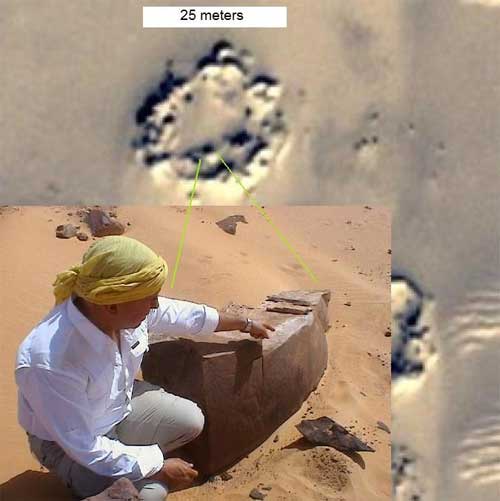
Brophy with shaped megalith from “Complex Structure A” at Nabta Playa (inset) and satellite image of the detritus left after excavation of the megalithic structure.
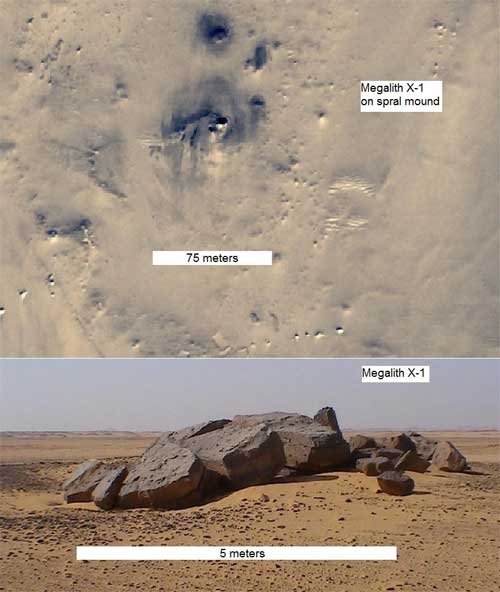
The largest megalith at Nabta Playa, called “X-1” seen on the ground and from satellite. Now broken or cut, its ancient function remains mysterious.
Others, like us, take an opposing view. We see the mysterious, unexplained data as more valuable, because if we try to understand the mystery, we might learn something new. To us that is what scientific research is—or ought to be—all about. In this frame of mind, then, we will look in more detail at some mysterious aspects of Nabta Playa in the hope that such an approach might shed even more light on this mysterious place…
Books by Robert Bauval & Thomas Brophy
|
|
Black Genesis |
|
|
The Egypt Code |
|
|
The Origin Map: Discovery of a Prehistoric, Megalithic, Astrophysical Map and Sculpture of the Universe |
|
|
The Message of the Sphinx: A Quest for the Hidden Legacy of Mankind (aka Keeper of Genesis) |
Robert G. Bauval was born in Alexandria, Egypt, in 1948. In 1967 he went to England to complete his higher education in Building Construction and Management at the University of the South Bank in London. From 1973 to 1985 Bauval worked on various construction projects in Oman, Iran, Sudan, Guinea, and Saudi Arabia. He now lives in Cairo near the Giza pyramids with his wife Michele. In 1989 Bauval published a study which proposed that the layout of the three Giza Pyramids and their relative position to the Nile was intended to mirror the layout of the three stars in Orion’s belt and their relative position to the Milky Way. This thesis, now known as the ‘Orion Correlation Theory’, became the subject of his first book, The Orion Mystery, published in 1994. The Orion Mystery has been translated in more than twenty languages and has also been the subject of TV documentaries, by the BBC, ABC, Discovery Channel, Germany ZDF-Arte, Italy RAI, France A3, and many other European channels. Bauval’s second book, Keeper of Genesis (Message of the Sphinx in the USA) was co-authored with Graham Hancock, and has been translated in more than twenty-three languages as well as being the subject of several major TV documentaries. Other books by Bauval are Secret Chamber (1999), Talisman (2004, with Graham Hancock), and The Egypt Code (2006). Bauval is presently working on a new book, Sirius Rising, that will track the influence of the Egyptian star-goddess Sopdet (Sirius) from prehistoric times up to the early Christian era, with special focus on her role in the rebirth cult and temple rituals and alignments.
http://www.robertbauval.co.uk/articles/articles/gizaorion.html
Thomas Brophy has a Ph.D. from the University of Colorado, was a staff research scientist at the Laboratory for Atmospheric and Space Physics, Boulder, with NASA interplanetary spacecraft projects, and was a National Science Foundation exchange scientist with the University of Tokyo and Japan Space Program. A member of one of the Voyager II spacecraft instrument teams, he developed theoretical understandings for data from the outer planets (Jupiter, Saturn, Uranus, Neptune), especially planetary rings and planetary dynamics. He was also involved in defining science goals for future space mission instrumentation. He devised a novel method of testing fundamental theories of planet formation by searching for extrasolar debris, that was reported on by Nature magazine. Those interests in general fundamental theory, and experience teaching at the University level, led to broader studies involving the non-calculable and immeasurable aspects of the universe, and Integral philosophy.