




Life is a mystery that will not be easily explained.
It is not simply a matter of how the physical processes of life began on Earth – although that is a problem for which the best scientific minds of the modern age have failed to come up with an answer.
But it is also the question of whether our lives have any meaning – a question to which religion responds with a resounding ‘yes’, and to which science by and large responds with a resounding ‘no’.
My own involvement with this mystery has been as an author of mass-market books of ‘alternative history’ – a genre that Britain’s Guardian newspaper has credited me with inventing. I have never wished, nor sought, to be anything other than a professional author – in other words to make a living from my writing. In recent years I have made a good living and I hope this is because millions of individual readers around the world have found my books entertaining and intellectually stimulating. If people have been lured into buying my books only by the hype – because they hope they will find some revelation or transcendental truth concealed therein – then I have not done my job properly.
The Sign And The Seal
My first book of ‘alternative history’, published in 1992, was The Sign And The Seal. It was the fruit of a long investigation that I had undertaken during the 1980’s into Ethiopia’s claim to be the last resting place of the lost Ark of the Covenent. I did not come to the book with any sense of moral mission. What drew me to it was a journalistic instinct that I had stumbled upon a good story that no-one had yet told properly. I decided to tell the story.
Many life-changing things happened to me while I was researching The Sign And The Seal, and most of them are reported in the book. I met Santha — who was later to become my wife. On her suggestion I gave up morally dubious business dealings that I had enjoyed in the 1980’s with the governments of Somalia and Ethiopia. I made a journey across deserts and mountains in a time of war. And I came eventually to stand before the gates of the chapel of the Ark only to be refused entry by a pious monk dressed all in black.
Along the way I learned something that I had not understood before.
This is that the foundations of orthodox academic history rest in a theory of the past that could be – I stress could be — either partially or completely wrong. The theory contains the following key ingredients:
- A few billion years ago life on Earth emerged by chance from the ‘primeval soup’.
- Life continuously evolved, throwing up ever more complex and sophisticated species;
- Eventually ape-like creatures appeared that were the direct ancestors of the human race.
- These ‘hominids’ continuously evolved over millions of years until the emergence of Homo sapiens sapiens, modern man, somewhere between 120,000 years ago and 40,000 years ago.
- Modern human beings have not demonstrated any significant physical evolution over the past 40,000 years. Human society, however, has evolved continuously from primitive hunter-gatherers and ‘cave men’, through the first sustained experiments in settled agriculture about 8,000 years ago, to the formation of ever larger villages, and finally, about 5,000 years ago, to the growth of ‘cities’.
- During these last 5,000 years, despite some ups and downs, society has gone on ‘evolving’ in the direction of ever greater sophistication and technological mastery.
- As the end products of all this evolution, modern humans are infinitely more sophisticated than their ‘primitive’ ancestors.
Whilst working on The Sign And The Seal, I gradually began to realise just how many anomalies and enigmas there were in the past which either were not adequately explained by the orthodox theory of history or which could be equally adequately explained by an alternative theory. For example, if the orthodox historians were right then the strange ‘powers’ of the Ark of the Covenant, described in the Bible and elsewhere, were just figments of folklore and scribal imagination. The part it played in knocking down the walls of Jericho, the ‘voice’ and ‘sparks’ that were said to have come out of it, its bad habit of striking people dead whenever they touched it, the ‘cancerous tumours’ it caused amongst the Philistines of Ashdod – and many other signs and wonders – were all just fantastic literary inventions that were completely detached from historical reality.
Certainly it could have been so.
But what surprised me was that no-one had seriously attempted to investigate the alternative possibility allowed by the very consistent accounts that ancient sources give us about the Ark – namely that it could have been a technological device of some sort. This possibility had not been considered because historians recognise no ancient civilisation capable of designing a piece of technology that could do what the Ark did. They believe they know the past well enough to reject the suggestion that such a civilisation could have escaped their notice. They have therefore concluded that no such civilisation ever existed and also reject all categories of evidence that in any way suggest the contrary.
I realise that the case for the Ark as a piece of technology, laid out in Part IV of The Sign And The Seal, may not be the strongest argument I have ever presented. But the point I want to make here is that it was worth presenting anyway. My purpose in writing these chapters was to confront my readers with a catalogue of the Ark’s mysterious attributes and characteristics – which are many – and to question at every stage whether it was reasonable to explain them all away as ‘fantastic literary inventions’. I argued that the Ark’s powers might have been derived from the forgotten knowledge of a lost civilisation and that it could indeed have been some sort of artefact or instrument.
Lost Civilisation
The same basic rationale also lies at the heart of my next book, Fingerprints Of The Gods (published in 1995), in which my purpose was to make a comprehensive case for the existence of a lost civilisation – a great, worldwide prehistoric culture that was all but wiped out, leaving only a few survivors, at the end of the last Ice Age some 12,500 years ago.
To this day I am astonished by the response that Fingerprints has generated amongst orthodox academics and their supporters. Some reacted with intense horror, like devout Catholics affronted by an act of blasphemy. Others poked fun at me – as though I must be a lunatic even to have conceived of such ideas. Others noticed how popular Fingerprints had become – a Number One bestseller in Britain, Italy and Japan with total sales in excess of three million – and concluded that I had somehow conned the public into making me rich.
I sincerely hope that I have done no such thing. As I said a moment ago, I have never claimed to be anything other than a professional author. After years of debt and dicing with financial disaster I am proud to say that my books are now making money. This gives me independence and freedom of action and allows me to invest in proper field research. Whether my arguments are 100 per cent right or 100 per cent wrong, it tells me that people must like to read me and must, by and large, feel that they get ‘value for money’ from doing so. It also tells me what my ‘job’ is – the job, in other words, that the public are funding me to do when they buy my books. This is to make the best case I possibly can for a lost civilisation, to fight tooth and claw with the historians, archaeologists and other ‘authorities’ who insist that no such civilisation ever existed, and to champion the intuition – which many of us share — that a great mystery may have been locked away somewhere deep in humanity’s past.
A parallel for what I do is to be found in the work of an attorney defending a client in a court of law. My ‘client’ is a lost civilisation and it is my responsibility to persuade the jury – the public – that this civilisation did exist. Since the ‘prosecution’ – orthodox academics – naturally seek to make the opposite case as effectively as they can, I must be equally effective and, where necessary, equally ruthless.
So it is certainly true, as many of my critics have pointed out, that I am selective with the evidence I present. Of course I’m selective! It isn’t my job to show my client in a bad light!
Another criticism is that I use innuendo to make my case. Of course I do – innuendo and anything else that works.
I don’t care about the ‘rules of the game’ here – because it isn’t a game and there are no rules. The 20th century witnessed the emergence of an overwhelming academic concensus, supported in the media and at all levels of the education system, that no lost civilisation lies forgotten in the human past. This concensus is so strongly reinforced that no serious research has been done on the subject for more than 50 years and not a single academic institution in the Western world presently has a faculty of ‘Lost Civilisation Studies’!
So I’m proud to have stood shoulder to shoulder during the 1990’s with my friends and fellow writers Robert Bauval and John Anthony West in stirring things up so badly for orthodox historians — Egyptologists in particular — that millions of people all around the world now have serious doubts about the ‘official’ picture of past. I’m proud that so many who were formerly indifferent are now prepared to give the benefit of this doubt to the extraordinary and exciting possibility of a lost civilisation. And I’m proud that orthodox thinkers, who would prefer to have ignored us, have been compelled into a backlash.
Trial and error
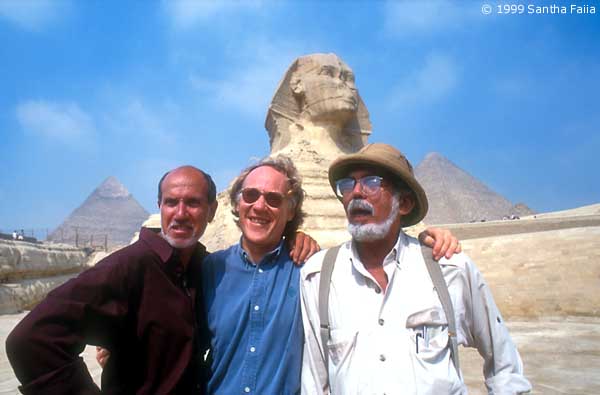 Left, Robert Bauval; Centre, Graham Hancock; Right, John Anthony West. |
Much attention is focussed on ‘mistakes’ that Robert, John and I have made.
Of course we’ve made mistakes! Our theory of a lost civilisation of prehistory and its impact on historical cultures is in its early stages and will require constant refinement, perhaps for years, before all its errors have been eliminated. But does this mean that it would have been better if we hadn’t begun to develop the theory in the first place? I don’t think so. Does it mean that we should have just sat back and ignored anomalies and puzzles that orthodox historians offer no satisfactory explanations for? Again, I don’t think so.
To give a specific example, would it have been better if John West had never become curious about the apparent water-weathering of the Great Sphinx of Giza or if he had never begun to suggest that it might have acquired this profile during the heavy rains of the last Ice Age – thousands of years before the birth of the historical civilisation of Egypt?
Surely only a fool, or a pedant with invincible confidence in the orthodox theory that dates the Sphinx to 2,500 BC, would argue that West should have dropped the matter? Surely it’s better to debate such issues freely and to consider all possible lines of inquiry and evidence rather than to rule out a whole range of possibilities at the outset?
Similarly would it have been best if Robert Bauval had simply not noticed the similarity that exists between the pattern of the three stars of Orion’s belt — as viewed looking south from Giza — and the pattern of the three Great Pyramids of Giza. Or, having noticed it, would it have been better if he had not researched the matter further? Was it in some way irresponsible of him in his book The Orion Mystery to put before the public a very large and compelling body of evidence which suggests that the ground plan cannot possibly be a coincidence? Should he have just kept quiet about this information and not rocked the boat?
I think not. Contrary to their detractors, I believe that the work of West and Bauval has been a powerful force for good. It has stimulated a new spirit of generosity towards the past and a new spirit of enquiry into age-old mysteries. Bogged down in received wisdom and unquestioned assumptions, orthodox historical thinking about the origins of civilisation had become stale, uncreative and boring by the beginning of the 1990’s. What would have been the point of continuing along that path, without challenge, just because Professor X and Dr Y said it was so?
So I’m proud to have been part of all this and that my books have put radical alternative ideas about the past before a readership of millions. I repeat and re-emphasise my confident expectation that those of us who have been involved will have made many mistakes in our work! After all, what worthwhile new scientific theory ever comes into existence all at once and fully formed? Most good theories are the result of years of experimentation and trial and error — with bad hypotheses being abandoned and better ones gradually strengthened. Some of our ideas may be good, therefore, and others not so good — but its only by putting them forward to be tested and criticised that we can really discover what works and what doesn’t, what is strong and what is weak.
My own work is evolving and where I have discovered that I have made mistakes I have said so publicly. I want to give a lengthy example of this here, which followed criticisms in 1998 on the Internet newsgroup Egyptnews — and elsewhere — concerning arguments that I had presented in Fingerprints of the Gods and Keeper of Genesis (the latter co-authored with Robert Bauval) about possible 19th century falsification of hieroglyphic graffiti in the so-called ‘relieving chambers’ above the King’s Chamber in the Great Pyramid. The criticisms, mainly from a gentleman named Martin Stower, were well-deserved and pointed out fatal errors in my analysis. I responded with the following full retraction which was published on Egyptnews and on many widely-read websites (NB links cited may be out of date):
A Position Statement From Graham Hancock On The Antiquity And Meaning Of The Giza Monuments
|
Yonaguni
Recently I’ve been spending much less time at Giza. The research for my new book involves diving to possible sites of underwater ruins all around the world. Some of Santha Faiia’s photographs from these dives are on display in the Gallery pages of this website.
The most difficult problem that we have faced, and an extraordinarily complex one, is how to decide whether these predominantly monolithic structures were shaped and carved by human hands or whether they could have ended up looking the way they do as a result of natural weathering. If they are natural then their significance does not exceed their geological curiosity. But if they were made by people then, ultimately, they have the potential to force through a revolution in society’s perception of prehistory. This — to state the obvious! — is because they must have been carved out the surrounding bedrock before sea-level rose to its present height. In some cases this suggests an age of at least 12,000 years.
Might these underwater structures be relics of a lost, antediluvian civilisation – and since they are found all around the world, might this prehistoric civilisation have been global before it was destroyed?
There is incredibly strong resistance to such ideas. An example is the way in which ignorant, idle people, who are often too cowardly or too incompetent to scuba dive in the dangerous waters that swirl around the Japanese island of Yonaguni, nevertheless rush to assert that the underwater structures there are purely natural geological phenomena that have had nothing to do with the works of man. The same goes for what I call the "tourist academics" who come to Yonaguni, do four or five dives and leave, again declaring that the structures are natural.
A recent example of the latter is the German geologist Wolf Wichmann who made a total of just three dives at Yonaguni this summer and then declared – in Der Spiegel magazine (34/1999)- "I didn’t find anything that was man-made."
Here, translated into English, is Der Spiegel’s story about Wichmann’s "expedition":
STEPS TO NOWHERE
Just off the coast of Japan there is a submerged rock monument 10,000 years old – perhaps a relic of a previously unknown super civilisation?
The expedition ship dropped anchor near the south Japanese island of Yonaguni under a bright blue sky. Wolf Wichmann, a graduate geologist from Seevetak, near Hamburg, struggled into his neoprene suit and stuck a hammer and foot-rule into his belt. Then the rock expert, a good 9000 kilometres from home,jumped into the sea.
Almost immediately the expert found himself facing a massif that was straight out of a sci-fi movie. Below him a stepped tower some 25 metres high rose from the ocean floor. The frogman swam past platforms and patios covered with algae, and inspected flights of steps and huge chunks of rock that looked as though they had been cut by a diamond saw.
What kind of architectural alien was lying there in Japan’s territorial waters? The oldest structure in the world? Atlantis in the Pacific? One of the greatest discoveries in the history of archaeology? This mysterious monument has been the cause of scares and flash headlines for months on end.
The sandstone block is some 200 metres long, its highest plateau some five metres below the surface. According to experts, this structure must have been sinking slowly into the ocean for over 10,000 years.
The pyramids were discovered by skin-diver Kihachiro Aratake back in 1986. While plotting an underwater chart he discovered, 250 metres from the island, a rocky massif whose cliffs rose upwards like the "walls of a castle". The structure looked like "an Inca temple", said the diver. He was seized by "fear and emotion". "I thought I was seeing something supernatural."
There might actually be something in that. 10,000 years ago, primitive hunter-gatherers roamed the coasts of Japan. So who created this monumental structure?
Japan’s marine scientists haven’t got a clue. "It is unlikely to be anything natural" said the oceanographer Terukai Ishii from Tokyo. Masaaki Kimura, a marine researcher at the Rykyus University (Okinawa) talks about "a masterpiece". He thinks the sandstone is a sacred edifice built by a hitherto unknown "new culture" possessing advanced technical abilities. But which one?
The debate going on in the Orient has awakened the curiosity of the West. People with second sight find themselves magically attracted by "Iseki Point ("ruins"). At the beginning of 1998 the geologist Robert Schoch, who believes the Sphinx was built by the people of Atlantis, swam down to the site and declared it to be "most interesting". The guru of ancient antiquity and best-selling author Graham Hancock was also investigating the site. After an excursion in a submersible he records that at the base of the monument can be seen a "clearly-defined path".
However the rock expert Wolf Wichmann could not corroborate these conclusions. In the company of a team from SPIEGEL TV he returned to explore the coastal area, under threat from tsunamis. In a total of three diving operations he gathered rock samples and measured the steps and "walls". He was unconvinced by his findings: "I didn’t find anything that was man-made".
During the inspection it was revealed that the "gigantic temple" (Aratake) is nothing but naturally produced bedded rock. The sandstone is traversed by vertical cracks and horizontal crevices. Perpendicularity and steps have gradually developed in the fracture zones. The plateaux at the top are referred to by Wichmann as typical "eroded plains". Such flat areas occur when bedded rock is located right in the path of the wash of the waves."
Suggestive pictures rich in detail and contrast may indeed reveal something else, but in general the mass of rock looks like a structure rising out of a sandy bed, with no sign of architectural design. The plateaux have gradient sections, and there is no perpendicular wall. Some of the steps just end nowhere; others are in a spiral, like steep hen-roosts.
The stony blocks show no signs of mechanical working. "Had the ‘ashlars’ been hewn by tools, they would have been studded with flutes and cuts and scratches", said Wichmann. Three circular recesses on the topmost plateau, referred to by Kimura as column foundations, are nothing but "potholes". These occur when water washes through narrow spaces.
Facts like these fail to stem the current epidemic of mystery-fever. The Yonaguni monument has for some time played a key role in the world picture of archaeological dreamers. An "Atlantis Team" boldly declared on the Internet: "We found ourselves at the opening of an arched arcade of stone". At other websites the crag becomes a "ceremonial centre with broad promenades, flanked by pylon gateways."
Oceanographer Kimura bolsters such propositions with even more exploratory results. He has also discovered even more sites in the waters around the island near Okinawa. Cones and rock debris overgrown with algae become "boulevards, altars and rooms in temples."
The media are keen to take part in this explanatory drivel [presumably with the exception of Der Spiegel and Der Spiegel TV?]. In Japan Yonaguni has long been the navel of the world, and a new Mecca of primordial times. Brewers and Japan Airlines are on the bandwagon of the sub-aqueus Babylon in the Far east. The TV Broadcasters CNN and Channel Four were already there with their camera teams. Now the experts from the BBC wish to plumb these legendary depths.
The natives of Yonaguni are quite glad to see this ballyhoo of people. The monument’s discoverer, Kihachiro Aratake, is gratified by the influx of visitors to his small island home. "I am happy that everyone comes here, the foreigners too!" beams the explorer.
These patriotic high spirits are not without some self-interest, however. Kihachiro Aratake runs a big diving shop on the island. His parents own a hotel there.
A challenge
The general tone of this Der Spiegel article – derisive, condescending, ridiculing the islanders — is fairly typical of the way in which the quality Western press report on the Yonaguni structures. Also typical is the instant (and insulting) rejection of the conclusions of two highly qualified Japanese scholars (Terukai Ishii and Professor Masaaki Kimura — both of whom believe the Yonaguni monuments to be man-made) and the equally instant (and credulous) acceptance of the opinion of the German "expert" Wichmann, whose only qualification is that he is a geologist who has done three dives at Yonaguni. No mention is made of the fact that Professor Kimura is a geologist too and that he and his team of research students from the University of the Ryukus have reached their opinion about the artificiality of the monuments after a five-year survey there involving more than 200 dives.
There are a number of other serious lacunae and errors in the article.
For example, it tells us that Professor Robert Schoch of Boston University "believes the Sphinx was built by the people of Atlantis." This is completely untrue! Schoch does not believe any such thing – as he has stated explicitly on several well-documented occasions (e.g. see Link 1; for Schoch’s view on Yonaguni see Link 2)
Another pointer to the generally low level of knowledge upon which the Der Spiegel piece is based is the howling error that only "primitive hunter-gatherers" roamed the coasts of Japan 10,000 years ago. It is now well-established that at that date Japan was home to the remarkable Jomon culture which manufactured beautiful pottery at least 3000 years earlier than any other known civilisation in the world and which also mastered the domestication of rice at an extremely early date. The mounting evidence of the surprising sophistication and complexity of Jomon culture, coupled with evidence of advanced architectural abilities at sites like Sannai-maruyama and elsewhere, makes these mysterious prehistoric people look like very plausible candidates for the creators of the Yonaguni monuments.
All in all, therefore, it seems to me that the judgements expressed in the Der Spiegel article are narrow-minded, ignorant and premature. I don’t think anyone is in a position to form an intelligent opinion about what Yonaguni has to offer until they have put in extensive time there and dealt with some of the risks of repeated dives to its unique underwater sites.
Wolf Wichmann’s three dives don’t even begin to qualify him.
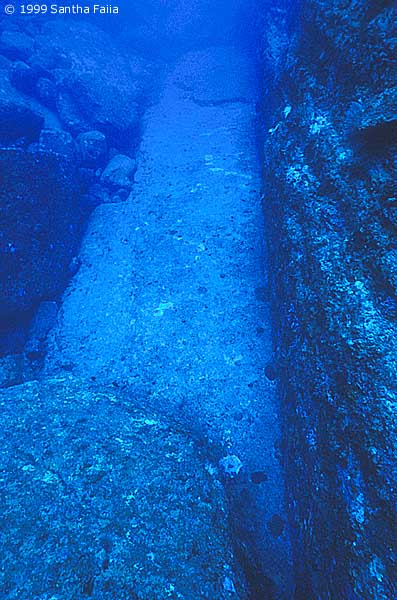 Yonaguni: clearly-defined path at the base of the monument. |
Since March 1997 I personally have made more than 100 dives to the Yonaguni monuments (not just "an excursion in a submersible" as Der Spiegel dishonestly asserts; actually I have never used a submersible at Yonaguni!). The experiences I have had as a hands-on diver (including examination, in ferocious currents, of what is, indeed, a "clearly-defined path" at the base of the monument) have convinced me that the structures are all inter-related and that they must, accordingly, be the result of some sort of masterplan. This is why, contrary to mainstream opinion, the better I get to know Yonaguni the more difficult it becomes for me to accept the various theories which claim that the underwater monuments are natural.
I would therefore like to offer a challenge to Wolf Wichmann, or for that matter to any suitably qualified, scuba-diving geologist – or preferably to a team involving both a geologist and an archaeologist (both of whom must be competent scuba divers and both of whom should already have formed the opinion that the Yonaguni structures are natural). Let us agree a mutually convenient time to do, say, 20 dives together at Yonaguni over a period of about a week. I will show you the structures as I have come to know them, and give you every reason, including expert academic opinion (which I will ask the relevant scholars to present in person), why I think that the monuments must have been worked on by human beings. You will do your best to persuade me otherwise. At the end of the week let’s see if either side has had a change of mind.
Meanwhile I remain puzzled that the overwhelming reaction of academics to the Yonaguni enigma is to attempt to debunk it with superificial arguments along the lines of the Der Spiegel piece.What is wrong with a bit of common-sense curiosity about bizarre and hard-to-explain phenomena — which these Japanese underwater "monuments" most certainly are (whatever they may ultimately turn out to be). Where did we get the idea that it’s right, "rational", "scientific" even, to approach all such anomalies in a hostile and sceptical spirit? Why shouldn’t our initial posture towards a problem like Yonaguni be one of intellectual generosity and open-mindedness — rather than one of pedantic, nit-picking meanness?
Archaeological dreamers?
Of course I believe that the same question applies to the wider mystery of prehistory. It is not inevitable that we must go on seeing our "Stone Age" predecessors as "primitives" or "savages". Nor is there any cause for us to assume that their spiritual and metaphysical thinking was in any way less "developed" than our own. One need only mention the poignant and eerie beauty of cave art around the world to demonstrate that powerful thinkers and inspired creative artists were at work in those times.
When I re-released the idea of a great lost civilisation into general circulation with the publication of Fingerprints of the Gods in 1995 the book was universally condemned by academics. In the years since then, however, I have seen — at the very least — a reaction to my ideas in scholarly circles. While the overall tone of hostility has never abated, it is a fact that more and more mainstream academics today are opening themselves, in one way or another, to the lost civilisation hypothesis. A recent example, well worth reading, is Richard Rudgley’s Lost Civilisations of the Stone Age (Century, London, 1998) which calls for a complete rethink of almost all our basic attitudes towards palaeolithic man. Although Rudgley accuses me and Robert Bauval of having built "castles in the sands of Egypt" with our books, his own supposedly more sober approach provides masses of compelling evidence for a point we have long argued – namely that modern man is a creature with amnesia with extensive blank patches in his memory covering long periods of his past. The earliest-surviving written records that we have date back less than 5000 years. Of the time before that, and of what people thought then, we know nothing and can only guess.
What is at stake is our memory of at least the first 40,000 years of our species’ existence (perhaps much longer) What is needed is a mood of willingness in society to investigate extraordinary possibilities — even it is just on the off-chance that there may be something to them. We have enormous resources as a species. We can afford to do this! And what does it matter if we make a few mistakes along the way and even end up looking foolish on some occasions. I believe the time has come to ask serious questions about the almost pathological eagerness of intellectuals to disparage any intelligent interest in the unexplained puzzles of the past as "mystery fever" and to persuade us that any opposition to the dominant historical paradigm must be the work of "archaeological dreamers."