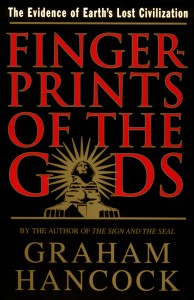
Fingerprints of the Gods - Evidence of Earth's Lost Civilization (1995)
by Graham Hancock
On 6th July 1960 Lt Colonel Harold Ohlmeyer, a United States Airforce Commander, sent a reply to a letter from one Professor Charles Hapgood who had requested his opinion on a feature found on a map of 1513 AD called the Piri Reis Map. Lt Colonel Ohlmeyer’s reply was a bombshell. The map, showing the coastline of the east coast of the Americas and the west coast of Africa, the Colonel remarked, also seemed to show the coastline of Queen Maud Land in Antarctica free of ice – a condition it had not been in for some 9000 years!
In fact, it is only in recent times that modern man has been able to map this coastline using sub-surface surveying techniques that can penetrate the ice sheet that lies on top of it.
Ohlmeyer had no idea how a map existing in the 16th century could have got hold of such knowledge.
This was one of the many mysteries that lead Graham to begin his epic journey into man’s past that is Fingerprints of the Gods – and it is a mystery whose solution is mindblowing.
Travelling first to South and Meso-America, Graham finds evidence of myths of a white-skinned ‘god’ named Quetzalcoatl or ‘Viracocha’ who came from a drowned land bringing knowledge of farming and culture after a great flood. Tied in with these myths Graham begins to crack an ancient code imprinted in these ancient tales that refer to the ‘great mill’ of the heavens.
It is an astronomical code that deals with the position of the stars over vast periods of time – a code that reveals the ancients knew far, far more than they are generally credited with. Traces of the same code appear in Egyptian myth, and it is to this desert land that Graham and Santha travel, finding there haunting parallels in architecture and ritual to the New World sites they have just left behind.
Moreover, the whole layout of the Giza plateau seems to point to a date many thousands of years earlier than the date of its supposed construction – a date revealed in the astronomical alignments of the Pyramids, the ‘mansions of a million years’, home of the god Osiris, the bringer of agriculture to the Egyptians, like Quetzalcoatl, after a flood.
Could the Piri Reis maps be evidence for a previously unknown complex maritime civilisation, capable of mapping the globe? A global culture, cataclysmically destroyed at the end of the ice age, remnants of which survived the devastation to pass on their knowledge to the shaken world?
Were the figures of Osiris and Quetzalcoatl survivors of this lost race – passing down not only advanced geographical knowledge, but a secret astronomical code veiled in myth that pointed to the devastation in the past, and warned of that which is to come?
From the mysterious sites of Tiahuanaco and Teotihuacan, to the enduring enigmatic Sphinx and pyramids of Egypt, the grandiose Nazca lines of Peru to the stark primal beauty of the Osireion at Abydos, this is a journey both around the globe and into the heart of the true prehistoric origins of man. Part adventure, part detective story, this book will force you to revaluate your beliefs of the past.
Fingerprints of the Gods; Sample chapter: Chapter 45
By Graham Hancock
The Works of Men and Gods
Among the numberless ruined temples of Ancient Egypt, there is one that is unique not only for its marvellous state of preservation, which (rare indeed!) includes an intact roof, but for the fine quality of the many acres of beautiful reliefs that decorate its towering walls. Located at Abydos, eight miles west of the present course of the Nile, this is the Temple of Seti I, a monarch of the illustrious nineteenth Dynasty, who ruled from 1306-1290 BC. [1]
Seti is known primarily as the father of a famous son: Ramesses II (1290-1224 BC), the pharaoh of the biblical Exodus. [2] In his own right, however, he was a major historical figure who conducted extensive military campaigns outside Egypt’s borders, who was responsible for the construction of several fine buildings and who carefully and conscientiously refurbished and restored many older ones. [3] His temple at Abydos, which was known evocatively as ‘The House of Millions of Years’, was dedicated to Osiris, [4] the ‘Lord of Eternity’, of whom it was said in the Pyramid Texts:
You have gone, but you will return, you have slept, but you will awake, you have died, but you will live… Betake yourself to the waterway, fare upstream … travel about Abydos in this spirit-form of yours which the gods commanded to belong to you. [5]
Atef Crown
It was eight in the morning, a bright, fresh hour in these latitudes, when I entered the hushed gloom of the Temple of Seti I. Sections of its walls were floor-lit by low-wattage electric bulbs; otherwise the only illumination was that which the pharaoh’s architects had originally planned: a few isolated shafts of sunlight that penetrated through slits in the outer masonry like beams of divine radiance. Hovering among the motes of dust dancing in those beams, and infiltrating the heavy stillness of the air amid the great columns that held up the roof of the Hypostyle Hall, it was easy to imagine that the spirit-form of Osiris could still be present. Indeed, this was more than just imagination because Osiris was physically present in the astonishing symphony of reliefs that adorned the walls-reliefs that depicted the once and future civilizer-king in his role as god of the dead, enthroned and attended by Isis, his beautiful and mysterious sister.
In these scenes Osiris wore a variety of different and elaborate crowns which I studied closely as I walked from relief to relief. Crowns similar to these in many respects had been important parts of the wardrobe of all the pharaohs of Ancient Egypt, at least on the evidence of reliefs depicting them. Strangely, however, in all the years of intensive excavations, archaeologists had not found a single example of a royal crown, or a small part of one, let alone a specimen of the convoluted ceremonial head- dresses associated with the gods of the First Time. [6]
Of particular interest was the Atef crown. Incorporating the uraeus, the royal serpent symbol (which in Mexico was a rattlesnake but in Egypt was a hooded cobra poised to strike), the central core of this strange contraption was recognisable as an example of the hedjet, the white skittle-shaped war helmet of upper Egypt (again known only from reliefs). Rearing up on either side of this core were what seemed to be two thin leaves of metal, and at the front was an attached device, consisting of two wavy blades, which scholars normally describe as a pair of rams’ horns. [7]
In several reliefs of the Seti I Temple Osiris was depicted wearing the Atef crown, which seemed to stand about two feet high. According to the Ancient Egyptian Book of the Dead, it had been given to him by Ra: ‘But on the very first day that he wore it Osiris had much suffering in his head, and when Ra returned in the evening he found Osiris with his head angry and swollen from the heat of the Atef crown. Then Ra proceeded to let out the pus and the blood.’ [8]
All this was stated in a matter-of-fact way, but-when you stopped to think about it-what kind of crown was it that radiated heat and caused the skin to haemorrhage and break out in pustulant sores?
Seventeen centuries of kings
I walked on into the deeper darkness, eventually finding my way to the Gallery of the Kings. It led off from the eastern edge of the inner Hypostyle Hall about zoo feet from the entrance to the temple.
To pass through the Gallery was to pass through time itself. On the wall to my left was a list of 120 of the gods of Ancient Egypt, together with the names of their principal sanctuaries. On my right, covering an area of perhaps ten feet by six feet, were the names of the 76 pharaohs who had preceded Seti I to the throne; each name was carved in hieroglyphs inside an oval cartouche.
This tableau was known as the ‘Abydos King List’. Glowing with colours of molten gold, it was designed to be read from left to right and was divided into five vertical and three horizontal registers. It covered a grand expanse of almost 1700 years, beginning around 3000 BC with the reign of Menes, first king of the First Dynasty, and ending with Seti’s own reign around 1300 BC. At the extreme left stood two figures exquisitely carved in high relief: Seti and his young son, the future Ramesses II.
Hypogeum
Belonging to the same class of historical documents as the Turin Papyrus and the Palermo Stone, the list spoke eloquently of the continuity of tradition. An inherent part of that tradition, was the belief or memory of a First Time, long, long ago, when the gods had ruled in Egypt. Principal among those gods was Osiris, and it was therefore appropriate that the Gallery of the Kings should provide access to a second corridor, leading to the rear of the temple where a marvellous building was located-one associated with Osiris from the beginning of written records in Egypt [9] and described by the Greek geographer Strabo (who visited Abydos in the first century BC) as ‘a remarkable structure built of solid stone… [containing] a spring which lies at a great depth, so that one descends to it down vaulted galleries made of monoliths of surpassing size and workmanship. There is a canal leading to the place from the great river…’ [10]
A few hundred years after Strabo’s visit, when the religion of Ancient Egypt had been supplanted by the new cult of Christianity, the silt of the river and the sands of the desert began to drift into the Osirieon, filling it foot by foot, century by century, until its upright monoliths and huge lintels were buried and forgotten. And so it remained, out of sight and out of mind, until the beginning of the twentieth century, when the archaeologists Flinders Petrie and Margaret Murray began excavations. In their 1903 season of digging they uncovered parts of a hall and passageway, lying in the desert about 200 feet south-west of the Seti I Temple and built in the recognizable architectural style of the Nineteenth Dynasty. However, sandwiched between these remains and the rear of the Temple, they also found unmistakable signs that ‘a large underground building’ lay concealed. [11] ‘This hypogeum’, wrote Margaret Murray, ‘appears to Professor Petrie to be the place that Strabo mentions, usually called Strabo’s Well.’ [12] This was good guesswork on the part of Petrie and Murray. Shortage of cash, however, meant that their theory of a buried building was not tested until the digging season of 1912-13. Then, under the direction of Professor Naville of the Egypt Exploration Fund, a long transverse chamber was cleared, at the end of which, to the north-east, was found a massive stone gateway made up of cyclopean blocks of granite and sandstone.
The next season, 1913-14, Naville and his team returned with 600 local helpers and diligently cleared the whole of the huge underground building:
What we discovered [Naville wrote] is a gigantic construction of about 100 feet in length and 60 in width, built with the most enormous stones that may be seen in Egypt. In the four sides of the enclosure walls are cells, 17 in number, of the height of a man and without ornamentation of any kind. The building itself is divided into three naves, the middle one being wider than those of the sides; the division is produced by two colonnades made of huge granite monoliths supporting architraves of equal size. [13]
Naville commented with some astonishment on one block he measured in the corner of the building’s northern nave, a block more than twenty-five feet long. [14] Equally surprising was the fact that the cells cut into the enclosure walls had no floors, but turned out, as the excavations went deeper, to be filled with increasingly moist sand and earth:
The cells are connected by a narrow ledge between two and three feet wide; there is a ledge also on the opposite side of the nave, but no floor at all, and in digging to a depth of 12 feet we reached infiltrated water. Even below the great gateway there is no floor, and when there was water in front of it the cells were probably reached with a small boat. [15]
The most ancient stone building in Egypt
Water, water, everywhere-this seemed to be the theme of the Osireion, which lay at the bottom of the huge crater Yaville and his men had excavated in 1914. It was positioned some 50 feet below the level of the floor of the Seti I Temple, almost flush with the water-table, and was approached by a modern stairway curving down to the south-east. Having descended this stairway, I passed under the hulking lintel slabs of the great gateway Naville (and Strabo) had described and crossed a narrow wooden footbridge-again modern-which brought me to a large sandstone plinth.
Measuring about 80 feet in length by 40 in width, this plinth was composed of enormous paving blocks and was entirely surrounded by water. Two pools, one rectangular and the other square, had been cut into the plinth along the centre of its long axis and at either end stairways led down to a depth of about 12 feet below the water level. The plinth also supported the two massive colonnades Naville mentioned in his report, each of which consisted of five chunky rose-coloured granite monoliths about eight feet square by 12 feet high and weighing, on average, around 100 tons. [16] The tops of these huge columns were spanned by granite lintels and there was evidence that the whole building had once been roofed over with a series of even larger monolithic slabs. [17]

Plan of the Osireion
To get a proper understanding of the structure of the Osireion, I found it helpful to raise myself directly above it in my mind’s eye, so that I could look down on it. This exercise was assisted by the absence of the original roof which made it easier to envisage the whole edifice in plan. Also helpful was the fact that water had now seeped up to fill all of the building’s pools, cells and channels to a depth of a few inches below the lip of the central plinth, as the original designers had apparently intended it should. [18]
Looking down in this manner, it was immediately apparent that the plinth formed a rectangular island, surrounded on all four sides by a water-filled moat about 10 feet wide. The moat was contained by an immense, rectangular enclosure wall, no less than 20 feet thick, [19] made of very large blocks of red sandstone disposed in polygonal jigsaw-puzzle patterns. Into the huge thickness of this wall were set the 17 cells mentioned in Naville’s report. Six lay to the east, six to the west, two to the south and three to the north. Off the central of the three northern cells lay a long transverse chamber, roofed with and composed of limestone. A similar transverse chamber, also of limestone but no longer with an intact roof, lay immediately south of the great gateway. Finally, the whole structure was enclosed within an outer wall of limestone, thus completing a sequence of inter-nested rectangles, i.e., from the outside in, wall, wall, moat, plinth.
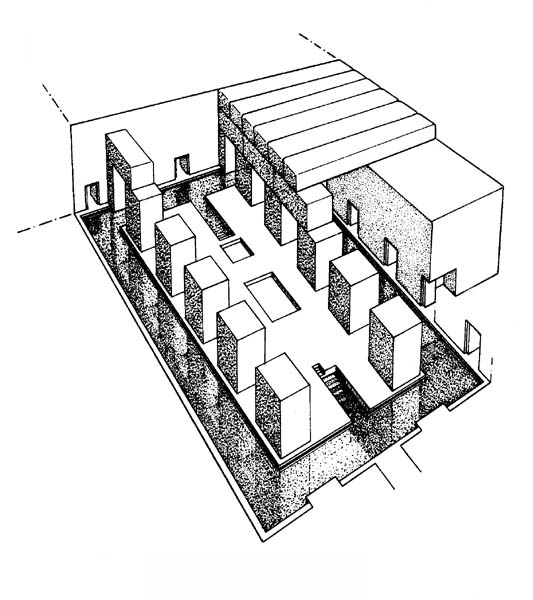
Reconstruction of the Osireion
Another notable and outstandingly unusual feature of the Osireion was that it was not even approximately aligned to the cardinal points. Instead, like the Way of the Dead at Teotihuacan in Mexico, it was oriented to the east of due north. Since Ancient Egypt had been a civilization that could and normally did achieve precise alignments for its buildings, it seemed to me improbable that this apparently skewed orientation was accidental. Moreover, although 50 feet higher, the Seti I Temple was oriented along exactly the same axis-and again not by accident. The question was: which was the older building? Had the axis of the Osireion been predetermined by the axis of the Temple or vice versa? This, it turned out, was an issue over which considerable controversy, now long forgotten, had once raged. In a debate which had many connections with that surrounding the Sphinx and the Valley Temple at Giza, eminent archaeologists had initially argued that the Osireion was a building of truly immense antiquity, a view expressed by Professor Naville in the London Times of 10 March 1914:
This monument raises several important questions. As to its date, its great similarity with the Temple of the Sphinx [as the Valley Temple was then known] shows it to be of the same epoch when building was made with enormous stones without any ornament. This is characteristic of the oldest architecture in Egypt. I should even say that we may call it the most ancient stone building in Egypt. [20]
Describing himself as overawed by the ‘grandeur and stern simplicity’ of the monument’s central hall, with its remarkable granite monoliths, and by ‘the power of those ancients who could bring from a distance and move such gigantic blocks’, Naville made a suggestion concerning the function the Osireion might originally have been intended to serve: ‘Evidently this huge construction was a large reservoir where water was stored during the high Nile… It is curious that what we may consider as a beginning in architecture is neither a temple nor a tomb, but a gigantic pool, a waterwork… [21]
Curious indeed, and well worth investigating further; something Naville hoped to do the following season. Unfortunately, the First World War intervened and no archaeology could be undertaken in Egypt for several years. As a result, it was not until 1925 that the Egypt Exploration Fund was able to send out another mission, which was led not by Naville but by a young Egyptologist named Henry Frankfort.
Frankfort’s facts
Later to enjoy great prestige and influence as professor of Pre-Classical Antiquity at the University of London, Frankfort spent several consecutive digging seasons re-clearing and thoroughly excavating the Osireion between 1925 and 1930. During the course of this work he made discoveries which, so far as he was concerned, ‘settled the date of the building’:
- A granite dovetail in position at the top of the southern side of the main entrance to the central hall, which was inscribed with the cartouche of Seti I.
- A similar dovetail in position inside the eastern wall of the central hall.
- Astronomical scenes and inscriptions by Seti I carved in relief on the ceiling of the northern transverse chamber.
- The remains of similar scenes in the southern transverse chamber.
- An ostracon (piece of broken potsherd) found in the entrance passage and bearing the legend ‘Seti is serviceable to Osiris’. [22]
The reader will recall the lemming behaviour which led to a dramatic change of scholarly opinion about the antiquity of the Sphinx and the Valley Temple (due to the discovery of a few statues and a single cartouche which seemed to imply some sort of connection with Khafre). Frankfort’s finds at Abydos caused a similar volte-face over the antiquity of the Osireion. In 1914 it was ‘the most ancient stone building in Egypt’. By 1933, it had been beamed forward in time to the reign of Seti I-around 1300 BC-whose cenotaph it was now believed to be. [23]
Within a decade, the standard Egyptological texts began to print the attribution to Seti I as though it were a fact, verifiable by experience or observation. It is not a fact, however, merely Frankfort’s interpretation of the evidence he had found.
The only facts are that certain inscriptions and decorations left by Seti appear in an otherwise completely anonymous structure. One plausible explanation is that the structure must have been built by Seti, as Frankfort proposed. The other possibility is that the half-hearted and scanty decorations, cartouches and inscriptions found by Frankfort could have been placed in the Osireion as part of a renovation and repair operation undertaken in Seti’s time (implying that the structure was by then ancient, as Naville and others had proposed).
What are the merits of these mutually contradictory propositions which identify the Osireion as (a) the oldest building in Egypt, and (b) a relatively late New Kingdom structure?
Proposition (b)-that it is the cenotaph of Seti I-is the only attribution accepted by Egyptologists. On close inspection, however, it rests on the circumstantial evidence of the cartouches and inscriptions which prove nothing. Indeed part of this evidence appears to contradict Frankfort’s case. The ostracon bearing the legend ‘Seti is serviceable to Osiris’ sounds less like praise for the works of an original builder than praise for a restorer who had renovated, and perhaps added to, an ancient structure identified with the First Time god Osiris. And another awkward little matter has also been overlooked. The south and north ‘transverse chambers’, which contain Seti I’s detailed decorations and inscriptions, lie outside the twenty-foot-thick enclosure wall which so adamantly defines the huge, undecorated megalithic core of the building. This had raised the reasonable suspicion in Naville’s mind (though Frankfort chose to ignore it) that the two chambers concerned were ‘not contemporaneous with the rest of the building’ but had been added much later during the reign of Seti I, ‘probably when he built his own temple’. [24]
To cut a long story short, therefore, everything about proposition (b) is based in one way or another on Frankfort’s not necessarily infallible interpretation of various bits and pieces of possibly intrusive evidence.
Proposition (a)-that the core edifice of the Osireion had been built millennia before Seti’s time-rests on the nature of the architecture itself. As Naville observed, the Osireion’s similarity to the Valley Temple at Giza ‘showed it to be of the same epoch when building was made with enormous stones’. Likewise, until the end of her life, Margaret Murray remained convinced that the Osireion was not a cenotaph at all (least of all Seti’s). She said,
It was made for the celebration of the mysteries of Osiris, and so far is unique among all the surviving buildings of Egypt. It is clearly early, for the great blocks of which it is built are of the style of the Old Kingdom; the simplicity of the actual building also points to it being of that early date. The decoration was added by Seti I, who in that way laid claim to the building, but seeing how often a Pharaoh claimed the work of his predecessors by putting his name on it, this fact does not carry much weight. It is the style of the building, the type of the masonry, the tooling of the stone, and not the name of a king, which date a building in Egypt. [25]
This was an admonition Frankfort might well have paid more attention to, for as he bemusedly observed of his ‘cenotaph’, ‘It has to be admitted that no similar building is known from the Nineteenth Dynasty.’ [26]
Indeed it is not just a matter of the Nineteenth Dynasty. Apart from the Valley Temple and other cyclopean edifices on the Giza plateau, no other building remotely resembling the Osireion is known from any other epoch of Egypt’s long history. This handful of supposedly Old Kingdom structures, built out of giant megaliths, seems to belong in a unique category. They resemble one another much more than they resemble any other known style of architecture and in all cases there are question-marks over their identity.
Isn’t this precisely what one would expect of buildings not erected by any historical pharaoh but dating back to prehistoric times? Doesn’t it make sense of the mysterious way in which the Sphinx and the Valley Temple, and now the Osireion as well, seem to have become vaguely connected with the names of particular pharaohs (Khafre and Seti I), without ever yielding a single piece of evidence that clearly and unequivocally proves those pharaohs built the structures concerned? Aren’t the tenuous links much more indicative of the work of restorers seeking to attach themselves to ancient and venerable monuments than of the original architects of those monuments-whoever they might have been and in whatever epoch they might have lived?
Setting sail across seas of sand and time
Before leaving Abydos, there was one other puzzle that I wanted to remind myself of. It lay buried in the desert, about a kilometre north-west of the Osireion, across sands littered with the rolling, cluttered tumuli of ancient graveyards.
Out among these cemeteries, many of which dated back to early dynastic and pre-dynastic times, the jackal gods Anubis and Upuaut had traditionally reigned supreme. Openers of the way, guardians of the spirits of the dead, I knew that they had played a central role in the mysteries of Osiris that had been enacted each year at Abydos-apparently throughout the span of Ancient Egyptian history.
It seemed to me that there was a sense in which they guarded the mysteries still. For what was the Osireion if was not a huge, unsolved mystery that deserved closer scrutiny than it has received from the scholars whose job it is to look into these matters? And what was the burial in the desert of twelve high-prowed, seagoing ships if not also a mystery that cried out, loudly, for solution?
It was the burial place of those ships I was now crossing the cemeteries of the jackal gods to see:
The Guardian, London, 21 December 1991: A fleet of 5000-year-old royal ships has been found buried eight miles from the Nile. American and Egyptian archaeologists discovered the 12 large wooden boats at Abydos… Experts said the boats-which are 50 to 60 feet long-are about 5000 years old, making them Egypt’s earliest roya1 ships and among the earliest boats found anywhere … The experts say the ships, discovered in September, were probably meant for burial so the souls of the pharaohs could be transported on them. ‘We never expected to find such a fleet, especially so far from the Nile,’ said David O’Connor, the expedition leader and curator of the Egyptian Section of the University Museum of the University of Pennsylvania… [27]
The boats were buried in the shadow of a gigantic mud-brick enclosure, thought to have been the mortuary temple of a Second Dynasty pharaoh named Khasekhemwy, who had ruled Egypt in the twenty-seventh century BC. [28] O’Connor, however, was certain that they were not associated directly with Khasekhemwy but rather with the nearby (and largely ruined) ‘funerary-cult enclosure built for Pharaoh Djer early in Dynasty I. The boat graves are not likely to be earlier than this and may in fact have been built for Djer, but this remains to be proven.’ [29]
A sudden strong gust of wind blew across the desert, scattering sheets of sand. I took refuge for a while in the lee of the looming walls of the Khasekhemwy enclosure, close to the point where the University of Pennsylvania archaeologists had, for legitimate security reasons, reburied the twelve mysterious boats they had stumbled on in 1991. They had hoped to return in 1992 to continue the excavations, but there had been various hitches and, in 1993, the dig was still being postponed.
In the course of my research O’Connor had sent me the official report of the 1991 season, [30] mentioning in passing that some of the boats might have been as much as 72 feet in length. [31] He also noted that the boat-shaped brick graves in which they were enclosed, which would have risen well above the level of the surrounding desert in early dynastic times, must have produced quite an extraordinary effect when they were new:
Each grave had originally been thickly coated with mud plaster and whitewash so the impression would have been of twelve (or more) huge ‘boats’ moored out in the desert, gleaming brilliantly in the Egyptian sun. The notion of their being moored was taken so seriously that an irregularly shaped small boulder was found placed near the ‘prow’ or ‘stern’ of several boat graves. These boulders could not have been there naturally or by accident; their placement seems deliberate, not random. We can think of them as ‘anchors’ intended to help ‘moor’ the boats. [32]
Like the 140-foot ocean-going vessel found buried beside the Great Pyramid at Giza (see Chapter Thirty-three), one thing was immediately clear about the Abydos boats-they were of an advanced design capable of riding out the most powerful waves and the worst weather of the open seas. According to Cheryl Haldane, a nautical archaeologist at Texas A-and-M University, they showed ‘a high degree of technology combined with grace’. [33] Exactly as was the case with the Pyramid boat, therefore (but at least 500 years earlier) the Abydos fleet seemed to indicate that a people able to draw upon the accumulated experiences of a long tradition of seafaring had been present in Egypt from the very beginning of its 3000 year history. Moreover I knew that the earliest wall paintings found in the Nile Valley, dating back perhaps as much as 1500 years before the burial of the Abydos fleet (to around 4500 BC) showed the same long, sleek, high-prowed vessels in action. [34]
Could an experienced race of ancient seafarers have become involved with the indigenous inhabitants of the Nile Valley at some indeterminate period before the official beginning of history at around 3000 BC? Wouldn’t this explain Egypt’s curious and paradoxical – but nonetheless enduring – obsession with ships in the desert (and references to what sounded like sophisticated ships in the Pyramid Texts, including one said to have been more than 2000 feet long)? [35]
In raising these conjectures, I did not doubt that religious symbolism had existed in Ancient Egypt in which, as scholars endlessly pointed out, ships had been designated as vessels for the pharaoh’s soul. Nevertheless that symbolism did not solve the problem posed by the high level of technological achievement of the buried ships; such evolved and sophisticated designs called for a long period of development. Wasn’t it worth looking into the possibility-even if only to rule it out-that the Giza and Abydos vessels could have been parts of a cultural legacy, not of a land-loving, riverside-dwelling, agricultural people like the indigenous Ancient Egyptians but of an advanced seafaring nation?
Such seafarers could have been expected to be navigators who would have known how to set a course by the stars and who would perhaps also have developed the skills necessary to draw up accurate maps and charts of the oceans they had traversed.
Might they also have been architects and stonemasons whose characteristic medium had been polygonal, megalithic blocks like those of the Valley Temple and the Osireion?
And might they have been associated in some way with the legendary gods of the First Time, said to have brought to Egypt not only civilization and astronomy and architecture, and the knowledge of mathematics and writing, but a host of other useful skills and gifts, by far the most notable and the most significant of which had been the gift of agriculture?
There is evidence of an astonishingly early period of agricultural advance and experimentation in the Nile Valley at about the end of the last Ice Age in the northern hemisphere. The characteristics of this great Egyptian ‘leap forward’ suggest that it could only have resulted from an influx of new ideas from some as yet unidentified source.
- Atlas of Ancient Egypt, p. 36.
- Dates from At1as of Ancient Egypt. For further data on Ramesses II as the pharaoh of the exodus see Profuses K. A. Kitchen, Pharaoh Triumphant: The Life and Times of Ramesses II, Aris and Phillips, Warminster, 1982, pp. 70-1.
- See, for example, A Biographical Dictionary of Ancient Egypt, pp. 135-7.
- Traveller’s Key to Ancient Egypt, p. 384.
- The Ancient Egyptian Pyramid Texts, pp. 285, 253.
- Traveller’s Key to Ancient Egypt, p. 386.
- The Encyclopaedia of Ancient Egypt, p. 59.
- Chapter 175 of the Ancient Egyptian Book of the Dead, cited in Myth and Symbol in Ancient Egypt, p. 137.
- See Henry Frankfort, The Cenotaph of Seti I at Abydos, 39th Memoir of the Egypt Exploration Society, London, 1933, p. 25.
- The Geography of Strabo, volume VIII, pp. 111- 13.
- Margaret A. Murray, The Osireion at Abydos, Egyptian Research Account, ninth year (1903), Bernard Quaritch, London, 1904, p. 2.
- Ibid.
- The Times, London, 17 March 1914.
- Ibid.
- Ibid.
- Traveller’s Key to Ancient Egypt, p. 391.
- The Cenotaph of Seti I at Abydos, p. 18.
- Ibid., p.28-9.
- E. Naville, ‘Excavations at Abydos: The Great Pool and the Tomb of Osiris’, Journal of Egyptian Archaeology, volume I, 1914, p. 160.
- The Times, London, 17 March 1914.
- Ibid.
- The Cenotaph of Seti I at Abydos, pp. 4, 25, 68-80.
- Ibid., in general.
- ‘Excavations at Abydos’, pp. 164-5.
- The Splendour that was Egypt, pp. 160-1.
- The Cenotaph of Seti I at Abydos, p. 23.
- Guardian, London, 21 December 1991.
- David O’Connor, ‘Boat Graves and Pyramid Origins’, in Expedition, volume 33, No.3, 1991, p. 7ff.
- Ibid., pp. 9-10.
- Sent to me by fax 27 January 1993.
- David O’Connor, ‘Boat Graves and Pyramid Origins’, p. 12.
- Ibid., p. 11-12.
- Guardian, 21 December 1991.
- See Cairo Museum, Gallery 54, wall-painting of ships from Badarian period c. 4500 BC.
- The Ancient Egyptian Pyramid Texts, p. 192, Utt. 519: ‘O Morning Star, Horus of the Netherworld … you having a soul and appearing in front of your boat of 770 cubits … Take me with you in the cabin of your boat.’
Fingerprints of the Gods, Sample chapter: Chapter 52
By Graham Hancock
Like a Thief in the Night
There are certain structures in the world, certain ideas, certain intellectual treasures, that are truly mysterious. I am beginning to suspect that the human race may have placed itself in grave jeopardy by failing to consider the implications of these mysteries.
We have the ability, unique in the animal kingdom, to learn from the experiences of our predecessors. After Hiroshima and Nagasaki, for example, two generations have grown to adulthood in awareness of the horrific destruction that nuclear weapons unleash. Our children will be aware of this too, without experiencing it directly, and they will pass it on to their children. Theoretically, therefore, the knowledge of what atom bombs do has become part of the permanent historical legacy of mankind. Whether we choose to benefit from that legacy or not is up to us. Nevertheless the knowledge is there, should we wish to use it, because it has been preserved and transmitted in written records, in film archives, in allegorical paintings, in war memorials, and so on.
Not all testimony from the past is accorded the same stature as the records of Hiroshima and Nagasaki. On the contrary, like the Canonical Bible, the body of knowledge that we call ‘History’ is an edited cultural artifact from which much has been left out. In particular, references to human experiences prior to the invention of writing around 5000 years ago have been omitted in their entirety and myth has become a synonym for delusion.
Suppose it is not delusion?
Suppose that a tremendous cataclysm were to overtake the earth today, obliterating the achievements of our civilization and wiping out almost all of us. Suppose, to paraphrase Plato, that we were forced by this cataclysm ‘to begin again like children, in complete ignorance of what had happened in early times’. Under such circumstances, ten or twelve thousand years from now (with all written records and film archives long since destroyed) what testimony might our descendants still preserve concerning the events at the Japanese cities of Hiroshima and Nagasaki in August 1945 of the Christian era?
It is easy to imagine how they might speak in mystical terms of explosions that gave off a ‘terrible glare of light’ and ‘immense heat’. Nor would we be too surprised to find that they might have formulated a ‘mythical’ account something like this:
The flames of the Brahmastra-charged missiles mingled with each other and surrounded by fiery arrows they covered the earth, heaven and space between and increased the conflagration like the fire and the Sun at the end of the world … All beings who were scorched by the Brahmastras, and saw the terrible fire of their missiles, felt that it was the fire of Pralaya [the cataclysm] that burns down the world.
And what of the Enola Gay which carried the Hiroshima bomb? How might our descendants remember that strange aircraft and the squadrons of others like it that swarmed through the skies of planet earth during the twentieth century of the Christian era? Isn’t it possible, probable even, that they might preserve traditions of ‘celestial cars’ and ‘heavenly chariots’ and ‘spacious flying machines’, and even of ‘aerial cities’. If they did, would they perhaps speak of such wonders in mythical terms a little like these:
- ‘Oh you, Uparicara Vasu, the spacious aerial flying machine will come to you – and you alone, of all the mortals, seated on that vehicle will look like a deity.’
- ‘Visvakarma, the architect among the Gods, built aerial vehicles for the Gods.’
- ‘Oh you descendant of the Kurus, that wicked fellow came on that all-traversing automatic flying vehicle known as Saubhapura and pierced me with weapons.’
- ‘He entered into the favourite divine palace of Indra and saw thousands of flying vehicles intended for the Gods lying at rest.’
- ‘The Gods came in their respective flying vehicles to witness the battle between Kripacarya and Arjuna. Even Indra, the Lord of Heaven, came with a special type of flying vehicle which could accommodate 33 divine beings.’
All these quotations have been taken from the Bhagavata Puranu and from the Mahabaratha, two drops in the ocean of the ancient wisdom literature of the Indian subcontinent. And such images are replicated in many other archaic traditions. To give one example (as we saw in Chapter Forty-two), the Pyramid Texts are replete with anachronistic images of flight:
The King is a flame, moving before the wind to the end of the sky and to the end of the earth … the King travels the air and traverses the earth … there is brought to him a way of ascent to the sky …
Is it possible that the constant references in archaic literatures to something like aviation could be valid historical testimony concerning the achievements of a forgotten and remote technological age?
We will never know unless we try to find out. And so far we haven’t tried because our rational, scientific culture regards myths and traditions as ‘unhistorical’. No doubt many are unhistorical, but at the end of the investigation that underlies this book, I am certain that many others are not …
For the benefit of future generations of mankind
Here is a scenario:
Suppose that we had calculated, on the basis of sound evidence and beyond any shadow of a doubt, that our civilization was soon to be obliterated by a titanic geological cataclysm – a 30° displacement of the earth’s crust, for example, or a head-on collision with a ten-mile-wide nickel-iron asteroid travelling towards us at cosmic speed.
Of course there would at first be much panic and despair. Nevertheless – if there were sufficient advance warning – steps would be taken to ensure that there would be some survivors and that some of what was most valuable in our high scientific knowledge would be preserved for the benefit of future generations.
Strangely enough, the Jewish historian Josephus (who wrote during the first century AD) attributes precisely this behaviour to the clever and prosperous inhabitants of the antediluvian world who lived before the Flood ‘in a happy condition without any misfortunes falling upon them’:
They also were the inventors of that peculiar sort of wisdom which is concerned with the heavenly bodies, and their order. And that their inventions might not be lost – upon Adam’s prediction that the world was to be destroyed at one time by the force of fire, and at another time by the violence and quantity of water – they made two pillars, one of brick, the other of stone: they inscribed their discoveries upon them both, that in case the pillar of brick should be destroyed by the Flood, the pillar of stone might remain and exhibit these discoveries to mankind; and also inform them that there was another pillar of brick erected by them …
Likewise, when the Oxford astronomer John Greaves visited Egypt in the seventeenth century he collected ancient local traditions which attributed the construction of the three Giza pyramids to a mythical antediluvian king:
The occasion of this was because he saw in his sleep that the whole earth was turned over, with the inhabitants of it lying upon their faces and the stars falling down and striking one another with a terrible noise … And he awaked with great feare, and assembled the chief priests of all the provinces of Egypt … He related the whole matter to them and they took the altitude of the stars, and made their prognostication, and they foretold of a deluge. The king said, will it come to our country? They answered yes, and will destroy it. And there remained a certain number of years to come, and he commanded in the mean space to build the Pyramids … And he engraved in these Pyramids all things that were told by wise men, as also all profound sciences – the science of Astrology, and of Arithmeticke, and of Geometry, and of Physicke. All this may be interpreted by him that knowes their characters and language …
Taken at face value, the message of both of these myths seems crystal clear: certain mysterious structures scattered around the world were built to preserve and transmit the knowledge of an advanced civilization of remote antiquity which was destroyed by a terrifying upheaval.
Could this be so? And what are we to make of other strange traditions that have come to us from the dark vault of prehistory?
What are we to make, for example, of the Popol Vuh, which speaks in veiled language about a great secret of the human past: a long-forgotten golden age when everything was possible – a magical time of scientific progress and enlightenment when the ‘First Men’ (who were ‘endowed with intelligence’) not only ‘measured the round face of the earth’ but ‘examined the four points of the arch of the sky’.
As the reader will recall, the gods became jealous at the rapid progress made by these upstart humans who had ‘succeeded in seeing, succeeded in knowing, all that there is in the world.’ Divine retribution quickly followed: ‘The Heart of Heaven blew mist into their eyes … In this way all the wisdom and all the knowledge of the First Men [together with their memory of their] origin and their beginning, were destroyed.’
The secret of what happened was never entirely forgotten because a record of those distant First Times was preserved, until the coming of the Spaniards, in the sacred texts of the original Popol Vuh. The abuses of the conquest made it necessary for that primordial document to be concealed from all but the most highly-initiated sages and replaced with a watered-down substitute written ‘under the law of Christianity’: ‘No longer can be seen the book of Popol Vuh which the kings had in olden times … The original book, written long ago, existed – but now its sight is hidden to the searcher and to the thinker …’
On the other side of the world, among the myths and traditions of the Indian subcontinent, there are further tantalizing suggestions of hidden secrets. In the Puranic version of the universal flood story, shortly before the deluge was unleashed, the fish god Vishnu warned his human protégé that he ‘should conceal the Sacred Scriptures in a safe place’ to preserve the knowledge of the antediluvian races from destruction. Likewise, in Mesopotamia, the Noah figure Utnapishtim was instructed by the god Ea ‘to take the beginning, the middle and the end of whatever was consigned to writing and then to bury it in the City of the Sun at Sippara’. After the waters of the flood had gone, survivors were instructed to make their way to the site of the City of the Sun ‘to search for the writings’, which would be found to contain knowledge of benefit to future generations of mankind.
Strangely enough, it was the City of the Sun in Egypt, Innu, known by the Greeks as Heliopolis – which was regarded throughout the dynastic period as the source and centre of the high wisdom handed down to mortal men from the fabled First Time of the gods. It was at Heliopolis that the Pyramid Texts were collated, and it was the Heliopolitan priesthood – or rather the Heliopolitan cult – that had custody of the monuments of the Giza necropolis.
More than just Kilroy was here
Let us return to our scenario:
- we know that our late twentieth-century, post-industrial civilization is about to be destroyed by an inescapable cosmic or geological cataclysm;
- we know – because our science is pretty good – that the destruction is going to be near-total;
- mobilizing massive technological resources, we put our best minds to work to ensure that at least a remnant of our species will survive the catastrophe, and that the core of our scientific, medical, astronomical, geographical, architectural and mathematical knowledge will be preserved;
- we are of course aware how slim are our chances of succeeding on both counts; nevertheless, galvanized by the prospect of extinction, we make an almighty effort to build the Arks or Vars or strong enclosures in which the chosen survivors can be protected, and we focus our considerable ingenuity on ways to transmit the essence of the knowledge we have accumulated during the 5000 years of our recorded history.
We start by preparing for the worst. We assume that there will be survivors but that they will be blasted back into the Stone Age by the cataclysm. Realizing that it may take ten or twelve thousand years for a civilization as advanced as our own to rise again like a phoenix from the ashes, one of our top priorities is to find a way to communicate with that postulated future civilization. At the least we would want to say to them: KILROY WAS HERE! and to be sure they got the message no matter what language they spoke or what ethical, religious, ideological, metaphysical or philosophical leanings their society might exhibit.
I’m sure we’d want to say more than just ‘Kilroy was here’. We’d want, for example, to tell them – those distant grandchildren of ours – when we had lived in relation to their time.
How would we do that? How would we express, say, AD 2012 of the Christian era in a language universal enough to be worked out and understood twelve thousand years hence by a civilization that would know nothing of the Christian or of any of the other eras by which we express chronology?
One obvious solution would be to make use of the beautiful predictability of the earth’s axial precession, which has the effect of slowly and regularly altering the declination of the entire star-field in relation to a viewer at a fixed point, and which equally slowly and regularly revolves equinoctial point in relation to the twelve zodiacal constellations. From the predictability of this motion it follows that if we can find a way to declare: WE LIVED WHEN THE VERNAL EQUINOX WAS IN THE CONSTELLATION OF PISCES we will provide a means of specifying our epoch to within a single 2160-year period in every grand precessional cycle of 25,920 years.
The only drawback to this scheme would evident if a civilization equivalent to our own failed to arise within 12,000 or even 20,000 years of the cataclysm, but took much longer – perhaps as much as 30,000 years. In that case, a monument or calendrical device declaring ‘lived when the vernal equinox was in the constellation of Pisces’ would no longer be unambiguous. If discovered by a high culture flourishing at the very beginning of a future Age of Sagittarius for example it could be read as meaning ‘we lived 4320 years before your time’ – that is, two full precessional ‘months’ prior to the Sagittarian Age (the 2160-year ‘months’ of Aquarius and Capricorn). But it could also mean ‘We lived 30,240 years before your time’, that is those two ‘months’ plus the full previous precessional cycle of 25,920 years. The Sagittarian archaeologists would not only have to use their wits to work out the meaning of the message (i.e. WE LIVED WHEN THE VERNAL EQUINOX WAS IN PISCES), but would need to decide from other clues which Age of Pisces we had lived in: the most recent, or the one in the previous precessional cycle, or perhaps even the cycle before that.
Geology would naturally be of assistance in making such broad judgements …
The civilizers
If we could find a way of saying WE LIVED IN THE AGE OF PISCES, and could specify the altitude above the horizon of certain identifiable stars in our own epoch (say, the prominent belt stars of the Orion constellation), we would be able to signal our dates to future generations with greater precision. Alternatively we could do as the builders of the Giza pyramids appear to have done and lay out our monuments in a pattern on the ground reflecting exactly the pattern of the stars in the sky in our time.
There would be several other options and combinations of options open to us, depending on our circumstances, on the level of technology available to us, on the extent of the early warning we were given, and on which chronological facts we wanted to transmit.
Suppose, for example, that there was not time to make proper preparations prior to the catastrophe. Suppose that the disaster, like ‘the Day of the Lord’ in 2 Peter 3, crept up on us unseen ‘as a thief in the night?’ What prospects might humanity be faced with?
Whether as the result of an asteroid strike or an earth-crust displacement or some other cosmic or geological cause, let us assume:
- massive devastation all around the world;
- the survival of only relatively small numbers of people, the majority of whom rapidly revert to barbarism;
- the presence, among this remnant, of a minority of well-organized visionaries – including master-builders, scientists, engineers, cartographers, mathematicians, medical doctors and the like – who dedicate themselves to salvaging what they can and finding ways to transmit the knowledge to the future for the benefit of those who might eventually understand it.
Let us call these hypothetical visionaries ‘the civilisers’. As they banded together – at first to survive, later to teach and to share ideas – they might take on something of the manner and belief systems of a religious cult, developing a clear sense of mission and of shared identity. No doubt they would make use of powerful and easily recognizable symbols to strengthen and express this sense of common purpose: the men might wear distinctive beards, for example, or shave their heads, and certain archetypal imagery like the cross and the serpent and the dog might be used to link the members of the cult together as they set out on their civilizing missions to relight the lamps of knowledge around the world.
I suspect, if the situation were bad enough after the cataclysm, that many of the civilizers would fail, or meet with only limited success. But let us suppose that one small group had the skill and dedication sufficient to create a lasting and stable beach-head, perhaps in a region which had suffered relatively little damage in the disaster. Then let us suppose that some other unexpected disaster were to occur – an aftershock or series of aftershocks from the original catastrophe perhaps – and the beach-head was almost totally annihilated.
What might happen next? What might be salvaged from this wreckage of a wisdom cult which had itself been salvaged from a greater wreck?
Transmitting the essence
If the circumstances were right it seems possible that the essence of the cult might survive, carried forward by a nucleus of determined men and women. I suspect, too, with the proper motivation and indoctrination techniques, plus a means of recruiting new members from among the half-savage local inhabitants, that such a cult might perpetuate itself almost indefinitely. This could happen, however, only if its members (like the Jews awaiting the Messiah) were prepared to bide their time, for thousands and thousands of years, until they felt confident that the moment had come to declare themselves.
If they did that, and if their sacred objective were indeed to preserve and transmit knowledge to some evolved future civilization, it is easy to imagine how the cult members might be described in terms similar to those used for the Egyptian wisdom god Thoth who was said to have
succeeded in understanding the mysteries of the heavens [and to have] revealed them by inscribing them in sacred books which he then hid here on earth, intending that they should be searched for by future generations but found only by the fully worthy …
What might the mysterious ‘books of Thoth’ have been? Is it necessary to suppose that all the information they were purported to contain should have been transmitted in book form?
Is it not worth wondering, for example, whether Professors de Santillana and von Dechend might have earned their place among the ‘fully worthy’ when they decoded the advanced scientific language embedded in the great universal myths of precession? In so doing, is it not possible that they might have stumbled upon one of the metaphorical ‘books’ of Thoth and read the ancient science inscribed upon its pages?
Likewise, what about Posnansky’s discoveries at Tiahuanaco, and Hapgood’s maps? What about the new understanding that is dawning concerning the geological antiquity of the Sphinx at Giza? What about the questions raised by the gigantic blocks used in the construction of the Valley and Mortuary Temples? What about the secrets now being teased, one by one, from the astronomical alignments and dimensions and concealed chambers of the pyramids?
If these, too, are readings from the metaphorical books of Thoth, it would seem that the numbers of the ‘fully worthy’ are increasing, and that new and even more startling revelations may soon be at hand …
To return briefly and for the last time to our evolving scenario:
- at the begining of the twenty-first century of the Christian era, near the cusp of the Age of Pisces and the Age of Aquarius, civilization as we know it is destroyed;
- among the devastated survivors a few hundred or a few thousand individuals band together to preserve and transmit the fruits of their culture’s scientific knowledge into a distant and uncertain future;
- these civilizers split into small groups and spread across the globe;
- by and large they fail, and perish; nevertheless, in certain areas, some do succeed in making a lasting cultural impression;
- after thousands of years – and perhaps several false starts – a branch of the original wisdom cult influences the emergence of a fully fledged civilization …
Of course the parallel for this last category is once again to be found in Egypt. I would seriously propose as a hypothesis for further testing that a scientific wisdom cult, made up of the survivors of a great, lost, maritime civilization, could perhaps have established itself in the Nile Valley as early as the fourteenth millennium BC. The cult would have been based at Heliopolis, Giza and Abydos, and perhaps at other centres as well, and would have initiated Egypt’s early agricultural revolution. Later, however, beaten down by the huge floods and other disturbances of the earth which took place in the eleventh millennium BC, the cult would have been obliged to cut its losses and withdraw until the turmoil of the Ice Age was over – never knowing whether its message would survive the subsequent dark epochs.
Under such circumstances, the hypothesis suggests that a huge and ambitious building project would have been one way cult members could preserve and transmit scientific information into the future independently of their physical survival. In other words, if the buildings were large enough, capable of enduring through immense spans of time and encoded through and through with the cult’s message, there would be hope that the message would be decoded at some future date even if the cult had by then long since ceased to exist.
The hypothesis proposes that this is what the enigmatic structures on the Giza plateau are all about:
- that the Great Sphinx is indeed, as we have argued in previous chapters, an equinoctial marker for the Age of Leo, indicating a date in our own chronology of between IO,970 BC 8810 BC;
- that the three principal pyramids are indeed laid out in relation to the Nile Valley to mimic the precise dispositions of the three stars of Orion’s Belt in relation to the course of the Milky Way in 1O,450 BC.
This is a pretty effective means of ‘specifying’ the epoch of the eleventh millennium BC by using the phenomenon of precession, which has been rightly described as the ‘only true clock of our planet’. Confusingly, however, we also know that the Great Pyramid incorporates star shafts ‘locked in’ to Orion’s Belt and Sirius at around 2450 BC. The hypothesis resolves the anomaly of the missing years by supposing the star shafts to be merely the later work of the same long-lived cult that originally laid out the Giza ground-plan in 10,450 BC. Naturally, the hypothesis also suggests that it was this same cult, towards the end of those 8ooo missing years, that provided the initiating spark for the sudden and ‘fully formed’ emergence of the literate historical civilization of dynastic Egypt.
What remains to be guessed at are the motives of the pyramid builders, who were presumably the same people as the mysterious cartographers who mapped the globe at the end of the last Ice Age in the northern hemisphere. If so, we might also ask why these highly civilized and technically accomplished architects and navigators were obsessed with charting the gradual glaciation of the enigmatic southern continent of Antarctica from the fourteenth millennium BC – when Hapgood calculates that the source map referred to by Phillipe Buache was drawn up – down to about the end of the fifth millennium BC?
Could they have been making a permanent cartographical record of the slow obliteration of their homeland?
And could their overwhelming desire to transmit a message to the future through a variety of different media – myths, maps, buildings, calendar systems, mathematical harmonies – have been connected to the cataclysms and earth changes that caused this loss?
An urgent mission
The possession of a conscious, articulated history is one of the faculties that distinguishes human beings from animals. Unlike rats, say, or sheep, or cows, or pheasants, we have a past which is separate from ourselves. We therefore have the opportunity, as I have said, to learn from the experiences of our predecessors.
Is it because we are perverse, or misguided, or simply stupid that we refuse to recognize those experiences unless they have come down to us in the form of bona fide ‘historical records’? And is it arrogance or ignorance which leads us to draw an arbitrary line separating ‘history’ from ‘prehistory’ at about 5000 years before the present – defining the records of ‘history’ as valid testimony and the records of ‘prehistory’ as primitive delusions?
At this stage in a continuing investigation, my instinct is that we may have put ourselves in danger by closing our ears for so long to the disturbing ancestral voices which reach us in the form of myths. This is more an intuitive than a rational feeling, but it is by no means unreasonable. My research has filled me with respect for the logical thinking, high science, deep psychological insights, and vast cosmo-graphical knowledge of the ancient geniuses who composed those myths, and who, I am now fully persuaded, descended from the same lost civilization that produced the map-makers, pyramid builders, navigators, astronomers and earth-measurers whose fingerprints we have been following across the continents and oceans of the earth.
Since I have learned to respect those long-forgotten and still only hazily identified Newtons and Shakespeares and Einsteins of the last Ice Age, I think it would be foolish to disregard what they seem to be saying. And what they seem to be saying to us is this: that cyclical, recurrent and near-total destructions of mankind are part and parcel of life on this planet, that such destructions have occurred many times before and that they will certainly occur again.
What, after all, is the remarkable calendrical system of the Mayas if it is not a medium for transmitting exactly this message? What, if not vehicles for the same sort of bad news are the traditions of the four previous ‘Suns’ (or sometimes of the three previous ‘Worlds’) passed down in the Americas since time immemorial? By the same token, what might be the function of the great myths of precession which speak not just of previous cataclysms but of cataclysms to come and which (through the metaphor of the cosmic mill) link these earthly disasters to ‘disturbances in the heavens’? Last but by no means least, what burning motive impelled the pyramid builders to erect, with such care, the powerful and mysterious edifices on the Giza plateau?
Yes, they were saying, ‘Kilroy was here’.
And, yes, they found an ingenious way to tell us when they were here.
Of these things I have no doubt.
I am also impressed by the enormous lengths they went to to provide us with convincing proof that theirs was a serious and scientifically advanced civilization. And I am even more impressed by the sense of urgency – of a vitally important mission – that seems to have enlightened all their works and deeds.
I go on intuition again, not on evidence.
It’s my guess that their underlying objective could have been to transmit a warning to the future, and that this warning could be to do with a global cataclysm, perhaps even a recurrence of the same cataclysm that so clearly devastated mankind at the end of the last Ice Age when ‘Noah saw that the earth had tilted, and that its destruction was near, and cried out in a bitter voice: “Tell me what is being done on the earth that the earth is so afflicted and shaken … ” ‘ These words are from the Hebrew Book of Enoch, but similar afflictions and shakings have been foretold in al1 the Central American traditions that speak of the demise of the present epoch of the world – an epoch, as the reader will recall, in which ‘the elders say [that] there will be a movement of the earth and from this we shall all perish.’
The reader will also not have forgotten the date calculated by the Ancient Maya calendar for the end of the world:
The day will be 4 Ahau 3 Kankin [corresponding to 23 December AD 2012], and it will be ruled by the Sun God, the ninth Lord of the Night. The moon will be eight days old, and it will be the third lunation in a series of six …
In the Mayan scheme of things we are already living in the last days of the earth.
In the Christian scheme of things too, the last days are understood to be upan us. According to the Watch Tower Bible and Tract Society of Peansylvania: ‘This world will perish just as surely as did the world before the Flood … Many things were foretold to occur during the last days, and all of these are being fulfilled. This means that the end of the world is near … ‘
Similarly the Christian psychic Edgar Cayce prophesied in 1934 that around the year 2000: ‘There will be a shifting of the poles. There will be upheavals in the Arctic and the Antarctic that will make for the eruption of volcanos in the Torrid areas … The upper portion of Europe will be changed in the twinkling of an eye. The earth will be broken up in the western portion of America. The greater portion of Japan must go into the sea.’
Curiously the epoch of the year 2000, which figures in these Christian prophecies, also coincides with the Last Time (or highest point) in the great upwards cycle of the belt stars of the Orion constellation, just as the epoch of the eleventh millennium BC coincided with the First Time (or lowest point) of that cycle.
And curiously, also, as we saw in Chapter Twenty-eight:
A conjunction of five planets that can be expected to have profound gravitational effects will take place on 5 May in the year 2000, when Neptune, Uranus, Venus, Mercury and Mars will align with the Earth on the other side of the sun, setting up a sort of cosmic tug-of-war …
Could the recondite influences of gravity, when combined with our planet’s precessional wobble, the torsional effects of its axial rotation, and the rapidly growing mass and weight of the Antarctic ice-cap, be enough to spark off a full-scale crustal displacement?
We may never know, one way or another – unless it happens. Meanwhile, I do not think the Egyptian scribe Manetho was being less than literal when he spoke of a harsh and deadly cosmic power at work in the universe:
Just as iron is likely to be attracted and led after the loadstone, but often turns away and is repelled in the opposite direction, so the salutary, good and rational movement of the world at one time attracts, conciliates and mollifies that harsh power; then again, when the latter has recovered itself, it overthrows the other and reduces it to helplessness …
In short, through metaphors and allegories, I suspect the ancients may have tried to find many ways to tell us exactly when – and why – the hammer of global destruction is going to strike again. I therefore think, after 12,500 years of the pendulum, that it would only be wise for us to devote more of the resources to studying the signs and messages that have come down to us from that dark and terrifying period of amnesia which our species calls prehistory.
A speeding up of physical research at the Giza plateau would also be highly desirable – not only by Egyptologists determined to resist any threats to the scholarly status quo but by eclectic teams of investigators who could bring some of the newer sciences to bear on the challenges of this most enigmatic and impenetrable of sites. The Chlorine-36 rock-exposure dating technique mentioned in Chapter Six, for example, looks like a particularly promising means of resolving the impasse over the antiquity of the Pyramids and the Sphinx. Likewise, if the will is there, then a way can be found to get through to whatever lies beyond the little door concealed in the Great Pyramid 200 feet up the southern shaft of the Queen’s Chamber. At the same time serious efforts should be made to investigate the contents of the large, square-edged and apparently man-made cavity in the bedrock, deep beneath the paws of the Sphinx, that was discovered when a seismic survey was carried out at the site in 1993.
Last but not least, far away from Giza, I suspect that our efforts might also be repaid if we were to undertake a proper investigation of the sub-glacial landscapes of Antarctica – much the most likely continent to hide the complete remains of a lost civilization. If we could establish what destroyed that civilization, then we might be in a better position to save ourselves from a similar cataclysmic fate.
In making these latter suggestions I am, of course, fully aware that there are many who will be scornful and will assert the uniformitarian view that ‘all things will continue as they have done since the beginning of creation.’ But I am also aware that such ‘scoffers in the last days’ are those who for one reason or another are deaf to the testimony of our forgotten ancestors. As we have seen, this testimony appears to be trying to tell us that a hideous calamity has indeed descended upon mankind from time to time, that on each occasion it has afflicted us suddenly, without warning and without mercy, like a thief in the night, and that it will certainly recur at some point in the future, obliging us – unless we are well prepared – to begin again like orphaned children in complete ignorance of our true heritage.
Walking in the last days
Hopi Indian Reservation, May 1994: Across the high plains of Arizona, for days and days and days, a desolate wind had been blowing. As we drove across those plains towards the tiny village of Shungopovi, I went over in my mind all I had seen and done in the previous five years: my travels, my research, the false starts and dead-ends I had encountered, the lucky breaks, the moments when everything had come together, the moments when everything seemed about to fall apart.
I had traveled a long road to get here, I realized – far longer than the 300-mile freeway that had whisked us up into these austere badlands from Phoenix, the state capital. Nor did I expect to return with any great degree of enlightenment.
Nevertheless, I had made this journey because the science of prophecy is still believed to be alive among the Hopi: Pueblo Indians, distantly related to the Aztecs of Mexico, whose numbers have been reduced by attrition and misery to barely 10,000. Like the Ancient Maya whose descendants all across the Yucatan are convinced that the end of the world is coming in the year 2000 y pico (and a little), the Hopi believe that we are walking in the last days, with a geo1ogica1 sword of Damocles hanging over us. According to their myths, as we saw in Chapter Twenty-four:
The first world was destroyed, as a punishment for human misdemeanours, by an all-consuming fire that came from above and below. The second world ended when the terrestrial globe toppled from its axis and everything was covered with ice. The third world ended in a universal flood. The present world is the fourth. Its fate will depend on whether or not its inhabitants behave in accordance with the Creator’s plans … ‘
I had come to Arizona to see whether the Hopi thought we were behaving in accordance with the Creator’s plans …
The end of the world
The desolate wind, blowing across the high plains, shook and rattled the sides of the trailer-home we sat in. Beside me was Santha, who’d been everywhere with me, sharing the risks and the adventures, sharing the highs and the lows. Sitting across from us was our friend Ed Ponist, a medical-surgical nurse from Lansing, Michigan. A few years previously Ed had worked on the reservation for a while, and it was thanks to his contacts that we were now here. On my right was Paul Sifki, a ninety-six-year-old Hopi elder of the Spider clan, and a leading spokesman of the traditions of his people. Beside him was his grand-daughter Melza Sifki, a handsome middle-aged woman who had offered to translate.
‘I have heard,’ I said, ‘that the Hopi believe the end of the world is coming. Is this true?’
Paul Sifki was a small, wizened man, nut-brown in colour, dressed in jeans and a cambric shirt. Throughout our conversation he never once looked at me, but gazed intently ahead, as though he were searching for a familiar face in a distant crowd.
Melza put my question to him and a moment later translated her grandfather’s reply: ‘He says, “why do you want to know”?’
I explained that there were many reasons. The most important was that I felt a sense of urgency: ‘My research has convinced me that there was an advanced civilization – long, long ago – that was destroyed in a terrible cataclysm. I fear that our own civilization may be destroyed by a similar cataclysm … ‘
There followed a long exchange in Hopi, then this translation: ‘He said that when he was a child, in the 1900s, there was a star that exploded – a star that had been up there in the sky for a long while … And he went to his grandfather and asked him to explain the meaning of this sign. His grandfather replied: “This is the way our own world will end – engulfed in flames … If people do not change their ways then the spirit that takes care of the world will become so frustrated with us that he will punish the world with flames and it will end just like that star ended.” That was what his grandfather said to him – that the earth would explode just like that exploding star …’
‘So the feeling is that this world will end in fire … And having viewed the world for the past ninety years, does he believe that the behaviour of mankind has improved or worsened?’
‘He says it has not improved. We’re getting worse.’
‘So in his opinion, then, the end is coming?’
‘He said that the signs are already there to be seen … He said that nowadays nothing but the wind blows and that all we do is have a weapon pointed at one another. That shows how far apart we have drifted and how we feel towards each other now. There are no values any more – none at all – and people live any way they want, without morals or laws. These are the signs that the time has come …’
Melza paused in her translation, then added on her own account: ‘This terrible wind. It dries things out. It brings no moisture. The way we see it, this kind of climate is a consequence of how we’re living today – not just us, but your people as well.’
I noticed that her eyes had filled with tears while she was talking. ‘I have a cornfield,’ she continued, ‘that’s really dry. And I look up into the sky and try to pray for rain, but there is no rain, no clouds even … When we’re like this we don’t even know who we are.’
There was a long moment of silence and the wind rocked the trailer, blowing hard and steady across the mesa as evening fell around us.
I said quietly, ‘Please ask your grandfather if he thinks that anything can now be done for the Hopi and for the rest of mankind?’
‘The only thing he knows,’ Melza replied when she had heard his answer, ‘is that so long as the Hopi do not abandon their traditions they may be able to help themselves and to help others. They have to hold on to what they believed in the past. They have to preserve their memories. These are the most important things … But my grandfather wants to tell you also, and for you to understand, that this earth is the work of an intelligent being, a spirit – a creative and intelligent spirit that has designed everything to be the way it is. My grandfather says that nothing is here just by chance, that nothing happens by accident – whether good or bad – and that there is a reason for everything that takes place …’
At the millstone grinding
When human beings from around the globe, and from many different cultures, share a powerful and overwhelming intuition that a cataclysm is approaching, we are within our rights to ignore them. And when the voices of our distant ancestors, descending to us through myths and sacred architecture, speak to us of the physical obliteration of a great civilization in remote antiquity (and tell us that our own civilization is in jeopardy), we are entitled, if we wish, to stop our ears …
So it was, the Bible says, in the antediluvian world: ‘For in those days, before the Flood, people were eating, drinking, taking wives, taking husbands, right up to the moment that Noah went into the Ark, and they suspected nothing till the flood came and swept all away.’
In the same manner it has been prophesied that the next global destruction will fall upon us suddenly ‘at an hour we do not suspect, like lightning striking in the east and flashing far into the west … The sun will be darkened, the moon will lose its brightness, the stars will fall from the sky and the powers of heaven will be shaken … Then of two men in the fields, one is taken, one left; and of two women at the millstone grinding, one is taken, one left …’
What has happened before can happen again. What has been done before can be done again.
And perhaps there is, indeed, nothing new under the sun …
Contents
Acknowledgements
Part I
Introduction: The Mystery of the Maps
- A Map of Hidden Places
- Rivers in the Southern Continent
- Fingerprints of a Lost Science
Part II
Foam of the Sea: Peru and Bolivia
- Flight of the Condor
- The Inca Trail to the Past
- He Came in a Time of Chaos
- Were There Giants Then?
- The Lake at the Roof of the World
- Once and Future King
- The City at the Gate of the Sun
- Intimations of Antiquity
- The End of the Viracochas
Part III
Plumed Serpent: Central America
- Blood and Time at the End of the World
- People of the Serpent
- Mexican Babel
- Serpent Sanctuary
- The Olmec Enigma
- Conspicuous Strangers
- Adventures in the Underworld, Journeys to the Stars
- Children of the First Men
- A Computer for Calcutating the End of the World
- City of the Gods
- The Sun and the Moon and the Way of the Dead
Part IV
The Mystery of the Myths 1: A Species with Amnesia
- Echoes of our Dreams
- The Many Masks of the Apocalypse
- A Species Born in the Earth’s Long Winter
- The Face of the Earth was Darkened and a Black Rain Began to Fall
Part V
The Mystery of the Myths 2: The Precessional Code
- The Machinery of Heaven
- The First Crack in an Ancient Code
- The Cosmic Tree and the Mill of the Gods
- The Osiris Numbers
- Speaking to the Unborn
Part VI
The Giza Invitation: Egypt 1
- Cardinal Points
- Mansion of Eternity
- Tombs and Tombs Only?
- Anomalies
- Made by Some God
- Interactive Three-Dimensional Game
- Place of the Beginning
Part VII
Lord of Eternity: Egypt 2
- Are There Any Secret Left in Egypt?
- City of the Son, Chamber of the Jackal
- Anachronisms and Enigmas
- Looking for the First Time
- Gods of the First Time
- The Works of Men and Gods
- The Eleventh Millenium BC
- Sphinx
- Earth Measures
- The Power of the Thing
Part VIII
Conclusion: Where’s the Body?
- Not a Needle in a Haystack
- The Hammer and the Pendulum
- Like a Thief in the Night
References
Selected Bibliography
Index