




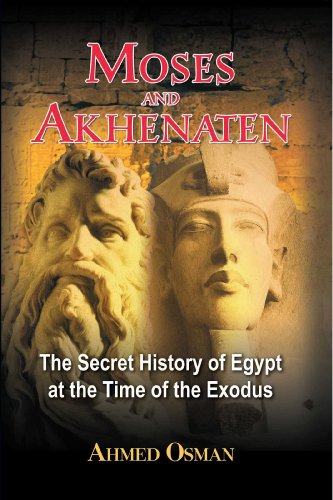
The Bible and the Kuran speak of Moses being born in Egypt, brought up in the pharaonic royal palace, and leading the Israelites in their Exodus to Canaan. In historical terms, when did Moses live, and who was the pharaoh of Oppression? Now that archaeologists have been able to uncover the mysteries of ancient history, we need to find answers to these questions. Egyptian born Ahmed Osman, believes that he has been able to find the answers for these questions which bewildered scholars for centuries. He claims that Moses of the Bible is no other than King Akhenaten who ruled Egypt for 17 years in the mid-14th century BC.
During his reign, the Pharaoh Akhenaten was able to abolish the complex pantheon of the ancient Egyptian religion and replace it with a single God, Aten, who had no image or form. Seizing on the striking similarities between the religious vision of Akhenaten and the teachings of Moses, Sigmund Freud was the first to argue that Moses was in fact an Egyptian. Now Ahmed Osman, using recent archaeological discoveries and historical documents, contends that Akhenaten and Moses were one and the same person.
In a stunning retelling of the Exodus story, Osman details the events of Moses/Akhenaten’s life: how he was brought up by Israelite relatives, ruled Egypt for seventeen years, angered many of his subjects by replacing the traditional Egyptian pantheon with worship of Aten, and was forced to abdicate the throne. Retreating to exile in Sinai with his Egyptian and Israelite supporters, he died out of the sight of his followers, presumably at the hands of Seti I, after an unsuccessful attempt to regain his throne.
Osman reveals the Egyptian components in the monotheism preached by Moses as well as his use of Egyptian royal and Egyptian religious expression. He shows that even the Ten Commandments betray the direct influence of Spell 125 in the Egyptian Book of the Dead. Osman’s book, Moses and Akhenaten provides a radical challenge to the long-standing beliefs concerning the origin of Semitic religion and the puzzle of Akhenaten’s deviation from ancient Egyptian tradition. In fact, if Osman’s contentions are right, many major Old Testament figures would be of Egyptian origin.
First Montheist
Akhenaten is the most mysterious and most interesting of all ancient Egyptian pharaohs. He created a revolution in religion, philosophy and art, which resulted in the introduction of the first monotheistic form of worship known in history. Sigmund Freud, father of psychoanalysis, was the first to suggest a connection between Moses and Akhenaten. In his last book Moses and Monotheism, published in 1939, Freud argued that biblical Moses was an official in the court of Akhenaten, and an adherent of the Aten religion. After the death of Akhenaten, Freud’s theory goes, Moses selected the Israelite tribe living east of the Nile Delta to be his chosen people, took them out of Egypt at the time of the Exodus, and passed on to them the tenets of Akhenaten’s religion.
When modern archaeologists came across the strangely-drawn figure of Akhenaten in the ruins of Tell el-Amarna, in the middle of the 19th century, they were not sure what to make of him. Some thought he was a woman disguised as a king. By the early years of the 20th century when the city of Amarna had been excavated and more became known about him and his family, Akhenaten became a focus of interest for Egyptologists, who saw him as a visionary humanitarian as well as the first monotheist.
In my attempt to pursue Freud’s theory through the examination of recent archaeological findings, I came to the conclusion that Moses was Akhenaten himself. The son of Amenhotep III and Queen Tiye, daughter of his minister Yuya whom I had identified as Joseph the patriarch, he had an Egyptian father and an Israelite mother. Yuya, whom I have identified as patriarch Joseph of the Bible, was appointed by Tuthmosis IV to be the Master of the King’s Horses and Deputy of the Royal Chariotry. On coming to the throne, Amenhotep III married his sister Sitamun, who was just a child of three years at the time, according to Egyptian customs. However, in his Year 2 Amenhotep decided to marry Tiye, the girl whom he loved and made her, rather than Sitamun, his Great Royal Wife (queen). As a wedding present, Amenhotep presented Tiye with the frontier fortress of Zarw (in the area of modern Kantara in north Sinai) the capital of the Land of Goshen, mentioned by the Bible as the area where the Israelites dwell in Egypt, where he built a summer palace for her. According to Egyptian customs the king could marry as many women as he desires, however, the queen whose children will follow him on the throne, must be his sister the heiress. To commemorate his marriage with Tiye, the king issued a large scarab and sent copies of it to foreign kings and princes.
The Birth of Moses
Akhenaten was born in Year 12 of his father Amenhotep III, 1394 BC, in the summer royal palace in the border city of Zarw in northern Sinai. Zarw, modern Kantara East, was the centre of the land of Goshen where the Israelites dwelt, and in the same location where Moses was born. Contrary to the biblical account, Moses was born inside the royal palace. His mother Queen Tiye had an elder son, Tuthmosis, who died a short time before Akhenaten’s birth. Tuthmosis had been educated and trained at the royal residence in Memphis, before he mysteriously disappeared, believed to have been kidnapped and assassinated by the Amun priests. Fearing for his safety, his mother Tiye sent him by water to the safekeeping of her father’s Israelite family outside the walls of Zarw, which was the origin of the baby-in-the-bulrushes story.
The reason for the priests’ hostility to the young prince was the fact that Tiye, his mother, was not the legitimate heiress to the throne. She couldn’t therefore be accepted as a consort for the state god Amun. If Tiye’s son acceded to the throne, this would be regarded as forming a new dynasty of non-Amunite kings over Egypt. During his early years, his mother kept Akhenaten away from both royal residences at Memphis and Thebes. He spent his childhood at the border city of Zarw, nursed by the wife of the queen’s younger brother General Aye. Later, Akhenaten was moved to Heliopolis, north of Cairo, to receive his education under the supervision of Anen the priest of Ra, who was the elder brother of Queen Tiye.
Young Akhenaten appeared at the capital city Thebes, for the first time, when he reached the age of sixteen. There he met with Nefertiti, his half sister daughter of Sitamun, for the first time and fell in love with her. Tiye, his mother, encouraged this relationship realizing that his marriage to Nefertiti, the heiress, is the only way he can gain the right to follow his father on the throne.
Akhenaten Co-Regent
Following his marriage to Nerfertiti, Amenhotep decided to make Akenaten his co-regent, which upset the priests of Amun. The conflict between Amhenhotep and the priests had started sixteen years earlier, as a result of his marriage to Tiye, daughter of Yuya and Tuya. On his accession to the throne as co-regent, Akhenaten took the name of Amenhotep IV. At Thebes, during the early years of his co-regency, Nefertiti was active in supporting her husband and more prominent than Akhenaten in official occasions as well as on all monuments. However, the climate of hostility that surrounded Akhenaten at the time of his birth surfaced again after his appointment as co-regent. The Amun priesthood opposed this appointment, and openly challenged Amenhotep III’s decision.
When the Amun priests objected to his appointment, Akhenaten responded by building temples to his new God, Aten. He built three temples for Aten one at the back end of the Karnak complex and the other at Luxor near the Nile bank and the third at Memphis. Akhenaten snubbed the Aumn priests by not inviting them to any of the festivities in the early part of his co-regency and, in his fourth year when he celebrated his sed festival jubilee, he banned all deities but his own God from the occasion. Twelve months later he made a further break with tradition by changing his name to Akhenaten in honour of his new deity. To the resentful Egyptian establishment Aten was seen as a challenger who would replace the powerful State god Amun and not come under his domination. In the tense climate that prevailed, Tiye arranged a compromise by persuading her son to leave Thebes and establish a new capital at Amarna in Middle Egypt, on the east bank of the Nile, some two hundred miles to the north of Thebes.
A New City for Aten
The situation calmed down, following Akhenaten’s departure while Amenhotep ruled alone in Thebes. For building his new city at Amarna Akhenaten chose a land that belonged to no god or goddess. The building started in his Year 4 and ended in Year 8, however he and his family moved from Thebes to Amarna in Year 6. A fine city it was. At this point the cliffs of the high desert recede from the river, leaving a great semi-circle about eight miles long and three miles broad. The clean yellow sand slope gently down to the river. Here Akhenaten built his new capital, Akhetaten, the Horizon of Aten, where he and his followers could be free to worship their God. Huge boundary stelae, marking the limits of the city and recording the story of its foundation, were carved in the surrounding cliffs. Akhenaten was a capital city possessed of both dignity and architectural harmony. Its main streets ran parallel to the Nile with the most important of them, the King’s Way, connecting the city’s most prominent buildings, including the King’s House where Akhenaten and his family lived their private family life. To the south of the house was the king’s private Temple to Aten. The Great Temple of Aten, a huge building constructed on an east-west axis, lay less than a quarter of a mile to the north along the King’s Way. It was entered through a pylon from the highway and a second entrance gave access to a hypostyle hall called the House of Rejoice of Aten. The house of the high priest Pa-Nehesy lay outside the enclosure’s south-east corner.
Akhenaten gave tombs, gouged out of the face of the cliffs surrounding his city, to those officials who had rallied to him. In the reliefs which the nobles carved for themselves in these tombs – showing Akhenaten with his queen and family dispensing honours and largesse, worshipping in the temple, driving in his chariot, dining and drinking – Nefertiti is depicted as having equal stature with the king and her names are enclosed in a cartouche.
Aten was represented by a disc at the top of royal scenes extended its rays towards the king and queen, and the rays end in their hands, holding the Ankh, the Egyptian cross symbol of eternal life, to the noses of the king and queen, a privilege which only they enjoy. Akhenaten conceived of a single controlling intelligence, behind and above all beings including the gods. The king and queen were the major figures in the cult of Aten, whose festivals they celebrated with the local people with music, chanting, offering of fruits and flowers, and rituals in the open air.
Military Coup
Following the death of his father, Amenhotep III, he organized a great celebration at Amarna in his Year 12, for foreign princes bearing tribute because of his assumption of sole rule. Akhenaten and Nefertiti appeared on window of appearance to receive the tribute of foreign missions coming from Syria, Palestine, Nubia and the Mediterranean islands, who offered him their presents. A military unit of Shasu from the Bedouins of Sinai, guarded the royal procession. It was then that the king decided to abolish the worship of all gods in Egypt, except Aten.
Akhenaten gave orders to his troops instructing them to close all the temples, confiscate its estates, and sack the priests, leaving only Aten’s temples throughout the country. Units were dispatched to excise the names of the ancient gods wherever they were found written or engraved, a course that can only have created mounting new opposition to his already rejected authority. This persecution, which entailed the closing of the temples, confiscating its property, the dispatch of artisans who entered everywhere to hack out the names of the deities from inscriptions, the banishment of the clergy, the excommunication of Amun’s name, was supervised by the army. Each time a squad of workmen entered a temple or tomb to destroy the name of Amun, it was supported by a squad of soldiers who came to see that the royal decree was carried out without opposition.
The military garrison at Amarna had detachments of Sinai Bedouins and foreign auxiliaries, in addition of Egyptian units. The loyalty of the army to Akhenaten was assured by the person of its commander Aye, brother of the king’s mother who held posts among the highest in the infantry and chariotry, posts held by Yuya his father.
The persecution of the old gods, however, proved to be hateful to the majority of Egyptians, including members of the army. Ultimately the harshness of the persecution had a certain reaction upon the soldiers who, themselves, had been raised in the old beliefs, and rather than risk a wholesale defection and perhaps even a civil war. After all, the officers and soldiers themselves believed in the same gods whose images the king ordered them to destroy, they worshipped in the very temples which they were ordered to close. A conflict arose between the king and his army. Akhenaten’s belief in one God, however, was too deep for him to allow any compromise with the priests. Horemheb, Pa-Ramses and Seti, planned a military coup against the king, and ordered their troops from the north and south to move towards Amarna. Aye, who received news of the troops’ movements, brought his chariots to guard Amarna. When the army and chariots came face to face at Amarna’s borders, Aye advised the king to abdicate the throne to his son Tutankhaten, in order to save the dynasty. Akhenaten agreed to abdicate and left Amarna with Pa-Nehesy, the high priest of Aten, and few of his followers to live in exile in area of Sarabit El-Khadem in southern Sinai.
Back From Exile
On hearing about Horemheb’s death, Akhenaten decided to leave his exile in Sinai and come back to Egypt, in order to reclaim his throne. Since his abdication, he had been living in exile in southern Sinai, with few of his followers, for about twenty five years, during the reigns of Tutankhamun, Aye, and Horemheb. Here, Akhenaten lived among the Shasu (Midianites) Bedouins with whom he formed an alliance.
In his rough Bedouin cloths, Akhenaten arrived at Pa-Ramses’ residence in the border city of Zarw, his birthplace that has turned to a prison for his followers. General Pa-Ramses, by now an old man, was making arrangements for his coronation, and getting ready to become the first ruler of a new 19th Ramesside dynasty, when he was informed of Akhenaten’s arrival. Akhenaten challenged Pa-Ramses’ right to the throne. The general, taken by surprise, decided to call a meeting of the wise men of Egypt to decide between them. At the gathering Akhenaten produced his scepter of royal power, which he had taken with him to exile, and performed some secret rituals, which only the king had the knowledge of. Once they saw the scepter of royal authority and Akhenaten’s performance of the rituals, the wise men fell down in adoration in front of him, and declared him to be the legitimate king of Egypt. Ramses, however, who was in control of the army, refused to accept the wise men’s verdict and decided to establish his rule by force.
The Exodus
When Akhenaten realized that his life was threatened by Rames, he escaped from Zarw with some of his followers during the night, and rejoined his Shasu allies in Sinai. However, he refused to accept defeat and decided to carry on challenging Ramses’ right to rule Egypt. Akhenaten gathered his Shasu allies in Sinai, and decided to cross the borders of Egypt into Canaan, where he could establish his rule in foreign parts of the Egyptian empire, in order to prepare an army to allow him to return and challenge Ramses. When Ramses got knowledge of Akhenaten’s plan, he decided to go out at the head of his army and crush the Bedouin power before they crosses the borders to Canaan. Ramese, however, died at this moment and was followed by his son Seti I.
Seti left the body of his father for the priests to mummify, and went out to chase Akhenaten and his Shasu followers in northern Sinai. After setting out on the route between the fortified city of Zarw and Gaza and passing the fortified water stations, pushing along the road in the Negeb the king scatters the Shasu, who from time to time gather in sufficient numbers to meet him. A military confrontation took place in the very first days of Seti I, on the route between Zarw and Gaza in Canaan. Just across the Egyptian border he arrived at the fortified town of Pe-Kanan, (Gaza), and stopped the Shasu entering it. Seti met Akhenaten in a face to face battle on top of a mountain, and was able to damage his eye before he killed him and left his body unburied on the mount. This confrontation which resulted in Akhenaten’s death, later became part of a new version of the Osiris-Horus myth where a confrontation took place between Horus and Set. Although the myth says that Horus won the battle, it was Set (whose name became Satan in later times) who killed Horus.