




For Aug. 2011 Author of the Month please welcome Jay Stuart Wakefield, co author, with Reinoud M. De Jonge, of the comprehensive work “Rocks & Rows – Sailing Routes Across the Atlantic and the Copper trade.” Join Jay this month, on the AoM message boards for a lively discussion on the work, research and theories documented in this in-depth study of the megalithic subject.
Born 1943, grew up on Mercer Island, Washington, and Truro, Cape Cod, with several years on a sailboat in the Bahamas. He was educated at Dartmouth and the University of Washington, in Biology. He was married in 1977 to former Suzanne Winslow Mygatt PhD, now a retired high school counselor. He has done real estate construction and development, and was president of small property management and research organizations. He has been a computer newsletter editor and book editor, and built a 46’ ketch and chartered it as its licensed skipper. Following a 4-generation family history of archaeological collecting, he has devoted the last 15 years to the study of megalithic monuments and petroglyphs. He has written two books, and about 25 magazine articles. He presents Powerpoints frequently about his Museum of the Axeheads of Man / Timeline Library, the Atlantic Copper Trade, Sailing Routes across the Atlantic, and Megalithic sites in Europe and America. email: [email protected]
See his websites: www.rocksandrows.com and http://www.howthesungod.com/purchase.html
The Shipping of Michigan Copper across the Atlantic in the Bronze Age (Isle Royale and Keweenaw Peninsula, c. 2400BC-1200 BC)
Summary
Recent scientific literature has come to the conclusion that the major source of the copper that swept through the European Bronze Age after 2500 BC is unknown. However, these studies claim that the 10 tons of copper oxhide ingots recovered from the late Bronze Age (1300 BC) Uluburun shipwreck off the coast of Turkey was “extraordinarily pure” (more than 99.5% pure), and that it was not the product of smelting from ore. The oxhides are all brittle “blister copper”, with voids, slag bits, and oxides, created when the oxhides were made in multiple pourings outdoors over wood fires. Only Michigan Copper is of this purity, and it is known to have been mined in enormous quantities during the Bronze Age.
The Geology of Copper
Copper is said to be the most common metal on the face of the Earth with the exception of iron. However, most of it is in the form of low-grade ores that require a sequence of concentration mechanisms to upgrade it to exploitable ore through a series of proto-ores. Copper ores of the “oxidized type”, including the oxide cuprite, and carbonates (malachite) are generally green or blue, and reducible to copper metal by simple heating with charcoal. Ores of the “reduced type” are sulfides or sulfosalts (chalcocite, chalcopyrite, tetrahedrite), and are not readily identified in outcrops as ores; they require roasting to convert them to oxides, then reduction of the oxides to produce metal. There are a number of places in the world where copper can be found in small deposits in the pure state, but it is usually embedded in a rock matrix, from which it must be freed by intensive labor, or, today, crushed in huge volumes, and treated to obtain the metal.
The Unique Geology of Michigan Copper
Early in Earth’s history, there were huge volcanic outflows over the Great Lakes area. As new sediments overlaid these flows, copper solutions were crystallizing in the Precambrian flood basalts of the lava layers. The copper had been crystallized in nodules and irregular masses along fracture zones a few inches, to many feet wide. After a billion years, about a quarter of the age of the Earth, four major glaciations ground upon the edges of the old layered basalt lava beds, and exposed some of the embedded copper (Fig.2, top drawing).

Click for fullsize image
Isle Royale and the Keweenaw Peninsula remained high ridges of volcanic basalt. The scraping and digging by the glaciers, followed by surface exposure of the hardest material, the metal, was followed by sluicing of the land by glacial meltwaters. This left many mineral nodules of all sizes on the surface, in the huge pine forests. This was called “float copper”, as it appeared that it had “floated” to the surface. Nodules of copper were discovered shining in the surf along the shores of Isle Royale. The prolonged crystallization, followed by glacial exposure, was a unique sequence of events. When exploited, it took man from the stone age to an industrial world. The half billion pounds mined in prehistory were followed by six and a half billion pounds mined in the “industrial age” in America, starting in the late 1800s

Click for fullsize image
Old World Copper
Most European copper was smelted out of copper ores starting about 4460 BC. These ores often had only a concentration of 15% copper in them, and had many trace element contaminants, such as lead (Ref.19). Buried hoards of bronze are usually composed of broken axeheads, miscellaneous broken pieces, and lumps, recycling the valuable metal. Henderson’s book (Ref.19) reports a German study that did 12,000 [!] chemical analyses of copper-containing artifacts, with the aim of identifying “workshops”. They were not able to do this, but noted that “hoards which often contain low impurity metal in South-Eastern England and Northern France may be linked to the occurrence of copper ingots, which also had low impurities.” Barber (Ref.28) says that “ingot (or ‘cake’) fragments are a common feature of founder’s hoards of the late Bronze Age, and often comprise pure, unalloyed copper.” Barber says only one mining site in the British Isles (Great Orme) shows evidence of activity after the early Bronze Age. Burgess (Ref.16) says of the British Isles Bronze Age, “the remarkable thing is that metallurgy seems to have started in the south-east, apparently as early as anywhere in Britain, [though] the southeast has no local ores”.

Click for fullsize image
The Miners of Michigan Copper
It is estimated that half a billion pounds (Ref.1) of copper were mined in tens of thousands of pits on Isle Royale and the Keweenaw Peninsula of Michigan by ancient miners over a period of a thousand years. Carbon dating of wood timbers in the pits has dated the mining to start about 2450 BC and end abruptly at 1200 BC. Officially, no one knows where the Michigan copper went. All the “ancient copper culture” tools that have been found could have been manufactured from just one of the large boulders. A placard in London’s British Museum Bronze Age axe exhibit says: “from about 2500 BC, the use of copper, formerly limited to parts of Southern Europe, suddenly swept through the rest of the Continent”. No one seems to know where the copper in Europe came from.
Indian legends tell the mining was done by fair-haired “marine men”. Along with wooden tools, and stone hammers, a walrus-skin bag has been found (Ref.1). A huge copper boulder was found in the bottom of a deep pit raised up on solid oak timbers, still preserved in the anaerobic conditions for more than 3,000 years. Some habitation sites and garden beds have been found and studied (various ref.). It is thought that most of the miners retired to Aztalan (near Madison, Wisconsin) and other locations to the south at the onset of the hard winters on Lake Superior. The mining appears to have ended overnight, as though they had left for the day, and never came back. A petroglyph of one of their sailing ships has been found (Fig.7).

Click for fullsize image

Click for fullsize image

Click for fullsize image
During this thousand-year period of mining, some of the miners must have explored the continent to the west, as evidenced by strangely large skeletons in a lot of places, such as the red-haired giants who came by boat to Lovelock Cave on Lake Lahontan (Nevada), that were found in 1924 with fishnets and duck decoys (Ref.77). There is “biological tracer” evidence for foot traffic back and forth across the continent, more that three thousand years before the Lewis and Clark Expedition. Huber (Ref.27) describes the “remarkable” presence of the shrub Devil’s Club on Blake Point, the northern tip of Isle Royale, and on Passage Island, offshore, and also on small islands around Rock Harbor, on Isle Royale. Its usual habitat is the rainforest gullies of the conifer forests of the Pacific Northwest. Huber claims it appears nowhere else east of the Rocky Mountains. This plant has giant leaves, with spines underneath, and frightfully spiny woody stems. It has a history of traditional use as a medicine, to treat diabetes, tumors, and tuberculosis, with its effectiveness confirmed by modern studies. It appears likely it was carried in a medicine bag to this remote island in Lake Superior in ancient times, and the places where the Devil’s Club are found are showing us where the miners were using medicines.
Silver in the Copper
Pieces of the “native” Michigan copper sometimes have crystals of silver inclusions, mechanically enclosed but not alloyed; this is called “halfbreed copper”. In the commercial mines, the miners are said to have cut these silver nodules off with knives, and take them home. The presence of silver nodules in “Old Copper Culture” tools shows they were made by hammering, called “cold working”. These hammered weapons and tools found in Hopewell mounds sometimes “show specks of silver, found only in copper of Lake Superior” (Ref. 69). Apparently, one instance of identification by silver inclusion has occurred overseas: In this letter of December 1st, 1995, Palden Jenkins, a historian from Glastonbury, writes, “I met the farmer who owns the land on which a megalithic stone circle is, called Merry Maidens, in far west Cornwall. While clearing hedges, he discovered an arrowhead, which was sent to the British Museum for identification. The answer returned: ‘5,000 years old; source, Michigan, USA’.” (Ref.76).
Trace Element Analysis
The temperature of a wood fire is 900°C, and with charcoal above 1000°C, but forced air fires are hotter, and met the need to obtain the 1084°C melting point of copper. The melting of crystallized copper, and pouring it into oxhide molds (the shape of the skin of a flayed ox) for shipping, wherever it was done, is the first step in its contamination. Re-melting, for pouring into tool molds, can involve the use of fluxes, fuel contamination, the addition of used/broken tools, and the addition of arsenic or tin.
Since metals always contain small portions of trace elements, it was thought we could follow the copper, by looking at trace elements in copper elsewhere, to see if it matched. The six early studies reported by Griffin (Ref.25), all report native copper at 99.92% copper. Rapp and others (Ref.8,53) report that using trace element “fingerprints”, using mostly Lake Superior copper samples, probable geographic/geologic source identification can be done. The work of Hancock et al. (Ref.47) showed again that native copper, including Michigan copper, showed lower levels of tin, arsenic, gold, and especially cobalt, than “European copper” manufactured artifacts. The British Museum reported “generally low trace element content [in] our Egyptian artifacts” (Ref.2). Years ago, the author collected some European copper and bronze axes, thinking that he might do some sampling of them for some commercially-available trace element analysis. Unfortunately, sample testing is only useful for hammered copper tools, not melted/cast ones. Looking at artifacts, full of mixed contaminants in their manufacturing, has for the most part, not been helpful. We need to look at the least-disturbed samples, the ingot form in which copper was shipped.
The Uluburun Ingots
In the excellent 30-page 2002 study by Hauptmann et al, on the “Structure and Composition of Ingots from the 1300 BC Uluburun Wreck” (Ref.54) the authors say “the cargo represents the ‘world market’ of bulk metal in the Mediterranean. The wreck contained 354 oxhide-shaped ingots and 121 discoid, or bun ingots, altogether 10 tons of copper (see Fig.4).

Click for fullsize image
Additionally a ton of tin ingots were recovered, in 120 ingots and fragments, a ratio which roughly corresponds to the ratio of copper to tin in ‘classical’ bronzes.” The cedar hull was badly damaged by a collision with the shore, but some of the wood was preserved by the corrosion products of the copper ingots. These ingots are all now in the Museum of Underwater Archaeology, in Bodrum, Turkey, with the ingots also found in the later date Cape Gelidonya shipwreck. These are more ingots than the total in all other museums and private collections put together. Some oxhide ingots have been excavated in the Minoan ruins of Hagia Triadha in Crete (dated to 1550-1500 BC), and others have been found in Sardinia, Cyprus, the Nile Delta, Turkey and Bulgaria. Researcher Zena Halpern, (Ref.71), reports “I saw heaps of copper ingots in the Maritime Museum in Haifa, Israel”. “Metal bars in the oxhide shape dating from c.1700 BC have been found at Falmouth in Cornwall”, England (Ref.78). Egyptian New Kingdom tomb paintings and temple reliefs depict a great number of copper ingots, but only one has been found in Egypt, as they were consumed there. (Ref.23).
For many years, the archaeological community has thought that lead isotope studies by an Oxford group, Gale et.al.(Ref.23,35,44,56) have proved that the ingots all came from Cyprus. In 1998 the Gale group (Ref.56) reports performing “approximately one thousand [!] lead isotope analyses of ores and ingots, including about 60 Uluburun ingots”. (They did not test a single sample of Michigan copper.) The study reports that the “Uluburun ingots are greater than 99.5% pure copper”.
In the Hauptmann study, a steel chisel was used to cut pieces for surface sampling of 151 of the Uluburun ingots, and three oxhides and one bun were drill cored all the way through (see Fig.2). Their report states that he samples showed porous volume typical of “blister copper”, that “exceeds by far our previous ideas on their inner structure, with void volume reaching 20% or higher, especially in the upper portions of the ingots. In general, cavities like these, called “spratzen”, are caused by the effervescence of gases, such as oxygen, carbon monoxide, and carbon dioxide, by water from burning charcoal. This is in contrast with copper from other periods and other localities… All the ingots contain angular-shaped inclusions of iron-silicate slags, features compatible with natural rocks affected by the impact of high temperatures in the solid state. These can be removed by repeated melting, but, while these were regular steps … at many metallurgical sites all over the middle and southern part of Africa, the Uluburun ingots were not processed in this way. The angular shape of the slag inclusions, the structure, and the existence of iscorite point to a pouring of copper into a mold when the slag was already solidified… Interfaces in the crystalline structure of the ingots points to different batches during casting. Almost all the samples contained cuprite (Cu2O) distributed in changing amounts throughout the ingots, associated with large voids. The cuprite formed by corrosion in the sea does not penetrate for more than 5mm or so. An oxygen-rich atmosphere necessary to produce cuprite in an amount observed does not prevail during the smelting of (roasted) ores. We therefore can eliminate the conclusion that the ingots consist of as-smelted raw copper from a smelting furnace. Most of the ore available on Cyprus is of chalcopyritic composition, and relics of sulfides are quite difficult to completely remove, yet this mixed sulfide does not occur in the copper ingots.”
The Hauptman study concludes that “from a chemical point of view, the purity of the ingots is extraordinary in comparison with other sorts of copper from Wadi Arabah (high lead), from the Caucasus (high arsenic), from Oman (high arsenic and nickel). The ingots are made of pure copper, and all the ingots show a homogeneous composition. From our metallographic investigations, we are able to exclude a conscious purification or even a refining process to produce the ingots. We see few indications that bronze scrap could have been added, due to the very low tin concentration, and would not include gas bubbles and slag inclusions. The ingots provide an explanation for the previously vexing question of how an ingot of a metal as ductile as copper could have been broken up into small pieces such as those excavated by the hundreds in Sardinia. Two characteristics of the Uluburun ingots stand out – the presence of a substantial degree of porosity, and a high concentration of copper oxide inclusions, which made it brittle. Simply dropping the ingots onto a hard surface would easily shatter the ingots.”
A 32 page 1995 study by Budd et al (Ref.55), reviewed all the work to date, and says “all the oxhide ingots are composed of essentially pure copper… No meaningful conclusions on provenance can currently be drawn from a consideration of trace element data for oxhide ingots, ores, and artifacts on Cyprus or Sardinia… It is no surprise that the only oxhide ingot mold ever found, at Ras Ibn Hani, Syria, in 1983 was surrounded by droplets bearing the same isotope signature as the vast majority of the oxhide ingots. The 1989 (Ref.35) Gale report concludes that the Aghia Triadha ingots on Crete “are certainly not made of Cypriot copper”, and the copper source could not be identified. Dickinson, author of the Aegean Bronze Age (Ref.21) “From outside the Aegean came …oxhide ingots. These have all, when tested, proved to be non-Aegean metal.”
Where did the copper go?
Enormous orders for bronze weapons are recorded on excavated Bronze Age clay tablets, for swords in the tens of thousands. The Roman soldier is said to have worn up to 48 pounds of bronze in his uniform. Armies throughout the ancient world were equipped with bronze weapons. Statues and musical instruments, chariots, furniture and vases were made of copper and bronze. Even rooms were lined with copper and bronze. After the bronze Colossus of Rhodes was destroyed in an earthquake in 226 B.C., it was sold to a merchant, who used almost 1,000 camels to ship the pieces to Syria (Ref.13). “From only 5% of the Karum Kanesh tablets, we already know of 110 donkey loads carrying 15 tons of tin into Anatolia, enough to produce (at 5-7% tin content) 200 to 300 tons of bronze.”(Ref.23).
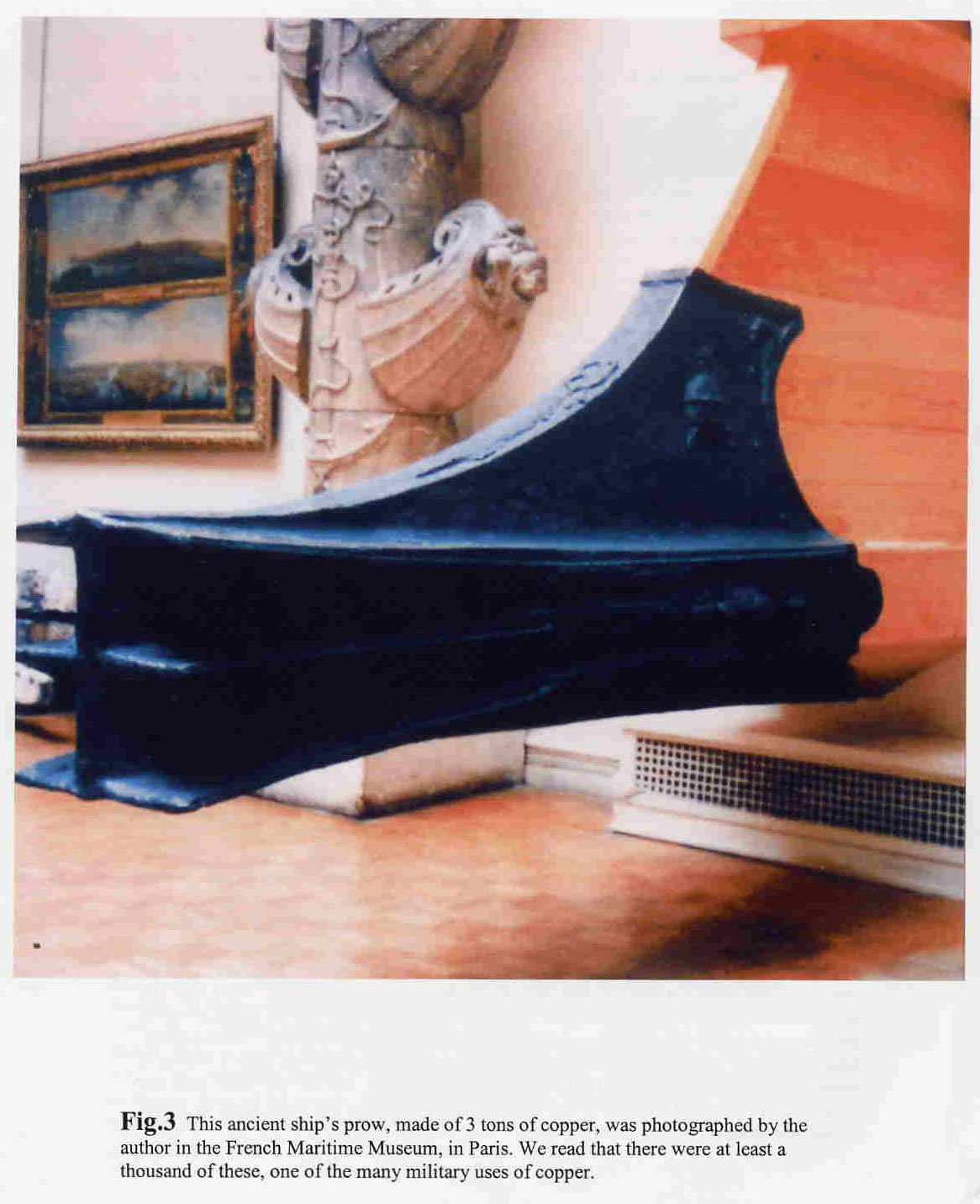
Click for fullsize image
Minoan Traders
A variety of cultural groups were involved in the mining, shipping, and trading of copper, among them the Egyptians, the Megalithic peoples of the western coast of Europe, the Atlanteans, and the Minoans. The Minoans have the reputation of controlling the copper trade in the Eastern Mediterranean. “It is in the New Palace period in Bronze Age Minoan Crete, that we find a large increase in population, particularly in settlements along the coasts, the growth of towns, which in some cases surround mini-palaces, luxurious separate town houses at palatial and other sites, and fine country villas…Villas and houses at Ayia Triadha and Tylissos contained not only weights and loom weights, but also copper oxhide ingots and Linear A tablets, and both are rich in luxury products and bronze objects. Minoan prowess in metal weapon production was not limited to the long sword, but included the short sword, the solid long dagger and the shoe-socketed and tube-socketed spearhead and arrowhead, all of which may have made their first Aegean appearance in Crete”… Neopalatial Crete is extremely rich in bronze, but very poor in sources of copper and of course totally lacking in sources of tin” (Ref.23). The Newberry Tablet of Newberry, Michigan (Fig.6) is in a Cypriot/Cretan sylabary. Cretan script may have been the basis of the Cree sylabary (Ref.7), and Mayan writing (Ref.3).

Click for fullsize image
The “Cavern of Glyphs” on the Ohio River had images of clothed figures that “singularly recall the dress of the Minoans, as seen on the frescoes at Knossos in Crete” (Ref.79). A Minoan pot has been unearthed in Louisiana. The Olmecs laid mosaic tiles at La Venta, (Mexico) upon asphalt, the same technique used in Crete (Ref.3). The excavation of the wealthy grave goods at Hallstatt (see Fig.5) show that traders brought Minoan pots as well as copper/bronze pots to trade for salt.

Click for fullsize image
It appears that the ruling elite of Hallstatt were among the end customers of Michigan copper, as well as the Egyptians.
References
- 1. Drier, R.W., Du Temple, O.J., Prehistoric Mining in the Lake Superior region, A Collection of Reference Articles, reprinted privately January 2005, #367
- 2. Davies, W.V., Catalogue of Egyptian Antiquities in the British Museum, VII, Tools and Weapons, Axes, British Museum Publications, London, 1987 (ISBN 0 7141 0934 7)
- 3. Bailey, J., Sailing to Paradise, The Discovery of the Americas by 7000 BC, Simon & Schuster, New York, 1994, (ISBN 0-684-81297-5)
- 4. Rydholm, C.F., Michigan Copper, The Untold Story, A History of Rediscovery, Winter Cabin Books, Marquette, 2006 (ISBN 0-9744679-2-8)
- 5. “Michigan’s Copper Country, The History of Copper Mining in Michigan’s Upper Peninsula, featuring cooperating sites of the Kaweenaw National Historical Park”, The History Channel, DVD, www.keweenawvideo.com
- 6. TerHaar, C., “Isle Royale Impressions, Video DVD of the Wildlife, Moods, and Scenery of Isle Royale National Park, set to Music”, Mackinac Scenics, 803 Islington Rd., Cedarville, Mi 49719, 2004
- 7. Jewell, R.J., Ancient Mines of Kitchi-Gumi, Cypriot/Minoan Traders in North America, Jewell Histories, Fairfield Pa., 2nd Ed, 2004 (ISBN 0-9678413-3-X)
- 8. Scott, D.A., and Meyers, P., Archeometry of Pre-Columbian Sites and Artifacts, The Getty Conservation Institute, Los Angeles, 1994, (ISBN 0-89236-249-9)
- 9. O’Brien, W., Bronze Age Copper Mining in Britain and Ireland, Shire Publications Ltd., Buckinghamshire, 1996 (ISBN 07478 0321 8)
- 10. Scheel, B., Egyptian Metalworking and Tools, Shire Publications Ltd., Aylesbury, 1989 (ISBN 0 7478 0001 4)
- 11. Martin, S.R., Wonderful Power, The Story of Ancient Copper Working in the Lake Superior Basin, Wayne State Univ. Press, Detroit, 1999 (ISBN 0-8143-2843-1)
- 12. Trevelyan, A.M., Miskwabik, Metal of Ritual, Metallurgy in Precontact Eastern North America, U. Press of Kentucky, Louisville, 2004 (ISBN 0-8131-2272-4)
- 13. Childress, D.H., Lost Cities of Atlantis, Ancient Europe & the Mediterranean, Adventures Unlimited Press, Stelle, Ill., 1996 (ISBN 0-932813-25-9)
- 14. Taylour, L.W., The Mycenaeans, Thames & Hudson, 1964 and 1983, New York (ISBN 0-500-27586-6)
- 15. Milner, G.R., The Moundbuilders, Ancient Peoples of Eastern North America, Thames and Hudson, London, 2004, (ISBN 0-500-28468-7)
- 16. Burgess, C., The Age of Stonehenge, Castle Books, Edison, N.J.,1980-2003 (ISBN 0-7858-1593-7)
- 17. De Jonge, R.M., and Wakefield, J.S., How the SunGod Reached America c.2500 BC, A Guide to Megalithic Sites, MCS., Kirkland, Wa. 2002 (ISBN 0-917054-19-9)
- 18. Whittlesey, C., Ancient Mining on the Shores of Lake Superior, Smithsonian Contributions to Knowledge, 1862, reprinted 2007 Gustavs Library, Davenport Iowa, no ISBN
- 19. Henderson, J., The Science and Archaeology of Materials, An Investigation of Inorganic Materials, Routledge, New York, 2000, (ISBN 0-415-19934-4)
- 20. Halsey, J.R., Miskwabik – Red Metal, The Roles Played by Michigan’s Copper in Prehistoric North America, Michigan Dept of State, no date, publisher, or ISBN
- 21. Dickinson, O., The Aegean Bronze Age, Cambridge University Press, New York, 1994 (ISBN 0-521-456649)
- 22. Schertz, J.P., Old Water Levels and Waterways During the Ancient Copper Mining Era (about 3000 BC to 1000 BC), 1999, no ISBN
- 23. Gale, N.H., Bronze Age Trade in the Mediterranean, Papers Presented at the Conference held at Rewley House, Oxford, 1989, /Studies in Mediterranean Archaeology Vol.XC, Paul Astroms Forlag, 1991, no ISBN, Weiner, M.H., “The Nature and Control of Minoan Foreign Trade”
- 24. Isle Royale National Park, National Geographic Trails Illustrated Map, www.nationalgeographic.com/maps
- 25. Griffin, J.B., Lake Superior Copper and the Indians: Miscellaneous Studies of Great Lakes Prehistory, Anthropological Papers, Museum of Anthropology, University of Michigan No.17, Ann Arbor, 1961
- 26. Rothenburg B., Tylecote, R.F., Boydell, P.J., Chalcolithic Copper Smelting, Excavations and Experiments, Archaeo-Metallurgy/ Number One, Institute for Archaeo-Metallurgical Studies, London, 1978,(ISBN 0 906183 00 6)
- 27. Huber, N.K., The Geologic Story of Isle Royale National Park, Formerly U.S. Geologic Survey Bulletin 1309, 1983-1996, Isle Royale Natural History Association, Houghton, Mi (ISBN 0 932212-89-1)
- 28. Barber, M., Bronze and the Bronze Age, Metalworking and Society in Britain c.2500-800 BC, Tempus, Gloustershire, 2003 (ISBN 0-7524 2507 2)
- 29. Moore, C.N., Bronze Age Metalwork in Salisbury Museum, Salisbury and South Wiltshire Museum Occasional Publication, 1972, no ISBN
- 30. Gore, R., “Men of the Sea, A Lost History, Who were the Phoenicians?, National Geographic, October 2004, nationalgeographic.com/magazine
- 31. Wood, D.J., “Bronze Age Michigan” a final of 3 parts, Ancient American, Vol.8, no.51, pg.21
- 32. Rydholm, F., “Old World Copper Miners of Ancient Michigan”, The Barnes Review, July/Aug, 2002 Vol.VIII, No.4, pg.37
- 33. “Missing Link Discovered”, Ancient American, Issue #12, pg.14
- 34. Carter, G.F., and Razi, H., “Chemical Composition of Copper-Based Coins of the Roman Republic, 217-31 BC”, American Chemical Soc, Advances in Chemistry Series 220, Archaeological Chemistry IV, 1989, pg. 213
- 35. Gale, N.H., and Stos-Gale, Z.A., “Bronze Age Archaeometallurgy of the Mediterranean: The Impact of Lead Isotope Studies”, American Chemical Society, advances in Chemistry Series 220, Archaeological Chemistry IV, 1989, pg.160
- 36. Great Lakes, National Geographic Society, 1987
- 37. Ozment,K., “Journey to the Copper Age”, National Geographic, Vol. 195, No.4., April 1999 pg.70
- 38. Marquis, A.L., “Fighting Gravity, Saving What Remains of Michigan’s 19th Century Copper Industry”, National Parks, winter 2009, pg. 14
- 39. Carter, L.D., and Cheesman, P.R., “Michigan’s Mound Builders, Historical Background of the Soper-Savage Collection of Inscriptions and Photographs”, Ancient American, Issue #53, pg.2
- 40. Avery, R., Copper Country –God’s Country, Avery Color Studios, 1973, no ISBN
- 41. Pleger, T.C., “The Old Copper Complex of the Western Great Lakes”, 2000, www.fox.uwc.edu/depts/tpleger/oldcopper.html
- 42. Viegas, J., “Ancient Metalworking Recreated”, April 2005, www.disc.discovery.com/news/briefs/2005050425/metalworking.html
- 43. Wagner, H., “Wiconsin’s Ancient Copper Miners”, From Wisconsin Outdoor Journal, Ancient American, No. 75
- 44. Stos-Gale, Z.A., Maliotis,G., Gale, N.H., and Annetts, N., “Lead Isotope Characteristics of the Cyprus Copper Ore Deposits Applied to Provenance Studies of Copper Oxhide Ingots”, Archaeometry, Vol.39, Issue 1 Feb 1997, Pg.83-123
- 45. Ackley, J., Strauss Center for Conservation, Harvard Univ. Art Museums, personal email re: Knapp, S., “Mystery in Bronze”, Dartmouth Life, Pg.4, April 2003
- 46. Freeman, A.M., “Copper Artifacts: Correlation with Source Types of Copper Ores”, Science, Vol. 152, 1996, pg 1504
- 47. Hancock, R.G.V., Pavlish, L.A., Salloum, R.M., Fox, W.A., Wilson, G.C., “Distinguishing European Trade Copper and North-Eastern North American Native Copper”, Archaeometry 33, 1991 69-86
- 48. Fitzgerald, W.R., Ramsden, P.G., “Copper Based Metal Testing as an Aid to Understanding Early European- Amerindian Interaction: Scratching the Surface”, Canadian Journal of Archaeology, Vol.12, 1988
- 49. Martin, S.R., “The State of Our Knowledge about Ancient Copper Mining in Michigan”, The Michigan Archaeologist, 31 (2-3):119-138
- 50. Guerra, M.F., “Analysis of Archaeological Metals. The Place of XRF and PIXE in the Determination of Technology and Provenance”, X-Ray Spectrometry, Vol.27, 73-80, 1998
- 51. Budd, P., “Seeking the Origins of Bronze Tools”, British Archaeology, No.36, July, 1998: Features
- 52. “Uluburun Shipwreck”, http://uluburun-shipwreck.area51.ipupdater.com/
- 53. Rapp, G. Jr., Allert, J., Hendrickson, E., “Trace Element Discrimination of Discrete Sources of Native Copper”, American Chemical Society, 14, pg.270-293, 1984
- 54. Hauptmann, A., Maddin, R., Prange, M., “On the structure and Composition of Copper and Tin Ingots Excavated from the Shipwreck of Uluburun”, American Schools of Oriental Research, Bulletin No.328, pgs.1-30, Nov.2002
- 55. Budd, P., Pollard, A.M., Scaife, B., Thomas, R.G., “Oxhide Ingots, Recycling and the Mediterranean Metals Trade”, Journal of Mediterranean Archaeology, Vol.8, Issue 1, 1995 pgs.1-32, ISSN: 0952-7648
- 56. Stos-Gale, Z.A., Gale, N.H., Bass, G., Pulak, C., Galili, E., Sharvit, J., “The Copper and Tin Ingots of the Late Bronze Age Mediterranean: New Scientific Evidence”, Proceedings of the Fourth International Conference on the Beginning of the Use of Metals and Alloys (BUMA-IV), The Japan Institute of Metals – Aoba, Japan, 1998, pp. 115-126.
- 57. Salter, C.J., Northover, J.P., Jones, S., “Study of possible Bronze Age copper smelting debris from the Great Orme, Gwynedd, Wales”, Gwynedd Archaeological Trust, Current Research Projects, Oxford Material Science- Based Archaeology Group Index (abstract)
- 58. Ixer, R.A., “The Role of Ore Geology and Ores in the Archaeological Provenancing of Metals”, http://www.rosiehardman.com/harvard.htm
- 59. Joel, E.C., Sayre, E., Vocke, R., “Statistical Evaluation of the Lead Isotope Data on Geological Ore Samples from Western and Central Europe”, Smithsonian Center for Materials Research and Education, SCMRE Research Report FY 1993: Historical Archaeology, http://www.si.edu/scmre/about/93histarch.htm
- 60. Srinivasan, S., “The Use of Tin and Bronze in Prehistoric Southern Indian Metallurgy”, JOM, July, 1998
- 61. Ancient Cyprus Web Project, Bibliographies: Metallurgy 1990s, http://www.ancientcyprus.ac.uk/bibliographies/metal90.asp
- 62. Cherry, J.F., “Economy & Trade in the Later Bronze Age Aegean and East Mediterranean, Graduate Seminar, http://proteus.brown.edu/bronzeageeconomy/Home
- 63. Goodway, M., “Metals in Antiquity”, Smithsonian Center for Materials Research and Education, http://www.socarchsci.org/bulletin/9809/9809q.htm
- 64. Arch-Metals Archaeo-Metallurgical Bibliography, http://usersox.ac.uk/~salter/arch-metals/met-bib-ak.htm
- 65. Bass, G.F., and Pulak ,C., “Bronze Age Shipwreck Excavation at Uluburun”, http://ina.tamu.edu/ub_main.htm
- 66. Budd, P., “Seeking the origins of bronze tools”, British Archaeology, No.36, July 1998 Features
- 67. Viegas, J., “Ancient Metalworking Recreated, Ancient Metalworkers Burned Out of History”, Discovery News, http://dsc.discovery,.com/news/briefs/20050425/metalworking.html
- 68. Friedman, A.M., Conway, M., Kastner, M., Milsted, J., Metta, D., Fields, P.R., Olsen, E., “Copper Artifacts: Correlation with source Types of Copper Ores”, Science, Vol 152, 10 June 1966, pg 1504-06.
- 69. Cornell, M.F., Prehistoric Relics of the Mound Builders, Battle Creek, Michigan, 1892
- 70. Rapp, G., Copper Project Database, Archaeometry Laboratory, 214 RLB, University of Minnesota, Duluth, 55812
- 71. Halpern, Z., personal email 10/16/2007
- 72. Glascock, M.D., Archaeometry Laboratory, University of Missouri Research Reactor, Columbia, Mo. 65211, [email protected]
- 73. Analytical Chemistry, Tukwila, Wa. 206-622-8353, www.ancheminc.com
- 74. http://www.museum.mtu.edu , www.mg.mtu.edu-district4.gif , www.mg.mtu.edu/hist.htm
- 75. Roach, J., “Bronze Age Factory Discovered in Jordan”, National Geographic News 6/25/2002, http://news.nationalgeographic.com/news/2002/06/0620_020625_metalfactory.html
- 76. May, W., “Missing Link Discovered”, Ancient American, Issue #12, pg.14
- 77. Childress, D.H., Lost Cities of North and Central America, Adventures Unlimited Press, Illinois, 1992, (ISBN 0- 932813-09-7)
- 78. Herrmann, P., Conquest by Man, Harper & Brthers., N.Y., 1954
- 79. Wilkins, H., Secret Cities of South America, 1952, Adventures Unlimited Press, Kempton, Ill, p.291-292.
- 80. Farnoux, A., Knossos, Abrams Inc., (ISBN 0-8109-2819-1)
