




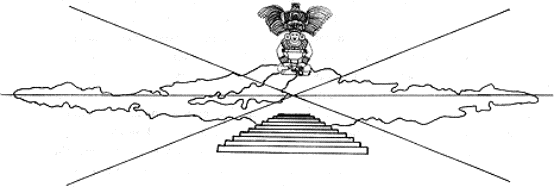
In my book Maya Cosmogenesis 2012, I was able to reconstruct several previously unrecognized concepts in ancient Mesoamerican astronomy. These “cosmo-conceptions” indicate an understanding of complicated astronomical processes; specifically, the ancient Mesoamerican astronomers utilized two different methods for tracking precession. The first was pioneered at the early Maya site called Izapa, and involves the slow precession of the solstice sun into alignment with the bright band of our Milky Way galaxy. The alignment of the December solstice sun with our Milky Way galaxy (incredibly, in the region of the Galactic Center) culminates in the years around 2012-coinciding nicely with the 13-baktun cycle end-date. The alignment is an apparent alignment as viewed from earth, but nevertheless was recognized and encoded into core Maya institutions. As I’ve been able to show through an interdisciplinary analysis of the academic literature, synthesizing material from ethnographic starlore, archaeoastronomy, linguistics, mythology, and iconography, the solstice-galaxy alignment was conceived as the union of the male principle (December solstice sun) with the female principle (the Milky Way’s center). The region of the Milky Way that the solstice sun will unite with contains not only the nuclear bulge of the Galactic Center (which, by the way, is recognizable with the naked eye) but also a “dark-rift” feature caused by interstellar dust. The modern Maya call this dark-rift or Great Cleft the xibalba be– the Road to the Underworld. This feature is the key to understanding the rebirth metaphor of the 2012 end-date, for it was also conceived, in Maya symbology, as the birth canal of the Great Mother (the Milky Way).
The concept of Father Sun being reborn at the end of the age is very similar to the events in Maya Creation mythology (the Popol Vuh) in which First Father / One Hunahpu is reborn in the underworld ballcourt. The ballgame metaphor, too, encodes the alignment. If we look at accepted notions of ballgame symbolism, we learn that it is basically about the rebirth of the sun on the temporal levels of day, year, and World Age. The sun is reborn daily at dawn, yearly at the December solstice, and, in terms of World Ages, on December 21, 2012-when the December solstice sun aligns with the Galactic Plane, which is the precession cycle’s “finish line.” The dark-rift that lies along this plane is the “goal” toward which the December solstice sun, as the gameball, moves over many millennia. In this way, the Maya conceived of the gameball going into the goalring as a replication of cosmic time’s end-game. Finally, yet another way that the solstice-galaxy alignment was encoded into basic Maya institutions involves King accession rites. Here, the king, as a shamanic journey, must be initiated into kingship my journeying into the “cosmic center”-something Siberian shamans have been doing for a long time. In the Maya tropical lands, however, the cosmic center is not the Polestar but the Galactic Center, identified by the nuclear bulge- the womb of the Milky Way mother toward which the “sun king” precesses. Precession reveals the king’s slow procession to ultimate enthronement in the heart of time and space. But for the sake of kingship in local space-time, he makes an initiatory vision journey into the celestial heart to be anointed and given the power of rulership and sacred knowledge.
This is the core of how the solstice-galaxy alignment of 2012 was encoded by ancient Maya thinkers into their basic institutions. In my book I call this end-date idea-complex “the Galactic Cosmology.” Please be aware that I’m paraphrasing material that is fully documented in my book. This is a ridiculously brief, in-a-nutshell treatment. All of these ideas are supported by accepted scholarship, as I argue in my book, yet have never been assembled in this way. This is primarily because Maya scholars generally ignore precession, are blinded by specialization, and have never concerned themselves with the galactic alignment. And yet it is the key to understanding not only 2012, but the deep and profound nature of Maya kingship, ballgame ritual and, indeed, the Maya Creation myth itself.
We aren’t done quite yet. Remember, I said that Mesoamerican astronomers utilized two methods for tracking precession. The one we just reviewed involves the Long Count calendar and the Popol Vuh Creation Myth (here we have that old astronomy plus mythology equation). The other system involves the Calendar Round (52 years) and the New Fire ceremony. Again, calendar (astronomy) and myth go together here.
Although this alternate precession-tracking system was developed at Teotihuacan in Central Mexico around 150 AD, it is in the Pyramid of Kukulcan at Chichen Itza that we find its best and most striking encryption. This is not so odd, considering that Tula inherited the traditions of Teotihuacan (especially the cults of Quetzalcoatl and the New Fire ceremony) and brought them to Chichen Itza in the ninth century AD, when the Pyramid of Kukulcan (Quetzalcoatl) was built.
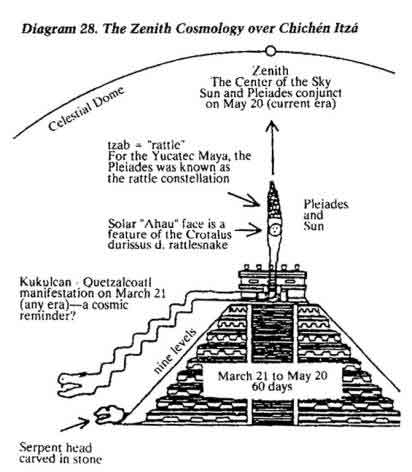 |
| Let’s look at how the Zenith alignment was encoded into the Pyramid of Kukulcan. It’s quite simple but, like a great deal of my reconstruction work, has been ignored. The diagram on the left shows the true importance of the Pyramid of Kukulcan, and how it encodes the precessional alignment of sun, Pleiades, and zenith |
Here’s how it works. Precession can be tracked by noticing the changing rise times of stars. In the tropics, other factors come into play. For instance, within the tropics the sun can pass through the zenith (the exact center of the sky) twice every year. The exact dates depend on one’s exact latitude of observation. For Teotihuacan the first solar zenith-passage date is May 17. The New Fire ceremony occurred at the end of each Calendar Round of 52 years. It was intended to calibrated the movement of the Pleiades into the zenith at midnight. This is the testimony we have from Sahagun’s chronicle. The midnight factor is extremely important, because it indicates the key to understanding this tradition, a key that Maya scholars have not noticed. The Pleiades pass though the zenith quite often, but they pass through the zenith at midnight on only one day every year. And this was the day of the New Fire ceremony: in AD 1507 it was November 14th. Here’s the important connection. The date of the Pleiades’s midnight zenith passage defines an event that always occurs exactly ½ year later: the conjunction of the Pleiades with the sun. Let’s state it again: The midnight zenith-passage of the Pleiades defines the day exactly six months later when the sun and the Pleiades are in conjunction. Why is this important? Well, it’s difficult to know exactly when the sun and the Pleiades are in conjunction, because in fact the Pleiades are lost in the rays of the sun for over six weeks-the conjunction is not directly visible. Also, both the November date (Pleiadian zenith passage at midnight) and the May date (sun/Pleiades conjunction) move forward though the year with precession. By observing the shifting dates of the Pleiades’s midnight zenith-passage in November, Central Mexican astronomers knew the exact date of the sun-Pleiades conjunction in May. The last recorded New Fire ceremony (among the Aztecs, in 1507) occurred on November 14, confirming the fact that the sun and the Pleiades were in conjunction on May 14. But that’s not all. Here’s the clincher: May 14 th is 3 days before the solar zenith-passage date at Teotihuacan. And every 52 or 104 years, the New Fire date (and the implied May date) needed to shift one day forward to adjust for precession. In this process, it was known that the united sun-Pleiades were moving closer and closer to passing through the exact center of the sky, together, in some future era, on May 17. The united sun-Pleiades symbolize the serpent-bird deity Quetzalcoatl, and via precession he slowly flies into his throne in the zenith. Like the solstice-galaxy alignment, this sun-Pleiades-zenith alignment was wrapped up in an eschatological doctrine of the world’s future ending. But the entire timing in this model is subject to one’s latitude, which defines the era of convergence. As mentioned, at Teotihuacan, this zenith-passage date is May 17 (and it always remains the same; it doesn’t shift with precession). As a result, the sun-Pleiades-zenith alignment would have occurred over Teotihuacan in the early 1800s. However, when Tula took Teotihuacan’s New Fire tradition and shifted base camp north to Chichen Itza, they effectively recalibrated their end-date. At Chichen the zenith-passage begins on May 20 th (there’s a six-day range), resulting in a sun-Pleiades-zenith convergence to begin in the 21 st century. Incredibly, this brought the two precession-tracking method into agreement, for the solstice-galaxy alignment also occurs in the 21 st century.
The tangible, visible meaning of this pyramid is widely known, and in fact every equinox thousands of people flock to Chichen to watch a shadow-serpent appear and slither down the stairs of the northern balustrade. But this equinox appearance is not everything that’s going on here. In fact, as marvelous and awe-inspiring as this event is considered to be, the real meaning of the Pyramid of Kukulcan makes this seem superficial. It is, in fact, only a shadow that points at a deeper truth. My decipherment of the true intention of the pyramid’s shadow-serpent dawned when I read that, in the Yucatec Maya language, the word for a snake’s rattle, tzab, is the same word for the Pleiades. In addition, research by Jose Diaz Bolio indicated that some Yucatecan rattlesnakes have a strange little three-dot marking in a circle near the rattle. This symbol was read by Bolio as a solar ahau face, a symbol of the sun. Now, when the serpent shadow appears, if we wish to imagine the snake’s tail, it must pierce the temple on top of the pyramid (the fifth, central direction-the zenith direction) and then it points up into the center of the sky (see diagram). Since the rattle is called tzab (Pleiades) and the three-dot ahau face design is the sun, the symbolism states unequivocally: sun and Pleiades in the zenith. Of course, this alignment doesn’t occur on the equinoxes, but at Chichen Itza it occurs on May 20 th in the 21st century. The point is that the pyramid “points”, with this symbolism, to an astronomical alignment that occurs in a specific precessional era. As such, the Pyramid of Kukulcan is a precessional star clock constructed in stone. Can one imagine anything that compares to this anywhere else on earth? Something that combines architectural alignment to horizon astronomy and snake symbology to state something as specific and profound as a rare alignment in precession? In my view, the Pyramid of Kukulcan is unique. Again, this reconstruction of mine is supported by additional evidence and the skeptical reader should really check out the full argument in my book Maya Cosmogenesis 2012.
These are the main discoveries that I’ve set forth in my book. In addition, a lengthy chapter examines the early site of Izapa, where the Long Count calendar and the end-date alignment cosmology was devised. A brief summary of my discoveries at Izapa is at http://www.alignment2012.com/izapa.html For all the books that have been written on the Maya calendar and its end date, none but mine have looked closely at it place of origin, Izapa. My reading of the site’s alignments and its sixty carved monuments is another story in and of itself, and should be left for another time.
 John Major Jenkins is a Maya scholar and a leading researcher of Maya cosmology, calendrics, mythology, and astronomy. Recognized as a leading voice in explaining difficult areas of Maya thought, and for decoding the true intention behind the Maya calendar’s 2012 end-date, he is the author of dozens of articles and seven books, including Tzolkin (an in-depth reconstruction of the Mayan Venus calendar published by Borderlands in 1994), Mayan Sacred Science (1994), and the groundbreaking Maya Cosmogenesis 2012 (1998).. In 1990, while studying at Metropolitan State College, John began publishing his research into unresolved questions in Maya cosmology. He has presented his research at the prestigious Institute of Maya Studies in Miami, the Maya Calendar Congress in Merida, Mexico, the 4 th International Mayan Dreamtime Festival in Glastonbury, England, and has taught at the Esalen Institute and Naropa University in Boulder, Colorado. His work has been featured on The Discovery Channel’s “Places of Mystery” series, and in documentaries such as Earth Under Fire and The Fifth Gate (Milton Media, Denmark).
Reviews of Maya Cosmogenesis 2012:
Building on the pioneering work of de Santillana and von Dechend (Hamlet’s Mill) and Linda Schele (Maya Cosmos), repeatedly testing his own observations at key sites, Jenkins here lays out the impressive results of twelve years of dedicated study and inspired synthesis.
With his better than academic decoding of the mysterious Maya glyphs that incorporate both their colorful mythology and sophisticated astronomy, John Major Jenkins has validated that shamans, with their out-of-body clairvoyance, were responsible for the amazing accuracy of Mayan and other Mesoamerican calendar systems that cover thousands of years of earthly, planetary, and galactic motion. That Mayan deities represent astronomical bodies, as did the pantheons of Egypt and Mesopotamia, is equally validated by Jenkins. His emphasis on the famous Long Count calendar shows that when the rising sun on the December solstice of the year 2012 conjuncts with the Milky Way’s galactic center – or birth canal of the Great Mother of us all – a new age is expected, one in which humanity will mutate spiritually into a new relationship with space-time and the material universe.
In Maya Cosmogenesis 2012, author John Major Jenkins has combined his gift for incisive, mythic and symbolic interpretation with rigorous research, to reveal the Mayan calendar as a world cosmology and spiritual philosophy, firmly grounded in precise observations of celestial patterns and rhythms. According to Jenkins’ in depth yet accessible and often poetic analysis, the Maya had reconciled a number of planetary and sidereal cycles to accurately define the passage of our earth and solar system, as it moves through millennia, in and out of alignment with the galactical core and equator. This vast, celestial conjunction, so central to the Mayan sages and astronomers, holds profound transformative implications for individuals and civilization today.
Meticulously and exhaustively researched, carefully written, this book’s patiently arrived at (but never jumped to) highly original conclusions have both the weight and the ring of that authority found only in the very best scholarship. Unlike other books devoted to decoding the Mayan ‘prophecies’ it also has a potentially happy ending.
The extensive research by John Major Jenkins into the Mayan mysteries is very impressive indeed, and his book will no doubt become a classic in this field of study.Maya Cosmogenesis 2012 is a must read for all those who feel that there is far more to our ancient past than meets the eye.
The basis for Jenkins’ reconstruction is a meticulous search behind the Mayan belief system which led him to deciphering the Hero Twin Myth in the Popol Vuh, the Ball Court symbology, and the Long Count system used to predict the precession of the galactic center. All of this took the Mayan priests many thousands of years to perfect, and a thousand man-hours by Jenkins to understand. . . This is a book with a rich sense of our spiritual evolution that only John Jenkins can state so eloquently.”
With Jenkins’ scholarly effort of comparative calendric research and investigation into Mayan cosmology, we may all ascend to new levels of insight concerning the wealth of coded messages that remain in the Mayan legacy to modern mankind in this age of transformation.
Additional Information
 |
| Maya Cosmogenesis 2012 is available at bookstores everywhere, amazon.com, amazon.uk, or alignment2012.com |
Please take note that my work in identifying the astronomical foundation of the Maya calendar end-date of A.D. 2012 is not “new age.” My work has been to reconstruct the reason why the ancient Maya astronomers chose 2012 to end a vast cycle of time in their calendric system. I have studied, surveyed, and synthesized interdisciplinary scholarship to reach my conclusions, and have followed the strictest standards of reason and documentation. An extensive bibliography of the academic source material used in my work to reconstruct the ancient Maya calendar cosmology can be found at http://Alignment2012.com/bibbb.htm
John Major Jenkins
Denver, Colorado
[email protected]
Maya Calendrics and Cosmology: http://Alignment2012.com/
This essay is copyrighted, all rights reserved worldwide, unless usage rights are otherwise granted. © John Major Jenkins. 2001.