



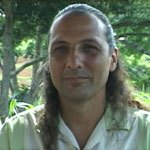

We are very pleased to welcome scientist Nassim Haramein as our February 2011 Author of the Month. Born in Geneva, Switzerland, in 1962, Nassim Haramein from as early as nine years old was developing the basis for a unified hyperdimensional theory of matter and energy, which he eventually called the Holofractographic Universe theory. He has spent most of his life researching the fundamental geometry of hyperspace.
Combining this knowledge with a keen observation of nature, he discovered a specific geometric array that is fundamental to creation. His unification theory, known as the Haramein–Rauscher Metric (a new solution to Einstein’s field equations that incorporates torque and Coriolis effects), and his recent paper “The Schwarzschild Proton” lay down the basis of what could be a fundamental change in our current understandings of physics and consciousness.
In the past 20 years, Mr Haramein has directed research teams of physicists, electrical engineers, mathematicians and otherscientists. He founded a non-profit organisation, The Resonance Project Foundation, where as Director of Research he continues exploring unification principles and their implications.
The foundation is actively developing a research park in Hawai’i which combines science, sustainability and green technology.
Nassim Haramein has been giving lectures and seminars on his theory for more than 10 years.
For more information and to contact Nassim Haramein, visit http://www.theresonanceproject.org.
This article originally appeared in Nexus Magazine.
Exploring the Nature of Reality
Have you ever wondered about the structure of reality? Where did it come from? How did it get here? And how did it self-organise to result in my observing it? These are fundamental enquiries that most people have asked themselves at some point in life. They might have thought of these questions in many different ways, perhaps not exactly as stated above, but most people have wondered about the source of existence, about a beginning and an end or an eternal continuous dynamic.
From an early age, these questions felt to me as most worthy of investigation, and in a certain way my earlier adventures in the various sports industries became tools that I could use to investigate the reality I am in, my interaction with it, and my capacity to modify it or at least push it to the extreme. And to the extremes I pushed it: whether it was skiing, climbing or deep-sea diving, my tendency was to see how far I could push the edge of the structure of reality by my intent and capacity to overcome physical limitations. It was a test of mind over matter, and in every case I felt that a resonance field could be established with the structure of reality— what athletes typically call “the zone”— where, as best I can describe it, I felt a flow, a type of harmony with all the various dynamics I was encountering in these extreme situations.
Whether it was the forces involved, such as gravitational, or the sensations of the material world feeding back information to my body and my body responding to it—such as the fine edge of my ski slicing through an icy surface, or the sensations as the tips of my fingers conformed to sharp crystals while I climbed a thousand-foot rock face—these moments of high communion with nature taught me that there must be a fundamental relationship. I eventually came to describe this as a feedback in the structure of space-time which included this sense of complete integration within the wheelworks of nature that I was experiencing as well as the self- organising properties of the material world which I could clearly observe everywhere in the natural environment where highly organised and complex systems can be found
Yet there was more. My early interest in exploring the more mystical side of our experience led me to investigate the internal world of meditation, a world that is in complete reference to the event of consciousness, of a deep and fundamental self-discovery and exploration of the observer experiencing this reality. Therefore, it was both an external exploration, in which I could push the boundary of my influence on the external world (what one could call the material world), as well as an exploration of how far I could push the boundary of the internal world to identify the source of the observation. And to my great surprise, the two seemed to feed back on themselves. For instance, in those states of “the zone” during peak experiences in sporting events, nature seemed to be speaking to me beyond the receptor sites of my five senses to a deeper, more profound sense, as in a unity between my physicality and the physicality of the world around me. Similarly, in deep meditative states and moments of rapture, a profound sense of unity with the material world around and inside of me seemed to take place. The question then was: what are the mechanics of the apparent feedback between me, the observer, and the material world, and is there a medium that makes the connection between all things possible in order to produce unification?
In order to answer these questions appropriately, I had to conduct, on the one hand, an in-depth study of the physics of our world and, on the other hand, a study of the mores (the customs and ritual practices) of various societies that could reveal a deeper understanding of the relationship between the observer and the material world. In my mind, both were equally important, although the task of studying both in parallel, which encompassed fields ranging from applied physics to cosmology and quantum mechanics as well as archaeology, psychology and spirituality, seemed insurmountable. Therefore, it was with great procrastination and reluctance that I finally abandoned my professional careers in the sports industry to dedicate all of my time and energy to the studies necessary in order to begin answering some of these questions.
This led to a prolonged, isolated period of my life, when I lived in a van with a bare minimum necessary to survive, living the simplest life possible in order to dedicate every second of my day (and many nights) to the study of these various fields. Still, to this day, I consider those times as some of the most wonderful, productive and mystical times of my life. I was completely free—free of telephones, appointments and interactions with the outside world. I was completely free to think whatever I wanted to think, to study whatever I wanted to study and to move wherever I wanted to move, as all I had to do was put the key into the ignition, press on the gas pedal and I was instantaneously relocating. My home was wherever I parked, and I was fortunate enough to be in some of the most beautiful and remarkable natural environments on our planet. From the alpine meadows of British Columbia and Alberta, Canada, to the high deserts of the American Southwest and everything in between, I spent many months in communion with the natural world while in deep contemplation of its physics and of the relationship between this physics and my observations of it.
I continued a routine of physical activities to balance the typical 15 to 18 hours a day I spent studying. At the time, most of my physical activity consisted of rock- climbing, as I would typically start my morning with a sunrise climb after some time meditating or I would get out of the van at sunset for a little fresh air and a quick multi-pitch climb to get my blood flowing. Since I was usually alone, these climbs mostly consisted of free solos (no protective gear) where, once again, I was free from having to worry about companions and their well-being.
At the fine edge of these experiences, where any mistake would surely result in the obvious outcome of a body falling through space being rudely arrested by the ground, I could get into that zone where, however extreme the experience of reality was, there was a complete sense of comfort, a sense of absolute trust, of harmony with all of nature and complete relaxation— and that stuff was addictive. I was in love with nature, and it felt like nature was in love with me.
I distinctly remember moments when my cheek was glued to the face of sheer rock-walls, with the exposure of a few thousand feet unravelling below me, and I was gazing at teeny crystals glistening in the rising Sun and thinking about the molecules and atoms and subatomic particles that make up those crystals. Where did they begin, and where did they end? After all, these crystals I was climbing were part of a larger crystal, a large geode called the Earth, and the Earth was part of a solar system, and the solar system was part of a galaxy, and the galaxy was part of a cluster of galaxies, which was most likely part of a supercluster, and so on. Furthermore, every crystal was made out of millions and millions of molecules, and each molecule was made out of atoms, and these atoms were made out of subatomic particles, and so on. Was it appropriate to think that the Universe ended somewhere, whether on the infinitely large scale or on the infinitely small scale?
These moments often brought on trance-like states in which I would completely lose track of my whereabouts and either dive down the rabbit hole into the molecular structure of these crystals or expand into galactic and universal structures, imagining and contemplating
A Matter of Scale
From the study of the physics I was conducting and from various discoveries I had made in exploring my internal experience, I realised that if we were truly to look for a complete picture of the dynamics and mechanics that produce both the material world and the observer that experiences it, the model would have to be based on an infinite relationship of scales.
I discovered within myself what seemed to be an infinite division of the scales, beyond reconciliation with the concept of a bubble Universe from which everything started with a bang, without any clear understanding of either what produced it or how the material got there to bang in the first place.
I remember being very young, probably about seven, when it was explained to me that the Universe was like a big balloon expanding. My first question to myself was: expanding in what? Surely, if the Universe were expanding, it must be expanding inside another Universe, larger than the one we are in. And then again, if that one were expanding as well, surely it must be expanding in a larger one, and so on. There was no easy solution to the riddle. The only thing that made sense was that the Universe was infinitely large and infinitely small, that we lived in a continuum of divisions, and that our world was defined by the mere fact that we observed the Universe from a very specific scale.
For instance, if you were experiencing the Universe from the scale of an atom or even a subatomic particle, your experience would be widely different from the experience you have of your Universe as a human being. And if I were to grow you from an atom to the size of a human, you would most likely think that you had changed Universes or even changed dimensions (although that would be partially true, as you have literally changed in dimension).
These thoughts had come to me in various ways throughout the years, but how could they be appropriately expressed in physics? Was there any physics already written in our world that indicated such a principle at hand? Furthermore, did these concepts agree with thousands and thousands of years of advanced thinking in philosophy, mysticism and religious belief?
The first clue had come in my teenage years, when I initially realised that for almost 100 years a chasm had existed in our physics between the mathematics and models we use for large objects, which predict a continuum that tends towards singularity and infinities (Einstein’s field equations), and the quantum world of atomic and subatomic particles, which predicts linear functions of bounded states, well defined and with finite behaviours. Yet big things are made out of small things, so how could the Universe use two completely different sets of physics?
How could the Universe be both finite and infinite at the same time? Truly, day-to-day experience seems to point to the existence of well-defined finite boundaries. After all, your body’s dimensions are defined by what appears to be a very specific scale. The same applies to the chair you’re sitting on, or the pole you’re holding onto while you’re reading this article on the bus on your way to work. But wouldn’t an infinite Universe have no definition, no distinct way of identifying a boundary to define all other ones? All of this became the subject of many years of contemplation, and the answer, interestingly, came from an unexpected source.
The Organising Principle of Nature
From my study of ancient civilisations, there seemed to be a persistent, recurring theme, and that theme, to cut to the chase, seemed to have something to do with geometry and some fundamental medium permeating everything, being omnipresent, omniscient and the organising principle of nature. I looked to find if similar concepts were present in our history of physics and the advanced physics of today, and indeed I found similarities.
On the geometric side, for instance, was Einstein’s geometrisation of the structure of space-time. As well, in mathematics, fractal theory resembled many ancient concepts and symbols and provided a perfect relationship between infinities and the boundary condition, as an infinite amount of boundaries could be embedded within a finite initial boundary (the scale at which you are observing). As far as an omnipresent permeating energy was concerned, it occurred to me then that maybe, just maybe, the all-prevailing intensely energetic vacuum of the quantum world might fit the bill.
Maybe the space between all of the molecules and atoms that I was observing on my cliff-face inside the crystal that my hands were so firmly gripping, the space between our planet and the Sun, the space inside our galaxy and the space between galaxies was full instead of empty. Maybe space was permeated with all the information of all things in the space and was the great connector between all these things. After all, from infinitely large to infinitely small, space would always be present, since even the extremely small radius of an atom still contains some 99.99999 per cent space. Perhaps space defined matter, rather than the material world defining the space.
What if matter were only the result of a discrete boundary condition of the space itself, like the feedback iterations that produced the divisions of a fractal? Was the world-space experiencing itself? Were we an extreme extension of the space looking back at ourselves and experiencing matter? Einstein seemed to think so, as in his quote: “Physical objects are not in space, but these objects are spatially extended. In this way the concept ’empty space’ loses its meaning.”
But if space were the great medium that connected all things, gathering information from all places so as to self-organise and create the complexity we observed in our natural world, then space would have to be infinitely dense—infinitely dense with information or energy. Was this possible, and if so, was there any evidence as such? I was probing deeper and deeper into the physics that had been written and into the experiments that had been performed throughout nearly 300 years of modern physical theory, and I came across something significant.
Energy Density of the Vacuum
It seemed that in the quantum world, a difficulty had been encountered when physicists tried to calculate the energy density of an oscillator such as an atom. It turned out that some of the vibrations still existed, even when the system was brought to absolute zero, where you would think that all the energy would be gone. In fact, the equations showed that there was an infinite amount of possible energy fluctuation even within the vacuum.
To understand this better, physicists applied a principle of “renormalisation”, using a fundamental constant to cut off the number and get a finite idea of how dense the vacuum energy must be, with all its vibrations. The cut-off value used was the Planck’s distance or length, named after the great physicist Max Planck, who is considered to be the founder of quantum theory. This value is thought to be the smallest vibration possible, being in the order of 10–33 centimetres and having a mass–energy in the order of 10–5 grams.
The calculations that were done entailed working out how many teeny Planck’s volume vibrations could coexist in a cubic centimetre of space. The answer, since each Planck’s volume had a specific mass, was a mass–energy density that existed in a centimetre cubed of space. The result was enormous! The vacuum energy density, or what can be called a Planck’s density, was in the order of 1093 grams per cubic centimetre of space and was quickly dubbed “the worst prediction physics has ever made” or “the vacuum catastrophe”.
To give you an idea of how dense this value is, if you were to take all of the matter we observed in our Universe today with billions of galaxies containing billions of stars, most of which are much larger than our Sun, and we were to stuff them all into a centimetre cube of space, the density of that cube would only be 10 55 grams. This is still some 38 orders of magnitude less dense than the density of the vacuum. Many scientists thought that this figure was ridiculous, and in general it fell into obscurity. Even today, some trained physicists are not necessarily aware of this value. Throughout the years I’ve received prompt criticism from certain physicists who either were unaware of its existence or simply discarded it, as if the largest energy quantity ever predicted could be completely ignored.
However, the vacuum fluctuations of energy are crucial to our understanding of particle physics at this point, as they are the source of virtual particle creation at the atomic level, which is essential to our current understanding of physics.
More importantly, in 1948 the Dutch physicist Hendrik Casimir calculated and elaborated a configuration that would ultimately allow an experimental validation of this vacuum energy. Casimir reasoned that if two plates were placed close enough to each other so that the longer wavelengths of the vacuum oscillations would be eliminated from between the plates and yet would still be present on the outside of the plates, then a minute gradient could be generated where there would be more pressure on the outside and less on the inside, resulting in the plates being pushed together. However, when the distance by which the plates had to be separated to do the job was calculated, it was found that the plates had to be mere microns apart. This was an impossible task in 1948, and it wasn’t until the early 1990s that this experimental test could be done successfully. The result agreed very well with the calculations done by Casimir, showing that this energy of the structure of space itself is truly present.
So at least the energy was there in the vacuum at the quantum resolution. Could it be the energy that connects all things, the energy from which everything emerges and to which everything returns? Well, if so, it would have to be present at all scales.

That is, there had to be evidence of this energy between stars and galaxies as well. I had studied quite a bit of cosmology by then, and at the time there was zero evidence of this energy being present at the cosmological level.
Nevertheless, I was in a highly creative mode, elaborating on many of the foundations that eventually brought me to form the various scientific papers I have written.
From the sense I was getting from my studies of both ancient civilisations and advanced physics, this vacuum energy could not be completely random. It had to have structure, some kind of geometry, and most likely it was polarised—that is, spin was involved. And it was these thoughts that eventually brought me to add a fundamental force to Einstein’s field equations in order to show that space-time, in addition to curving to produce gravitation, twisted as well—like water going down the drain—to produce the spin of all organised matter from galaxies to stars and even to subatomic particles. That twisting of space would imply that space itself was imbued with gyroscopic and Coriolis effects that needed to be included in Einstein’s geometrisation of space and time. Yet if this torque really was present, then we should be able to detect it at the cosmological level.
I will always remember the day when this confirmation fell into my lap. It must have been around the late 1990s, when I was in Joshua Tree National Park where I liked to spend part of the winter climbing and studying. Typically I would go in and stay for weeks at a time before my supplies ran out and I would have to come out again to get a little bit of shopping done. My budgets were quite restricted (on average, $3,000 a year), so I would buy a very minimal amount of food (I mostly lived on prana—vacuum energy) but almost every time I would buy popular science magazines to keep in touch with the latest scientific discoveries.
So on a beautiful morning after one such expedition the night before and then after my ritual climb, I sat on the edge of the stairs of my van and opened what I recall was an issue of Astronomy magazine. And there it was: astronomers had found evidence that the Universe was not only expanding, but was also accelerating as it did so.
This discovery produced a large amount of controversy at the time, and most theorists agreed that the best approach to deal with this anomaly was to reinstate a constant that was first used by Einstein. He had added this fudge factor, called the cosmological constant, in his early mathematical expressions to make the Universe static (which was believed to be the case at the time). It was later removed when astronomer Edwin Hubble discovered that the Universe was expanding, as Einstein’s equations would predict, without the fudge factor. Now astronomers reinstated the cosmological constant in such a way as to make the Universe accelerate as it expanded. The fudge factor was back. This eventually was dubbed “dark energy”, and it wasn’t until very recently that it started to be associated with the vacuum energy. For me, however, that was an easy and obvious leap, as I had already expected that the polarised Coriolis dynamics of the vacuum structure would produce such an effect on the universal expansion and rotation.
So the vacuum energy was there at all scales, although in various densities—a gradient in the structure of space itself. Was the vacuum dividing at specific densities from extremely large to extremely small? And if the vacuum energy was essentially infinitely dense, and all scales contained vacuum—since even the atom itself (as we saw earlier) contains a large percentage of vacuum—then each of all the atoms inevitably contained enough mass–energy to be considered a black hole. The Universe had to be black holes, from all the way up—the Universe that we’re in, for example—to all the way down. With this concept, I eventually coined the term “black whole”
A Black Hole Universe
While pursuing various readings at the time and looking at the currently accepted mass of our Universe, I realised that the Universe as a whole obeyed the condition that described a black hole. Later on, with the help of Dr Elizabeth Rauscher and afterwards Dr Michael Hyson, we developed various scaling graphs that supported the concept of a fractal black hole Universe.
Remarkably, after some 20 years of being almost alone in thinking that we may live in a black hole Universe, and in the middle of writing this article, popular science reports appeared that elaborated on the research of a physicist at Indiana University. The first sentence of the university’s communiqué asks: “Could our universe be located within the interior of a wormhole which itself is part of a black hole that lies within a much larger universe?” 1a–b
But could an atom, or the nucleus of an atom, be considered a black hole? I didn’t know, and it was not until the year 2003 that I finally got to working out the calculations to make such a prediction.
At the time, I was living on the Big Island of Hawai’i and my daily routine started at sunrise with an encounter with the creatures of the ocean, usually wild dolphins, spinner dolphins in particular. The sensation of gliding in the ocean and the vorticular spinning hydrodynamics of the water around my body often reminded me of our daily “swim” through the vacuum structure and the Coriolis dynamic that was part of my views of the physics of creation.
It occurred to me that a certain percentage of the mass–energy of the vacuum must be contributing to the energetic event that we call the nucleus of an atom. I called Dr Rauscher right away and discussed the simple calculations that would tell us how much of the vacuum energy was necessary for a proton (the particle at the nucleus of an atom) to be in the Schwarzschild condition, the condition of a black hole. It took a remarkably small amount of the energy of the vacuum to do the job, but what was notable was that the energy it took was equivalent to the energy necessary to produce the force typically described as the strong nuclear force, or the strong force.
The strong force has always bothered me because, as in many other instances in modern physics (such as with dark energy and dark matter), the force had been simply invented, plucked out of thin air. When it was found that the protons were highly charged but confined to a very small radius in the nucleus of an atom, physicists went on to invent a force that would overcome the repulsion of the electrostatic fields of these particles, and they made it exactly what it was needed to be to do the job. Eventually it was found that the proton seemed to have smaller constituents within it called quarks, which were confined in an even smaller space, and so the colour force had to be invented and was thought to be infinitely strong. Now the original strong force was seen as only a remnant of this colour force.
From my point of view, the infinitely strong nuclear force was the result of the gravitational attraction of mini–black holes and it was extremely confirming to find that, when one considered the proton as a black hole, the energy necessary to make it such an entity was the energy typically associated with the strong force. Furthermore, although these calculations were very rough at the time, as we were scribbling on pieces of paper and napkins, it seemed that the Schwarzschild proton, as I came to call it, nicely predicted certain measured values of the proton entity. This was, and still is, a radical idea—although more and more physicists are coming to these conclusions now. Imagine all of the atoms that make up your physical body and the entire material world around you, made out of mini–black holes the size of a proton.
Although these initial calculations were somewhat conclusive, it took until 2008 before a first version of the calculation was published in one of our papers entitled “Scale Unification: A Universal Scaling Law for Organized Matter”. A more complete version entitled “The Schwarzschild Proton” was eventually presented at a scientific conference in Belgium in 2009, where it won a “Best Paper Award”, and is to be published this year
Reflections on a Revolution in Physics
Post Office Box 764
Holualoa, HI 96725, USA
Email: [email protected]
Website:
http://www.theresonanceproject.org/
We live at a remarkable time. It is a time of great changes, including fundamental changes in our understanding of the physics of our world and its relationship to consciousness. There is a quiet revolution occurring in physics that will modify our understanding of the atomic structure, as many other researchers are now starting to realise that atoms may be considered as mini–black holes 2a–d and that the vacuum structure may be a crucial player in the existence of our world.
Why is this exciting? Because if we understand the source of energy that generates our Universe, its forces and the mechanics under which the creation process occurs, then we can reproduce these dynamics with advanced technological means and completely transform our relationship to nature. Such discoveries will change our world from a society which believes that there are only limited amounts of resources and available land—and then wars fought over them—to a society which realises that there is an infinite amount of energy all around and within us, and a whole Universe to explore with the means literally to reach for the stars.
However, we don’t need to wait for these advances to start to transform ourselves and our environment. We need only take a few moments every day to connect with the infinite potential present at the centre of our entire material world, which makes up our existence, and experience its infinite nature and beyond.
Endnotes
- 1a. “Our universe at home within a larger universe? So suggests IU theoretical physicist’s wormhole research”, Indiana University press release, 6 April 2010, http://newsinfo. iu.edu/news/page/normal/13995.html
- 1b. Poplawski, Nikodem J., “Radial motion into an Einstein–Rosen bridge”, Physics Letters B 2010 Apr 12; 687(2-3):110-113
- 2a. “Could the Universe Be Made Up of Mini Black Holes? Two Leading Experts Say ‘Yes'”, The Daily Galaxy, 7 April 2010, available at http://tinyurl.com/y2p7lpe
- 2b. Coyne, D.G. and D.C. Cheng, “A Scenario for Strong Gravity in Particle Physics: An alternative mechanism for black holes to appear at accelerator experiments”, at http://arxiv.org/ftp/arxiv/papers/0905/ 0905.1667.pdf
- 2c. Holzhey, C.F.E. and F. Wilczek, “Black Holes as Elementary Particles”, Nuclear Physics B 1992 Aug 10; 380(3):447-77, at http://arxiv.org/abs/hep-th/9202014v1
- 2d. Oldershaw, R.L., “Hadrons As Kerr–Newman Black Holes”, Journal of Cosmology 2010; 6:1361-74, at http://arxiv.org/abs/astro-ph/0701006
You said that you mostly lived on prana, that’s so interesting because I always wanted to be able to feed on it as Jesus did.
Really digging how you connect ancient rituals to the brain’s capacity to go beyond perceived limits—makes me wonder if we’re just limited by our own narratives.