




Journey of the Serpent People


Mirrors of Orion


Star Shrines and Earthworks of the Desert Southwest


The Kivas of Heaven


Eye of the Phoenix


The Orion Zone


Gary David has been intrigued by the Four Corners region of the United States since his initial trip there in 1987. The following year he spent six months examining rock art and indigenous ruins in northern New Mexico. This prompted a move to Arizona In 1994, where he began an intensive study of the ancestral Pueblo People (sometimes misnamed the Anasazi) and their descendants the Hopi.
In late 2006 after more than a decade of independent fieldwork and research, his nonfiction book The Orion Zone: Ancient Star Cities of the American Southwest was published by www.adventuresunlimitedpress.com. This describes a pattern of Hopi villages and ruin sites that precisely mirrors Orion, with an ancient site corresponding to each major star in the constellation.
The sequel, also published by Adventures Unlimited Press (2008), is titled Eye of the Phoenix: Mysterious Visions and Secrets of the American Southwest. The book deals with diverse topics: the Ant People, Snake People, Dog Star People, Sedona Sanskrit, Arizona Knights Templar Crosses, Reptilian Round Towers, Frontier Freemasonry, Meteor Crater, Hopi Kachinas, Stone Tablets and the End Times.
His articles have appeared in Fate (see beginning of article at: www.fatemag.com/issues/2000s/2007-01article2.html), World Explorer, Atlantis Rising, Ancient American, and Four Corners magazines. He has been interviewed on national radio programs and has given presentations extensively.
Mr. David earned a master's degree in English literature from the University of Colorado and is a former adjunct professor. He is also a poet, with numerous volumes published. In addition, he is a professional musician, publisher of Island Hills Books (an online showcase for the literature inspired by the spirit-of-place, http://islandhills.tripod.com), and executive director/webmaster for www.theorionzone.com.
Gary, his wife, and two cats live in rural northern Arizona, where the skies are still relatively pristine.
What People Are Saying About His Work:
"Gary David's work is a treasure of enormous importance. He draws us deep into the mystery of Arizona and deeper still into the lost secrets of ancient cosmology. The truth behind the myths and symbols he's uncovering has the power to unify us, just as the Hopi prophesied." –
"The Orion Zone is an extensively researched study of archaeological evidence, historical accounts, and the oral traditions of the Hopi peoples of the American Southwest. Readers interested in astro-archaeology or in pre-Columbian America will find a great deal of thought-provoking material here, along with citations for further study." –
In his book Eye of the Phoenix, Gary David's "…analysis of Hopi cosmology is instructive. Noting their relationship with "Star People", coverage of the "Starchild" skull, UFOs and "Ant People" is thus part of the territory. Completing his discussion of the Hopi worldview, David looks at their prophecies about the progression of worlds and the signs leading to the next End Time in our era-signs that we'd be wise not to ignore. An atmospheric, inspiring book." –
"I have examined the Arizona-Orion ground-sky relationship, and I must say that I find this work intriguing. It is worth pursuing to the very end." –
"The correlation Mr. David makes between the Hopi and the Egyptian 'sky view' is most interesting." –
More articles
The Orion Zone: Ancient Star Cities of the American Southwest by Gary A. David, 17 February 2006
From late 1966 though late 1967 the small town of Point Pleasant, West Virginia along the Ohio River was terrorized by a series of sightings of an uncanny creature that became known as Mothman. He was typically described as a broad-shouldered black or gray humanoid at least seven feet in height with moth-like wings that extended about ten feet. His glowing red eyes seemed to have a hypnotic effect. Sometimes the creature appeared headless, with his round, reflective eyes set down in his shoulders.
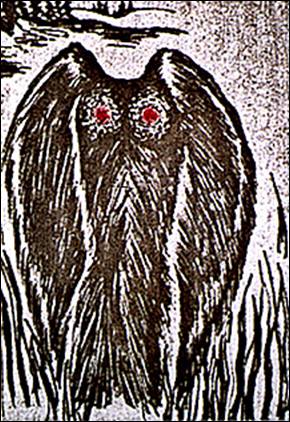
Artist's sketch of one variation of Mothman.
The eerie entity would reportedly swoop down on people or cars and chase them at very high speeds. Sometimes it would suddenly shoot straight up in the air and completely disappear. The same period saw increased sightings of luminous balls or other UFOs and unexpected appearances of Men In Black.
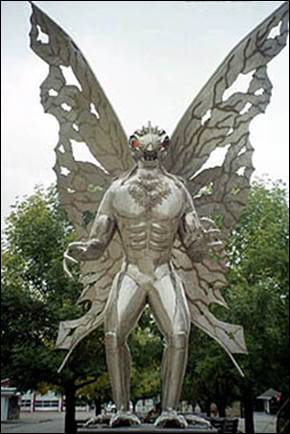
This 12-foot-high, stainless steel statue of the Mothman located in Point Pleasant, West Virginia was created by artist Robert Roach.
Were all these sightings of Mothman and other anomalous incidents just a weird precursor to the brief psychedelic era in popular culture when hallucinations became the norm? Or are there precedents for this phenomenon in the distant past?
Cut to the high plain of central New Mexico in about the middle of the 14th century. On the western bank of a turbulent, muddy river we see a flat-topped pyramid where a bizarre ritual is taking place. It involves a ring of elders wearing feathered headdresses, geometric medallions, white sashes, and brightly painted capes. Some are holding round shields and eagle-talon staffs.
At the center stands a tall being with the gray wings and coiled proboscis of the night flying hawk moth. One of the elders raises a woven plaque heaped with tiny yellow and black seeds and brown spiny pods. The participants begin to eat the seeds, while low chants punctuated by a lone cottonwood drum rise into the endless desert night.
An uncertain period passes as dizzy heads spin in swirling silver smoke. The creature then extends his massive wings and rockets high above the lone pyramid. He soars over whispering cornfields and circles the bulwark of the pueblo. Suddenly in a burst of purple light the Mothman disappears into gauzy clouds while moths flutter gently over jimsonweed blossoms glowing ghostlike in silent moonlight.
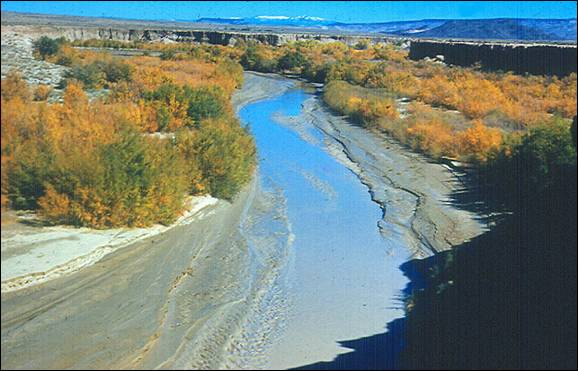
The eroded cutbanks of the Rio Puerco in central New Mexico.
Located about 12 miles southwest of the modern town of Los Lunas is the ancient village where this ritual took place. Archaeologists know it as Pottery Mound, named for the profusion of polychrome potsherds. In fact, a greater variety of pottery styles were found there than at any other spot in New Mexico, with culturally distinctive ceramics coming from the Zuni and Acoma regions to the northwest and the Hopi region even farther northwest. About 90 percent of the pottery retrieved from the site is non-utilitarian or decorative, so in its heyday the place was probably a major ceremonial center.
Frank C. Hibben, the head archaeologist who initially excavated the site, writes: "The Rio Puerco Valley at the site of Pottery Mound is wide and almost level. In the whole region there is no place where a flat-topped structure of even modest dimensions would appear more imposing than at this spot. It is easy to see why the original builders constructed a pyramid there. " [1]
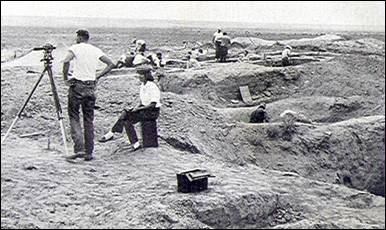
The pyramid itself, technically called a 'platform mound', was constructed of puddled adobe and trash fill. As Hibben suggests, it must have dominated the expansive landscape, although it once rose only about 13 feet above the plain. Its sloping sides were originally coated with a smooth caliche surface. The mound was built on two levels with the upper one covering about 215 square feet.
Surprisingly, three pueblos, each three or four stories high, had been constructed at different times -one above the other- on top of the pyramid, with additional buildings extending down the sides and around the base. Perhaps these were added at a later stage. Also unearthed were four plazas and 16 rectangular kivas (subterranean ceremonial prayer-chambers) that were roughly 30 by 30-some feet in size plus one round kiva 22 feet in diameter.
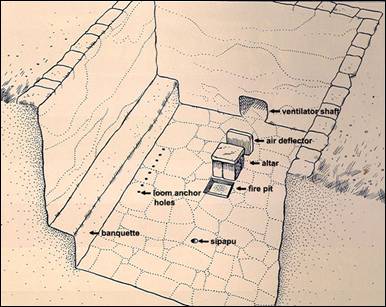
Typical kiva at Pottery Mound. The access was via a ladder through an overhead hatchway. Colorful murals (described below) covered all four walls. The sipapu (hole in the floor) is conceptualized as a portal to the underworld.
The flat-topped structure was similar to those found in Mexico, especially at the major settlement of Paquimé (also called Casas Grandes) in Chihuahua. It may even have had an affinity to the larger stone pyramids farther south, for which the Toltec, Maya, and Zapotec are renowned. A sunken edifice that looks like a ball court located just south of the mound also points to Mesoamerican influences.
The most spectacular feature of Pottery Mound, however, is not either the pyramid or the pottery. Instead we find the walls of every kiva covered with lavishly painted murals depicting a variety of social and spiritual motifs.
Rock art expert Polly Schaafsma defers in this case to the subtler visual medium by stating that these murals were essentially the "apex of Pueblo art":
"The mural art consists of bold, dynamic design layouts adapted to the entire wall surface. Border and framing lines are often used to break up the wall surface, or the whole wall may be treated as a single, unbounded, integrated composition. Subject matter consists of ceremonial and ritual themes into which elaborately attired humans, animals, birds, and abstract designs are incorporated. Shields, feathers, baskets, pots, jewelry, textiles, miscellaneous ceremonial items, food, and plants are also pictured. While this is a highly meaningful art, full of graphic portrayals and symbolic content, it is, at the same time, very decorative. Colors are highly varied and sensitively juxtaposed. Areas of flat solid color contrast with those broken into intricate patterns or bold designs." [2]
One of the most striking aspects of murals is the variety of brilliant colors: eight shades of red, three of yellow, two of green, two of blue, as well as purple, lavender, maroon, orange, pink, salmon, white, gray, and outlines of black. From three to 38 layers of plaster, each one providing a visual space for the paintings, were found on the kiva walls. Thus, the total prehistoric murals numbered about 800!
Some murals seem to have been plastered, painted, and then re-plastered after just a couple days when their ritual purpose had been fulfilled. This practice is similar to the destruction of Navajo sand paintings or Tibetan mandalas, which form a crucial part of a given sacred ceremony but are no longer needed when it is concluded.
Among the plethora of images are non-indigenous green parrots and scarlet macaws, which also suggest a wide trade network with Mexico. One fresco even depicts a jaguar and an eagle, which may refer to the ancient Mexican jaguar-eagle cult. Another shows a rattlesnake superimposed on an "eagle-man." Just add a cactus and you'd have the traditional symbol for Mexico.
One disturbing image shows an unfortunate man painted purple with a red equilateral, outlined cross on his chest being eaten by a horned serpent with sharp teeth and a feathered ruff. This creature is, of course, the archetypal plumed serpent Quetzalcoatl, also called Awanyu by the ancestral Puebloans of New Mexico. Another mural shows a horned serpent with a zigzag body cradling a four-pointed star with a circular face at the center. This star-face (which, by the way, is frowning) supposedly signifies a "soul-face," possibly the soul of a warrior killed in battle. (See painting below.)

Some of the most unusual murals, however, are those that depict what we call today the Mothman. One shows the creature with a red body, white sash, black kilt with geometric designs, and a red headdress. His translucent wings are crosshatched and painted with a few lavender spots. One wing's lower edge has three red spots on a white jagged background.
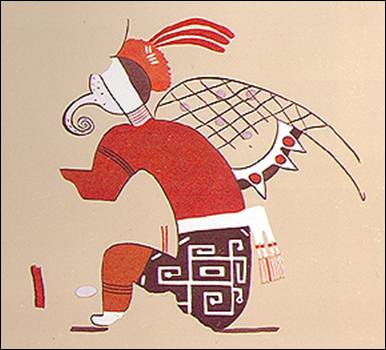
Mothman mural
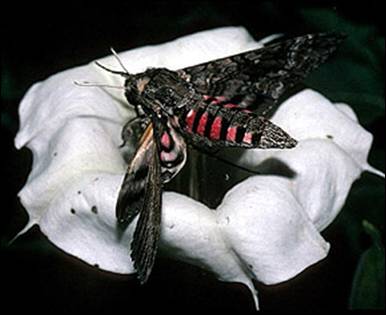
Pink-spotted hawk moth on a jimsonweed bloom
The other figure in basically the same pose has a yellow body and a brown and yellow headdress. This one has star symbols on his wings and a couple of dragonfly symbols beneath him. With his left hand he is grasping a lightning bolt emanating from a bowl balanced on a maiden's head. (She is not seen in this picture, but she is, by the way, holding a macaw in each hand.) Both of the Mothman figures have a coiled or curved proboscis.
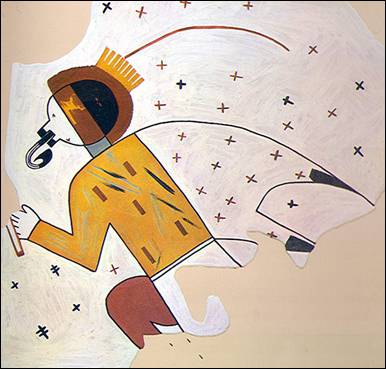
Another Mothman mural
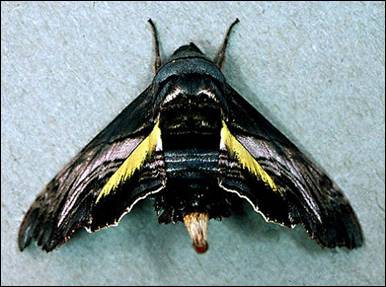
Sphinx moth
What prompted the depiction of this strange insect-human hybrid? One of the archaeological interns who originally excavated Pottery Mound and helped to copy its murals has put forth an intriguing theory. In a poster presentation at the Society for American Archaeology conference, March 2005 in Salt Lake City, Utah, independent researcher and anthropologist Paul T. Kay provided some interesting links between the night flying hawk moth (Manduca sexta, also called sphinx moth) and the Datura plant. "There exists a mutualistic relationship in nature between the hawk moth and the Datura plant. ALL of this is related to the widespread ritualistic use of Datura during SHAMANISTIC practices…" [3] The pink-spotted hawk moth (Agrius cingulata) may also have been intended.
Datura wrightii is known as devil's weed, thorn apple, or jimsonweed. The latter term is a corruption of Jamestown weed, after the Virginia colony where Europeans first unwittingly ingested a similar species. This perennial grows throughout the American Southwest in open land with well-drained soil. Its nocturnally blooming, white trumpet-shaped flowers are pollinated by the hummingbird-sized hawk moth, which inserts its long proboscis into the fragrant flower tube to reach the profuse nectar.
Kay furthermore believes that the classic plumed serpent traditionally depicted on ceramics, murals, and rock art is actually the instar, or larva, of this moth. The only problem with this part of Kay's theory, however, is that the 'horn' is at the posterior, not the head. Ancient Pottery Mound inhabitants would surely have known this.
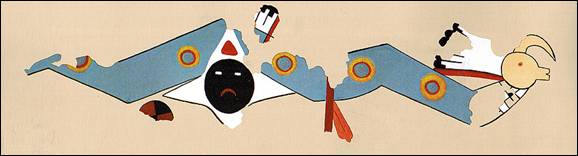
Mural of star-face and horned serpent with feather ruff
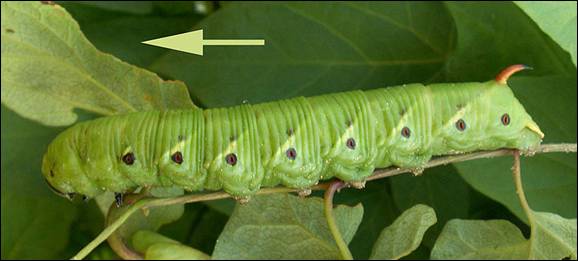
Hawk moth larva
Datura is a powerful and dangerous hallucinogen. [4] It has been used both medicinally and ritually for at least 4,000 years in the American Southwest. Ground-up portions of the plant were sometimes employed as an anesthetic or as a salve for wounds or bruises. The Aztecs called it toloatzin, which means "nodding head." This refers to the seedpods but may as well mimic the unconscious head of one who has ingested the psychotropic plant. The Navajo have a folk adage regarding this poisonous tropane alkaloid of the nightshade family: "Eat a little, and go to sleep. Eat some more, and have a dream. Eat some more, and don't wake up."
Symptoms of Datura intoxication include dizziness, flushing, fever, dilated pupils, temporary blindness, dry skin and mouth, difficulty swallowing, tachycardia, heightened sexuality, restlessness, inability to concentrate, idiosyncratic or violent behavior, delirium, visual and auditory hallucinations, sometimes terrifying phantasmagoria, inability to distinguish fantasy from "reality," and amnesia.
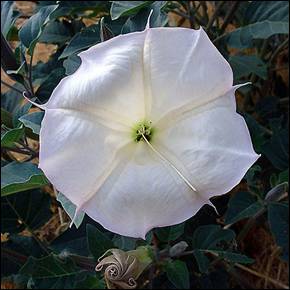
Blossom of Datura wrightii

Egyptian hieroglyph for 'star'. Various species of Datura grow in Egypt. Is the morphology of the night-blooming "moonflower" the source for this hieroglyph? Duat, the Egyptian word meaning 'underworld', was also spelled Dat, the root of the word Datura. [5]
Andrew Weil highlights the negative aspects of the plant: "Datura is not a nice drug. Although sometimes classified as a hallucinogen, it should not be confused with the psychedelics. It is much more toxic than the psychedelics and tends to produce delirium and disorientation. Moreover, Datura keeps bad company. All over the world it is a drug of poisoners, criminals, and black magicians." [6]
For the indigenous people of the Andes in Peru, Datura is known as yerba de huaca, or 'herb of the graves'. This is because its use allowed communication with the spirits of ancestors. [7]
Many tribes of the western U.S. have traditionally incorporated the Sacred Datura into their religious rites. "Societies in the Great Basin and in much of California also used the plant, where it was commonly employed in vision quests for spirit helpers and in boys' initiation rites… Ritual uses include initiation, divination, good luck, and transport to the spirit world for other purposes. Shamanic healers have exploited the plant's mind-altering qualities to diagnose illnesses in patients." [8]
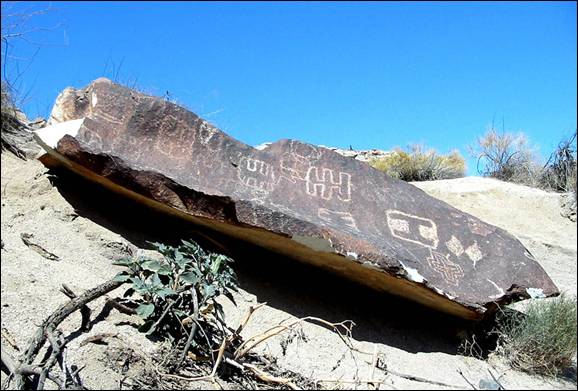
Grapevine Canyon in the southern tip of Nevada. Datura plant (foreground-left) in front of boulder with abstract petroglyphs, possibly depicting entoptic imagery. (For more photos of the site, see: http://www.theorionzone.com/grapevine_canyon.htm.)
Zuni priests of New Mexico used Datura to communicate with birds and petition them for rain. "In 1879 the writer discovered that the Zunis employed a narcotic… found to be Datura stramonium or jimson weed… when the rain priests go out at night to commune with the feathered kingdom, they put a bit of powdered root into their mouth so that the birds may not be afraid and will listen to them when they pray to the birds to sing for the rains to come." [9]
Extracts or derivatives of Datura mixed with the fat of a wild boar are sometimes used in a paste known as a "flying ointment." Anthropologist and author Carlos Castaneda, during his tutelage with the Yaqui shaman and diablero don Juan Matus, recounts his teacher's intimate knowledge of Datura to accomplish psychic flight:
"The second portion of the devil's weed [the root] is used to fly… The unguent by itself is not enough. My benefactor said that it is the root that gives direction and wisdom, and it is the cause of flying. As you learn more, and take it often in order to fly, you will begin to see everything with great clarity. You can soar through the air for hundreds of miles to see what is happening at any place you want, or to deliver a fatal blow to your enemies far away. As you become familiar with the devil's weed, she will teach you how to do such things." [10]
In this case the plant itself is referred to as a feminine ally who is actually conscious. Castaneda asks whether his own body actually flew like a bird, and don Juan replies:
"A man flies with the help of the second portion of the devil's weed. That is all I can tell you. What you want to know makes no sense. Birds fly like birds and a man who has taken the devil's weed flies as such [el enyerbado vuela así]."
"As birds do? [Así como los pájaros?]."
"No, he flies as a man who has taken the weed [No, así como los enyerbados]." [11]
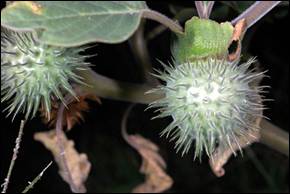
Spiny seedpods of the Datura
Several jimsonweed seeds were actually found in a deeply buried room floor at Pottery Mound. In addition, small ceramic effigy vessels have also been discovered in the region. Conical bumps on their outer surface resemble the spiny seedpods. They may have been used either to store the seeds or as a cup for the Datura brew.
A menacing anthropoid painted on the interior of a different type of flat pottery bowl has a body that resembles the plant's round, prickly seedpod. He has half-moon eyes, a rectangular mouth with teeth, and red hair or headdress. This last feature may correspond to the red headpiece of the first Mothman mural shown above.
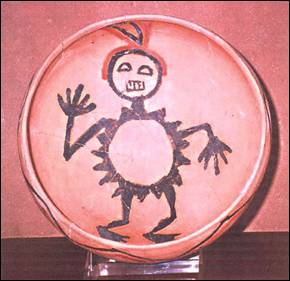
Ceramic bowl with "Datura Man."
Members of Hopi Fire Clan (Ko'kop) were also known as 'the redheads'. As the most aggressive Hopi clan, it founded the Warrior Society named Motswimi. According to one historian, these redheads were also the traditional enemies of the Aztecs. [12]
The Fire Clan is furthermore associated with an ominous being named Masau'u, the Hopi god of death, war, and the underworld. The figure depicted on the ceramic resembles some of the Hopi rock art renditions of this god. Interesting in this context is the Hopi word for 'moth': masivi. This word has the same root as the name of the Hopi death god, which literally means 'gray'-the color of moth wings.
One Hopi synonym for 'moth' is even more intriguing: Tsimonmana specifically refers to "a type of moth attracted to jimsonweed." This word literally means 'jimsonweed maiden' [13], thereby echoing the feminine designation of Datura that we find in Yaqui culture. Some Hopi legends do indeed describe pairs of licentious young femme fatales who wear Datura blossoms in their hair while they seduce and harm unsuspecting males. We thus have the moth and jimsonweed contained in the single Hopi word, Tsimonmana.
One Zuni legend describes a girl and boy who dwell in the underworld but suddenly find a trail that leads to the bright earth plane. On their heads they wear garlands of Datura blossoms, which allow them to put people to sleep and or make people see ghosts. This sorcery alarms the gods, so the children are sent back to the dark realm. The beautiful but deadly white flowers remain, however, and are soon spread far and wide across the desert. [14]
The Zuni are culturally related to the Hopi, so it is interesting that the Hopi puvuwi is another word that means 'moth' but has an alternative meaning of "someone who sleeps all the time."
Other peculiar creatures depicted at Pottery Mound seem to resemble those far to the south. Fortean researcher John A. Keel describes a number of cryptozoomorphs in his book The Mothman Prophecies, which ignited the initial frenzy surrounding the modern Mothman sightings. He specifically refers to Mexican tales of black flying entities called ikals that live deep in caverns like bats. [15] The Mayan word ik means 'air' or 'wind' and ikal means 'spirit', while ek means 'black'.
These hairy humanoids are on the average of three feet tall, and they have human hands but horse hooves on their feet. They are mostly nocturnal and spheres of light sometimes accompany them. The Tzeltal Maya of Chiapas try to fight off these ugly creatures with machetes when they fly down and attack them. They can paralyze humans and are known to kidnap and rape women.
One Pottery Mound mural seems to portray this figure precisely. The short, dark figure with piercing brown eyes and a frowning red mouth is suspended upside down in the air over a red slab that designates the earth. His left hand has two curved lines instead of fingers. This may correspond to the hooves of the Mayan version, though they are on his hand instead of his foot.
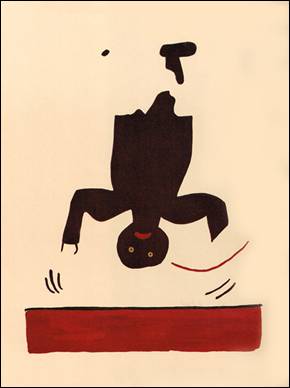
Pottery Mound mural of a creature that resembles the Mayan ikal
It also is similar to the Hopi death god Masau'u mentioned above.
The Mothman's flight patterns seem to range extensively through space and time. Just as he was seen along the Ohio River in recent times, he haunted the Rio Puerco Valley of New Mexico 700 years ago. The range of Datura is equally extensive, from the East to the West Coasts of the United States and from Canada down to southern Mexico. Perhaps this potent psychoactive plant merely opens a dark doorway through which the inter-dimensional Mothman flies toward the light. Whatever the reality, this wingéd wraith has taken hold of our modern imagination just as surely as it must have moved those pueblo people at Pottery Mound so long ago.
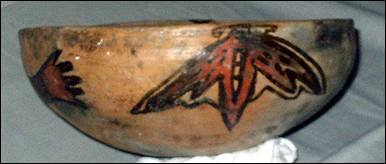
Pot with painted moth from the ruins of Puaray, located on the southern edge of the modern town of Bernalillo, New Mexico, a little over 40 miles north of Pottery Mound. Occupied between 1300 and some time prior to 1680 AD, Puaray was known as the pueblo of the Worm or the Insect, which may refer to the hawk moth larva. [16]
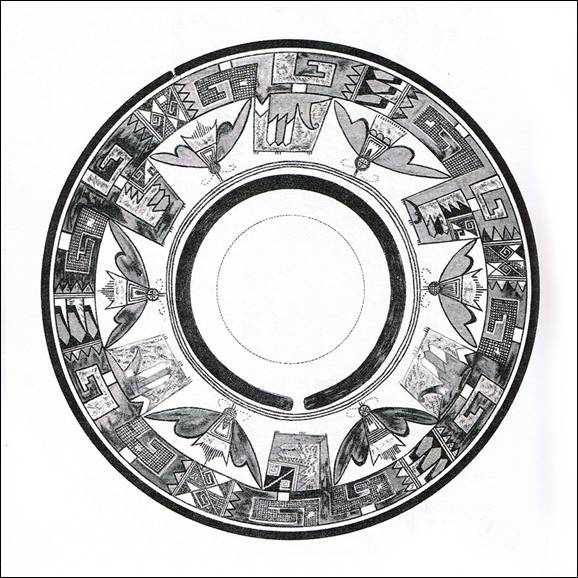
Top view of Hopi "butterfly vase." The six insects are actually moths, which represent the four directions plus the zenith and nadir
Copyright © 2009 by Gary A. David. All rights reserved.
Endnotes
- Frank C. Hibben: Kiva Art of the Anasazi at Pottery Mound (KC Publications, Las Vegas, Nevada, 1975), pp. 10-11. [back to text]
- Polly Schaafsma: Indian Rock Art of the Southwest (School of American Research/University of New Mexico Press, Santa Fe/Albuquerque, 1980), p. 251. [back to text]
- Paul T. Kay: "Ancient Voices…murals and pots speak. DATURA: A Poster Presentation for the 70th Annual Meeting of the Society for American Archaeology," http://paultkay.info/DATURA_05_08_2006.pdf. [back to text]
- CAVEAT-IMPORTANT WARNING FROM A TRUSTED ONLINE SOURCE: "I'd like to point out that there are countless warnings about Datura and reports of horrendous experiences using it throughout this site. More Datura reports fall under the 'Train Wreck' category than any other substance. It is NOT safely used haphazardly. Even with all the warnings and recommendations not to use it, people will continue to do so, often having never read anything about it. Hopefully, the wide variety of information presented here will help some people to take precautions with regard to their safety." http://www.erowid.org/ask/ask.php?ID=227 [back to text]
- R. T. Rundle Clark: Myth and Symbol In Ancient Egypt (Thames and Hudson, London, 1978, 1959), p. 165. [back to text]
- Andrew Weil: The Marriage of the Sun and Moon: A Quest for Unity in Consciousness (Houghton Mifflin, Boston, 1980), p. 166. [back to text]
- Ernst Bibra, and Jonathan Ott: Plant Intoxicants: A Classic Text on the Use of Mind Altering Plants (Inner Traditions/Bear & Company, Rochester, Vermont, 1995, originally published 1855), pp. 77-8. Digitized preview at http://books.google.com. [back to text]
- Lisa W. Huckell and Christine S. Vanpool, "Toloatzin and Shamanic Journeys: Exploring the Ritual Role of Sacred Datura in the Prehistoric Southwest": Religion In the Prehispanic Southwest, edited by Christine S. Vanpool, Todd L. Vanpool, and David A Phillips, Jr. (Altamira Press, Lanham, Maryland, 2006), p. 150. [back to text]
- Matilda Coxe Stevenson, quoted in Alex Patterson: A Field Guide to Rock Art Symbols of the Greater Southwest (Johnson Books, Boulder, Colorado, 1992), p. 80. [back to text]
- Carlos Castaneda: The Teachings of Don Juan: a Yaqui Way of Knowledge (Pocket Book, New York, 1977, 1974, 1968), p. 128. [back to text]
- Ibid., p. 129. [back to text]
- Harry C. James: Pages From Hopi History (The University of Arizona Press, Tucson, Arizona, 1974), p. 27. [back to text]
- Ekkehart Malotki, editor: Hopi Dictionary: A Hopi-English Dictionary of the Third Mesa Dialect (The University of Arizona Press, Tucson, Arizona: 1998), p. 631. [back to text]
- Marc Simmons: Witchcraft in the Southwest: Spanish and Indian Supernaturalism on the Rio Grande (University of Nebraska Press, Lincoln, 1980, 1974), p. 153. [back to text]
- John A. Keel: The Mothman Prophecies (Signet/New American Library, New York, 1975), p. 25. [back to text]
- Ralph Emerson Twitchell: The Leading Facts of New Mexican History, Vol. I (The Torch Press, Cedar Rapids, Iowa), p. 261. Digitized at http://books.google.com. [back to text]