




Bibhu Dev Misra is a graduate of the Indian Institute of Technology and the Indian Institute of Management and has been working as an Information Technology consultant for more than 12 years, for various organizations across the world. He is also an independent researcher and writer on topics related to ancient civilizations, myths, symbols, religion and spirituality and has travelled to many places of historical, religious and architectural importance. His articles have appeared in various internet websites and magazines. He can be contacted at [email protected] and via his personal blog: http://bibhudev.blogspot.com
More articles by Bibhu Dev Misra:
A Day and Night of Brahma: The Evidence from Fossil Records, 15 April 2011
The Opet Festival of Ancient Egypt: Has it been derived from the Jagannatha Rathyatra of Puri, India?, 15 April 2011
Evolution by Catastrophe: Does it indicate Intelligent Design?, 5 May 2011
Petra, Jordan – Is it an ancient Shiva Temple complex?, 22 June 2011
In a previous article titled “The Opet Festival of Ancient Egypt: Has it been derived from the Jagannatha Rathyatra of Puri, India?” I had pointed out the many similarities between Amun, the all-powerful Creator god of the ancient Egyptians (with his primary center of worship at Thebes), and Krishna, the Supreme Creator of the Vedic Indians. Both of them were blue-complexioned, wore “feathers in their head-dress” and were depicted with a “sacred river” emerging from their feet. In addition, the grand Opet festival of the ancient Egyptians, which was celebrated over a period of 24-27 days during the season of the flooding of the Nile, is identical in form and spirit to the Jagannath Rathyatra festival that is still celebrated every year at the tiny coastal town of Puri, India. The worship of Krishna (or Jagannath) and the observance of the Rathyatra festival are quintessentially Vedic festivals, which have been observed for thousands of years prior to the establishment of the cult of Amun at Thebes (as per the information contained in many Sanskrit texts). This implies that the Vedic triad of divinities – Krishna, Balarama and Subhadra – must have been transferred from India to Egypt sometime prior to the beginning of the New Kingdom in c. 1550 BC.
On further investigation I found many more similarities between these two ancient deities – Amun and Krishna. A number of hymns from the ancient Coffin Texts of Egypt associate Amun with the falcon-headed god Horus, while in Hindu myths Krishna is associated with the eagle-headed deity Garuda, who acts as his vahana i.e. carrier. Even the etymology of the name Amun has close associations with Krishna. In Egyptian, Amun is written as Ymn, which has been reconstructed by Egyptologists to “Yamanu”, and sometimes also spelled as “Yamun”. “Yamanu” or “Yamun” is very closely related to the sacred river “Yamuna” in India, which is intimately tied up with the childhood of Krishna, who grew up on the banks of the river Yamuna. The waters of the Yamuna are of a dark-blue color, which has been likened to the complexion of Krishna, and the river is regarded as the source of love, compassion and spiritual capabilities. It is possible that the Egyptian Ymn, may actually be a reference to the Yamuna, which became shortened to Yamun, and subsequently to Amun.
Even at a metaphysical level, Amun and Krishna are very similar. Amun was regarded as the “hidden one”, and the epithet, "he whose name is hidden", was frequently applied to him. Amun’s form was “unknown”, and it was said that no-one could behold or understand him, except Amun himself. The Boulaq Papyrus from the XVIII Dynasty (1552-1295 BC) describes Amun as the “Greatest in Heaven…Lord of all, who is in all things.” Amun abides in all; everything happens in him, and nothing exists outside him. He is the Supreme Creator: “The One maker of all things, Creator and Maker of beings, From Whose eyes mankind proceeded, From Whose mouth the Gods were created.” He was, “The One Whose forms are greater than every God, In Whose Beauty the Gods jubilate.” Amun was also the “champion of the poor” and he became the “personal savior” of anyone who took him into his heart.
“[Amun] who comes at the voice of the poor in distress, who gives breath to him who is wretched…You are Amun, the Lord of the silent, who comes at the voice of the poor; when I call to you in my distress You come and rescue me.”i
The same epithets are also associated with Krishna. Krishna is “karuna seendhu” (sea of compassion) and “deena bandhu” (the friend of the poor), who responds to a devotee’s call instantly, as exemplified in the Mahabharata, when he was invoked by Draupadi. In the Bhagavad Gita, Krishna asks Arjuna to regard him as his only protector, for, he says, “Remembering me, you shall overcome all difficulties through my grace.”ii Krishna, like Amun, abides in the heart of all creatures as the indestructible “Self”, and his “unknowable form” pervades the entire cosmos. The birth and dissolution of the cosmos itself take place in Krishna: “There is nothing that exists separate from me, Arjuna. The entire universe is suspended from me as my necklace of jewels”iii. Although, Krishna remains unknowable and invisible, the multifarious celestial beings of this created world reflect his various divine attributes: “Wherever you find strength, or beauty, or spiritual power, you may be sure that these have sprung from a spark of my essence.”iv Yet, no-one could understand the real nature of Krishna, for Arjuna tells Krishna, “Neither gods nor demons know your real nature. Indeed, you alone know yourself, O Supreme Spirit.”v This is similar to the Egyptian texts which assert that no-one could behold or understand Amun, except Amun himself. Krishna further confirms this: “I know everything about the past, the present, and the future, Arjuna; but there is no one who knows me completely”vi.
In fact, the entire Theban triad of Amun, Mut and Khonsu, are related to the triad of divinities – Krishna, Balaram and Subhadra – worshipped at the Jagannath temple at Puri, India. Krishna’s brother, the fair-skinned Balaram, is considered to be an incarnation of “Ananta-Sesha” – the primeval serpent of the abyss, in whose coils Vishnu rests in the middle of the cosmic Milky Ocean. Ananta-Sesha is himself a powerful agent of creation, and he co-exists with Vishnu at the beginning and end of the creative cycle. We find the same imagery associated with Khonsu, the son of Amun. On one of the walls at Karnak, a cosmogony is depicted in which Khonsu is described as the “Great Snake who fertilizes the Cosmic Egg in the creation of the world” (Wikipedia). In addition, Mut (who is believed to have been the wife of Amun), and Subhadra, the sister of Krishna, were both regarded as manifestations of the great mother goddess.
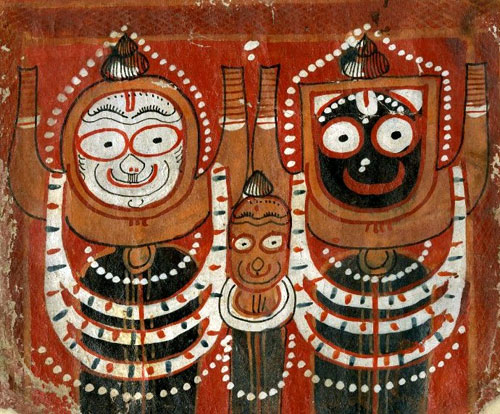
Fig 1: Krishna, Balaram and Subhadra – The Puri Triad. Subhadra is in the center, flanked by the dark-complexcioned Krishna and the fair-complexioned Balarama, on either side. Source: Wikipedia.
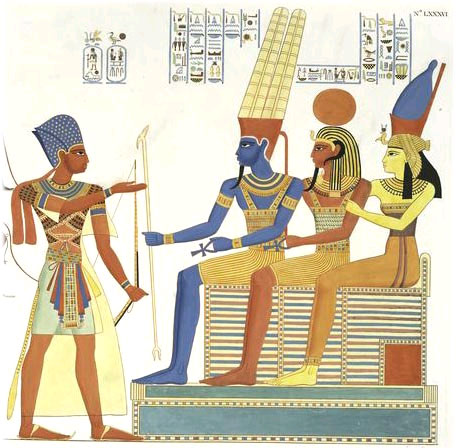
Fig 2: Amun, Mut and Khonsu- The Theban Triad. Khonsu is in the center, flanked by the dark-complexioned Amun and the fair-complexioned Mut. Source: www.kenseamedia.com
But the question is how did an entire pantheon of deities, along with associated ceremonies, rites and rituals migrate from India to Egypt, at a time when the existing pantheon and religious beliefs of the Egyptians was already well formulated? What historical events could have led to this?
In order to understand this sudden influx of Vedic beliefs into the religious practices of the ancient Egyptians, it is important to recount a critical event that took place before the beginning of the New Kingdom in Egypt i.e. prior to 1550 BC. Sometime during 1700 BC, Egypt had been overrun by a group of irreligious, nomadic invaders known as the Hyskos (which means “rulers of foreign countries”). The term was chiefly used during the Middle Kingdom to refer to the nomadic Semitic tribes of Canaan and Syria. As per the Egyptian accounts, the Hyskos had burnt the Egyptian cities to the ground, destroyed all their temples and had led their women and children into slavery. This was a time of great suffering for the Egyptian people. During this time, the Egyptian pharaohs had been forced to retreat south, driven into the neighbouring kingdom of Kush (Nubia), which was also referred to as “Ethiopia” by the classical Greek historians (although this region now falls within the boundaries of modern Sudan). The pharaoh Ahmose secured the favor of the Kushites by marrying Nefertari, the black princess of Ethiopia. She was of a very dark complexion, and was the most venerated woman in all of Egyptian history. Egyptologist George Rawlinson, in his book Ancient Egypt, says about King Ahmose (referred to as Aahmes):
“He married a princess, who took on the name of Nefet-ari-Aahmes , or “the beautiful companion of Aahmes,” and who is represented on the monuments with pleasing features, but a complexion of ebon blackness. It is certainly wrong to call her a “negress;” she was an Ethiopian of the best physical type; and her marriage with Aahmes may have been based upon a political motive. The Egyptian Pharaohs from time to time allied themselves with the monarchs of the south, partly to obtain the aid of Ethiopian troops in their wars, partly with a view of claiming, in the right of their wives, dominion over the Upper Nile region. Aahmes may have been the first to do this; or he may simply have followed the example of his predecessors, who, forced by the Hyksos to the south, had contracted marriages with the families of Ethiopian rulers.”
Armed with the financial and military help of the Kushites, the Hyskos invaders of Egypt were finally evicted from the country after 200 years of occupation. During this time, the pharaohs Kamose and Ahmose had fought under the banner of their new-found god: Amun. This event, which took place at around 1550 BC, signified the beginning of the 18th dynasty, which is acknowledged as the greatest royal family of Egypt. Ahmose became the first pharaoh of the 18th dynasty. Amun became the supreme protector god of the monarchy and the state, and his priesthood gained immense power. Magnificent temple complexes dedicated to Amun were established in Karnak. Since Amun came to the aid of the Egyptian people at the time of their greatest distress and ignominy, his cult became all powerful, and dwarfed all the other gods and goddesses of the Egyptian pantheon.
This historical event indicates that the worship of Amun must have passed on to Egypt from the ancient Kushites of Ethiopia. The 18th dynasty pharaohs continued to maintain strong matrimonial connections with their Kushite neighbours, and Kushite priests held sway at the temple complex at Karnak. But if that were the case, then how did the worship of Jagannath make its way to ancient Kush from India?
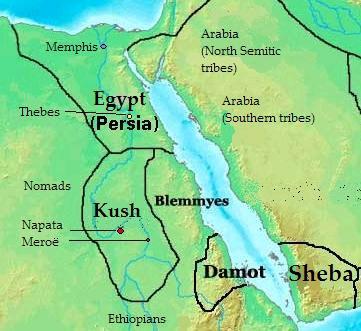
Fig 3: Map of Africa in 400 BC, showing the kingdom of Kush and its neighbouring countries. The river Nile flows through Kush and Egypt. Kush was also known as Nubia (The Land of Gold).
It was widely known in the ancient times that the kingdom of Kush (or Ethiopia) was an extension of the Vedic civilization of India. The earliest Ethiopian tradition says that they came from a land situated near the mouth of the Indus, and this has been confirmed by the testimony of Eusebius and Philostratus. Eusebius informs us that, “a numerous colony of people emigrated from the banks of the Indus, and crossing the ocean, fixed their residence in the country now called Ethiopia.”vii These earliest Ethiopians were a people highly civilized, and full of virtue and piety; their laws, their institutions, and especially their religion were celebrated far and wide. Apollonius of Tyana, a charismatic philosopher from the 1st century CE, had travelled extensively throughout the world and held discussions with a large number of philosophers. In a conference with the southern Ethiopians, finding that they spoke much in praise of the Indians in general, Apollonius told them, "you speak much in favour of every thing relating to the Indians; not considering that originally you were Indians yourself".viii Nilus the Egyptian had told Apollonius that, “the Indi of all people in the world were the most knowing; and that the Ethiopians were a colony from them, and resembled them greatly."ix The Encyclopaedia Brittanica confirms this: “all the ancients, both poets and historians, talk of a double race of Ethiopians; one in India and another in Africa”. The kingdoms of the Indians, the Egyptians and ancient Kush were widely regarded as part of one large global empire, and "India, taken as a whole, beginning from the north and embracing what of it is subject to Persia, is a continuation of Egypt and the Ethiopians."x Even now, the culture and traditions of the Ethiopian people bear a closer resemblance to that of India, than to the rest of Africa. The traditional dress and ornaments of the womenfolk, the spicy cuisine which is mostly vegetarian, the rich musical traditions (along with the use of the bamboo flute and the tabla), the presence of the caste system, the respect shown to elders – all of this invoke memories of an enduring connection between Ethiopia and India.
The timeless familiarity of the ancient Indians with the kingdom of Kush is borne out by the detailed information about the geography of Ethiopia that is contained in ancient Sanskrit texts. When Lieutenant John Hanning Speke was planning his discovery of the source of the Nile in 1858, he relied on a map that had been reconstructed by Lieutenant Wilford from information contained in the ancient Puranic texts, with the assistance of some Pundits of Varanasi. In this map, the river Nile, referred to as the “Great Krishna” (because of its deep blue waters), was traced from a great lake called “Amara”. Speke later found that the name “Amara” is actually the native name of a district bordering Lake Victoria Nyanza. The map also mentioned that the real source of the Nile was the twin peaks known as Somagiri – “Soma” in Sanskrit stands for “moon” and “Giri” means “peak”. Somagiri, therefore, refers to the fabled “Mountains of the Moon” in Central Africa! Speke says in his book Journal of the Discovery of the Source of the Nile (1863):
“Colonel Rigby now gave me a most interesting paper, with a map attached to it, about the Nile and the Mountains of the Moon. It was written by Lieutenant Wilford, from the "Purans" of the ancient Hindus. As it exemplifies, to a certain extent, the supposition I formerly arrived at concerning the Mountains of the Moon being associated with the country of the Moon, I would fain draw the attention of the reader of my travels to the volume of the "Asiatic Researches" in which it was published. It is remarkable that the Hindus have christened the source of the Nile Amara, which is the name of a country at the north-east corner of the Victoria N’yanza. This, I think, shows clearly, that the ancient Hindus must have had some kind of communication with both the northern and southern ends of the Victoria N’yanza.”xi
Such detailed geographical knowledge of the Nile and Ethiopia indicates that ancient Kush must have been a colony of the ancient Indians, as attested by various Greek historians. This leads us to wonder: what would have led them to colonize a land that was so far from their ancestral homeland on the banks of the Indus?
Philostratus mentions that the Ethiopians, an Indian race, dwelt in India under the rulership of King Ganges.xii But when they slew their king they were inflicted by a host of natural calamities which forced them to leave their homeland. They founded sixty cities along the path of their emigration, until they settled in the fertile land of Kush. This suggests that the colonization of Ethiopia may have been triggered by a large-scale emigration of people from the Indus Valley due to various environmental catastrophes. At its peak at around 2500 BC, the Indus Valley civilization included the whole of Pakistan, parts of Northern India, Afghanistan, and southern Iran, covering an area of roughly 1.2 million sq.km with a population of over 5 million, and constituted the largest urban settlement of the ancient world. Current research indicates that sometime around 1900 BC the Indus Valley civilization was plagued by a series of calamities. There was a long and devastating drought, followed by a series of cataclysmic earthquakes. Substantial portions of the Ghaggar Hakra river system (the “Saraswati” of the Rig Vedas) disappeared, and the Indus River changed its course. The princely state of Rajasthan turned into a desert. Parts of the civilization relocated to other sites along the Indus, and others migrated further eastwards to the fertile plains along the Ganges, and towards the southern parts of India. By around 1700 BC, most of the cities of the Indus Valley civilization were abandoned.
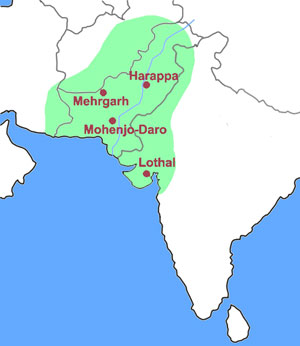
Fig 4: Map of the Indus Valley civilization, showing some of the important sites. Source: Wikipedia.
There was a large-scale westward migration of various Vedic tribes during this time. One of the migrating branches of the Vedic family was the Kassites or Kussites who first appear in Western Iran at about 1800 BC, when they attacked Babylonia in the 9th year of the reign of Samsu-iluna, the son of Hammurabi. The Kussites subsequently captured Babylon in the 16th century BC and ruled over it without any interruption for over 400 years. The Kussite pantheon of deities included Suriash (from Sanskrit Surya meaning the Sun), Maruttash (from Sanskrit Marut, a storm god) and Indas (from Sanskrit Indra, the king of the gods). Names of gods also appear in the names of Kussite kings, as is very typical among the Vedic people. Kussite kings established trade and diplomacy with far-flung kingdoms – Assyria, Egypt, Elam, and Hittites – and established royal alliances with them. They also governed with order, introduced advanced technologies, and followed the Vedic policy of honoring the customs and religious beliefs of the peoples whose land they occupied.
Although it is clear that the Kussites belonged to the Indo- Iranian stock of people, and worshipped Vedic deities, their exact point of origin still remains in question. The early Babylonian texts portray them as migrants from the “eastern mountains”. This was interpreted by some historians as a reference to the Zagros Mountains in south-western Iran. This is now doubted, since the Zagros Mountains could not have been the original homeland of the migrating Vedic tribes, and may simply have been one of the mountains that they crossed during their westward expansion. However, if we travel further east, we run into the majestic Hindu Kush mountain range, an offshoot of the mighty Himalayas, stretching between Afghanistan and Pakistan. For centuries, the Hindu Kush was recognized as the “mountains of India” or the “boundary of India”. It is of interest to note that the term “Hindu” is derived from the term “Sindhu”, which is the Sanskrit name of the river Indus; while the term “Kush” was always used in reference to the Kussites (or Kassites, Kushites). This means that the term Hindu Kush could be a reference to the mountain range which defines the “domain of the Kussites on the banks of the Indus” – the erstwhile Indus Valley Civilization. Many Sumerian inscriptions often refer to the Kussites as “Meluha-Kasi”. Interestingly, the ancient residents of the Indus Valley civilization were also referred to as “Meluha” (or Malaha, Meluhha, Mehluha). In fact, it is now accepted that “Meluha” was a term used in the Sumerian region for the Indus Valley civilization. The Sumerian cuneiform texts of the times of the Akkadian king Sargon (c. 2334 – 2279 BC) shows that Babylon had extensive trade with its neighboring countries, including Meluhha. Meluhha was described as a land of exotic commodities, and a wide variety of objects produced in the Indus region have been found at sites in Mesopotamia. Thus “Meluha-Kasi” must be a reference to the ancient Kussites of the Indus Valley.
There is a surprising lack of scholarly resources regarding the expansion of the Kussites, although ancient traditional sources constantly extol their numerous achievements. One of the few scholarly works which addresses this topic is the book, History of civilizations of Central Asia, which was commissioned by the UNESCO, and included participating scholars from Iran, Afghanistan, India, China, Pakistan, Russia and Mongolia and a panel of experts from USA, UK, Turkey, Japan and Hungary . This monumental study concludes that the, “invasion of Babylonia by the Kassites – which caused the fall of the first Babylonian dynasty – was already obviously connected with the migrations of the Proto Indians.”xiii The presence of the Indo-Aryan linguistic terms in the Kassite language, “speaks clearly for the assumption that the people of war-charioteers, which had induced the Kassites to invade Babylonia, belonged to the Proto-Indians.” The study further states that:
“It seems very likely that simultaneously with the movement of the Kassites – and in any case before 1700 BC at the latest, or perhaps even earlier, at the end of the third millennium BC – the immigration of Proto-Indian groups into Hurrian territory began, led by the class of war-charioteers (maryannu). They brought with them a new species of horse, more suitable for the war-chariot, a new method for horse training, described by Kikkuli, the man of Hurri, in a treatise written in Hittite, and a perfected form of the chariot. Through these important elements of their civilizations the Proto-Indians gave an impetus to the development of Hurrian society and, and to the organization of the Mitanni kingdom, many kings of which bore Proto-Indian names. The Proto-Indian tribal aristocracy spread also to Syria and Palestine where it brought about the formation of stage organization based on the class of war-charioteers. Proto-Indian linguistic influence was considerable on the vocabulary of horse-breeding, horse-training, social life and religion as shown by the following list of Proto-Indian terms borrowed by the Hurrians and other peoples of western Asia.”xiv
The Kussites were not the only Vedic tribe that migrated westward, as a consequence of the major cataclysms in the Indus Valley. The Hittites appeared in the upper Tigris-Euphrates basin and ruled from their capital at Hattusa from around 1800 BC. To their south was the Mitanni, who ruled from their capital at Wassukanni (c.1475 BC). The Hittites and Mitanni had concluded a treaty in c. 1380 BCE, which we know as the Suppiluliuma-Shattiwaza Treaty, which invokes the Vedic deities Mitra, Varuna, Indra and the Nasatyas.
However, of all the Proto-Indian tribes that had migrated westward, the Kussites were the ones who had left their indelible footprints over vast swathes of Central and West Asia, and Arica. Hundreds of towns and cities came to be named after them – Kissia, Kossea, Kussara, Kashan, Kashband, Kashgar, Kashmir, Kashi and many many more. Jacob Bryant writes about them in the book An Analysis of Ancient Mythology: "I have mentioned that the Cushites sent out many colonies; and partly by their address and superiority in science, and partly by force, they got access among various nations. In some places they mixed with the people of the country, and were nearly absorbed in their number: in other parts, they excluded the natives, and maintained themselves solely and separate."xv However, in spite of their formidable achievements the contributions of the Kussites have been largely ignored by modern historians. In the History of civilizations of Central Asia, the editor Vadim Mikhailovich Masson laments that, “In the present writer’s opinion recent research tends to underestimate or even to deny the role played by Proto-Indians in Mesopotamia in general and in the Mitanni kingdom in particular.”
However, we can construct a picture of what really happened from various traditional sources. The Kussites conquered the southern part of Mesopotamia called Sumer and reached the southern part of the Arabian Peninsula, where they founded many kingdoms, including that of Sheba (present day Yemen). The Kussites then crossed the Red Sea into Northeast Africa and established the renowned African kingdom of Kush. David Gibson mentions that “the descendants of Cush may have split, one part remaining in Asia, the other migrating to Africa to become the Ethiopia we still know to this day.”xvi Hence, (as per the Encyclopaedia Britannica), “it cannot be doubted that the tribes on both sides of that branch of the sea were kindred nations.”xvii Orientalist Edward Pococke describes this long march of the Vedic Indians from their ancient homeland to the fertile plains of Kush: "At the mouths of the Indus dwell a seafaring people, active, ingenious, and enterprising…these people coast along the shores of Mekran, traverse the mouth of the Persian Gulf, and again adhering to the sea-board of Oman, Hadramant, and Yemen (the Eastern Arabia), they sail up the Red Sea; and again ascending mighty stream that fertilizes a land of wonders, found the kingdom of Egypt, Nubia and Abyssinia."xviii
Kush attained its greatest power and cultural energy between 1700 and 1500 BC, during the Second Intermediate Period of Egypt. This is nearly a 100 years after the Kussites first emerged in western Iran in c.1800 BC. This was the time when Egypt was run over by the Hyskos, and the Egyptian pharaohs had retreated to Kush. We know that Amun was the principal god of the Kushites of Ethiopia. Here he remained a national deity for centuries, with his priests at Meroe regulating the whole government of the country via an oracle, choosing the ruler, and directing military expeditions. The pharaohs Kamose and Ahmose would have been introduced to this new cult at this time, and had carried it into Egypt after evicting the Hyskos. In this manner, the worship of Jagannath would have travelled the long distance from its Vedic homeland to the kingdom of Kush, from where it was adopted by the victorious pharaohs of the 18th dynasty.
We also find the indelible footprints of Vedic temple architecture in the grand temple complexes set up by the 18th dynasty pharaohs. The magnificent temple complex of Luxor, whose construction started at c.1400 BC (during the reign of Amenhotep III) after the beginning of the New Kingdom, incorporated advanced Vedic knowledge. The Egyptologist R.A.Schwaller de Lubicz had conducted as 15 year on-site study of the Luxor Temple complex in 1952 and had concluded that the “the various sections of the human body had been incorporated into the proportions of the temple. He found that specific locations within the temple correspond to the seven Hindu Chakras (energy centers) in the human body. These locations actually stimulate experiences and feelings that dowsers and meditators are able to perceive consciously.”xix Thus, the onset of the New Kingdom in Egypt was marked by a sudden influx of Vedic ideas, which we find reflected in its religion, art and architecture.
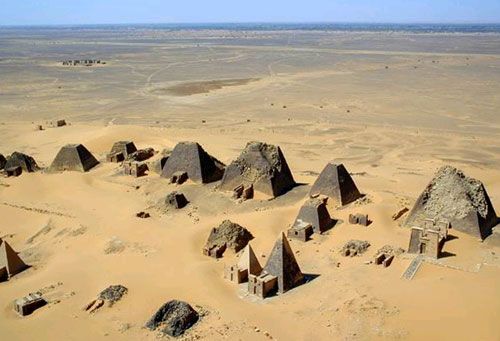
Fig 5: An aerial view of the Kushite pyramids at Meroe, the capital of ancient Kush. (Source: Wikipedia)
I had also mentioned in my previous article that the ancestral homeland of the ancient Egyptians, which they referred to as “Punt” (also called “Pwenet”) may be India. Punt was referred to as “Ta netjer” meaning the “Land of the Gods” or the “Land of Gods and Ancestors”. Most scholars agree that Punt was located to the south and east of Egypt, and could be reached leading off the Red Sea, in a south-east direction. India too can be reached from Egypt by sailing in a south-east direction by following the ancient maritime trade routes, popularly known as the Silk Route, which led from Egypt to the flourishing ports on the coasts of India. This long journey across the Indian Ocean may have been quite daunting for the ancient Egyptians, since the journey to the land of Punt was considered as “long and hazardous”. It was attempted quite infrequently, but when it did take place, it was executed on a grand scale, involving thousands of people and multiple ships.
The first mention of Punt comes to us from the Palermo Stone of the Old Kingdom, during the reign of King Sahure at around 2500 BC. This expedition returned with huge quantities of myrrh, which is a resin used for making incense that the Egyptians used for their temple rituals, along with precious wood, and electrum (an alloy of silver and gold). Further expeditions took place in subsequent dynasties, in which thousands of men were involved. The most detailed description of the expedition to Punt has been preserved in the reliefs in Hatshepsut’s mortuary temple at Deir el-Bahri in Thebes. Hatsheptsut’s expedition had been headed by her Chancellor Senmut, accompanied by a fleet of five ships. They received a warm welcome from the rulers of Punt, King Parahu and Queen Ati, and subsequently returned with ships laden with heaps of myrrh resin, fresh myrrh trees, ebony and pure ivory, gold, cinnamon wood, khesyt wood, incense, cosmetics, along with apes, monkeys, dogs, skins of the southern panther (which the priests of the Egyptian temples wore), and with natives and their children.
All the products of Punt, as depicted in the Hatshepsut illustrations can be found in abundant quantities in India. In fact, the primary export of Punt to Egypt i.e. myrrh for producing incense, was used extensively in India for all religious purposes. Of particular interest in this regard is the relief of the Great Indian one-horned rhinoceros at Hatshepsut’s mortuary temple at Deir el-Bahri, which is found only in the north-eastern part of India! In addition, the rulers of Punt during Hatshepsut’s expedition were called King Parahu and Queen Ati –these are clearly Indian names.
More evidence linking pre-dynastic Egypt with ancient India comes to us from the study of cranial features. In 1924-25, an expedition of the British School of Archaeology in Egypt, led by Sir Flinders Petrie, excavated 59 skulls at Badari, the site of the pre-dynastic Badarian culture in Upper Egypt, which flourished from around 5000 BC. These skulls were studied by Miss Stoessiger at University College, London, who concluded that: "Badarian skulls differ very little from other less ancient pre-dynastic skulls; they are just a bit more prognathous. Next to these, they most resemble primitive Indian skulls: Dravidians and Veddas. They also present a few affinities with Negroes, due no doubt to a very ancient admixture of Negro blood."xx In 1972, another study by Berry and Berry cluster Egyptians closer to each other than any other group, but find some similarities with Asian Indians. A craniofacial study by C. Loring Brace et al. (1993) concluded that: "The Predynastic of Upper Egypt and the Late Dynastic of Lower Egypt are more closely related to each other than to any other population. As a whole, they show ties with the European Neolithic, North Africa, modern Europe, and, more remotely, India, but not at all with sub-Saharan Africa, eastern Asia, Oceania, or the New World.”xxi
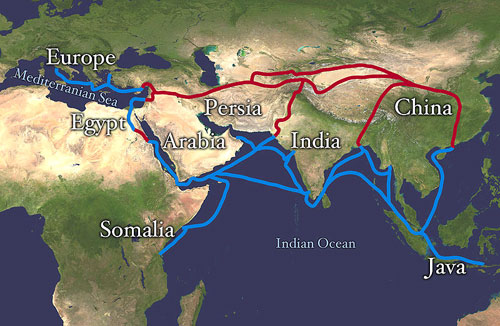
Fig 6: The Silk Road (both overland and water routes). Source: Wikipedia
Punt was also considered as a “personal pleasure garden” of the god Amun, whom we have already identified with Krishna (or Jagannath). The Boulaq Papyrus from the XVIII Dynasty (1552-1295 BC) describes Amun as the “Sovereign of Punt…Whose fragrance the Gods love When He comes from the land of Punt.”Queen Hatshepsut was an ardent devote of Amun and had actively developed the Opet festival into a grand ceremony. The expedition of Hatshepsut to the land of Punt was done primarily with the objective of acquiring incense and a number of exotic goods for her “divine father Amun”, and was conducted with the blessing of the god Amun:
“Said by Amen, the Lord of the Thrones of the Two Land: ‘Come, come in peace my daughter, the graceful, who art in my heart, King Maatkare [i.e. Hatshepsut]…I will give thee Punt, the whole of it…I will lead your soldiers by land and by water, on mysterious shores, which join the harbours of incense…They will take incense as much as they like. They will load their ships to the satisfaction of their hearts with trees of green [i.e. fresh] incense, and all the good things of the land.’xxii
Queen Hatshepsut had also returned with many species of trees from her expedition to Punt, specifically myrrh trees. On the walls of her mortuary temple at Deir el-Bahri she mentions that she had complied with the wish of the god Amun-Re, her father, to have a grove of myrrh trees “for ointment for the divine limbs”. She says: "I have hearkened to my father…commanding me to establish for him a Punt in his house, to plant the trees of God’s Land beside his temple, in his garden."xxiiiThe clear association between Amun and Punt indicates that Punt can be no other than India.
A very interesting discovery was made in 2003, by a team of British and Egyptian conservators under the aegis of the British Museum, working on the tomb of Elkab’s 17th dynasty (c.1600-1550 BC) governor Sobeknakht. They “stumbled upon an inscription believed to be the first evidence of a huge attack from the south on Elkab and Egypt by the Kingdom of Kush and its allies from the land of Punt, during the 17th dynasty”xxiv. This is during the same time that the pharaohs Kamose and Ahmose were in exile in Kush, preparing to launch an attack on the Hyskos. If Punt is India, then the “allies from the land of Punt” must be a reference to the Kussites who had migrated to Kush around this time from the banks of the Indus, as discussed earlier.
The migration of the Kussites from the Indus Valley to the Nile, sometime around 1700 – 1600 BC, or even earlier, as a result of the cataclysmic events in the Indus Valley, represents a forgotten, and often ignored, episode of human history which explains some remarkable similarities between the ancient civilizations of India, Egypt, the Middle East and West Asia. Of course, there were close economic ties between these nations, for many thousands of years prior to this event. However, the transfer of an entire pantheon of deities, along with associated rites and customs, was possible only because of an extensive process of migration spanning over many centuries. The hypothesis appears to be well-supported by evidences from various different sources, and will hopefully be investigated by historians in further detail.
i– Ancient Egyptian Literature: Volume II: The New Kingdom, Miriam Lichtheim, p105-106, University of California Press, 1976
ii– The Bhagavad Gita 18.57 – 18.58, translated by Eknath Easwaran, Penguin Books
iii– Ibid 7.6 – 7.7
iv– Ibid 10.41
v– Ibid 10.14 – 10.15
vi– Ibid 7.26
vii– Encyclopaedia Britannica, Vol XVI, p 309
viii– An Analysis of Ancient Mythology, Jacob Bryant, Vol III, p 217
ix– An Analysis of Ancient Mythology, Jacob Bryant, Vol III, p 218
x– Itinerarium Alexandri
xi– Journal of the Discovery of The Source of the Nile, Lieutenant John Hanning Speke, 1863
xii– Life of Apollonius of Tyana, Philostratus, Book 3, from livius.org
xiii– History of civilizations of Central Asia, Volume 1, Vadim Mikhaĭlovich Masson, Motilal Banarsidass Publ., 1999, p 370
xiv– History of civilizations of Central Asia, Volume 1, Vadim Mikhaĭlovich Masson, Motilal Banarsidass Publ., 1999, p 372
xv– An Analysis of Ancient Mythology, Jacob Bryant, Vol III, p 192
xvi– The Land of Eden Located, David J. Gibson, 1964, Chapter four
xvii– Encyclopaedia Britannica, Vol XVI, p 308
xviii– India in Greece, Edward Pococke, 1856, p. 42
xix– Martin Gray, Sacred Earth, Sterling Publishing, 2007, p 112
xx– Emile Massourlard, "Prehistoire et Protohistoire d’Egypt" 1949, p. 394
xxi– Brace et al., ‘Clines and clusters versus "race"’, 1993
xxii– The Life and Monuments of the Queen in T.M. Davis (ed.), the tomb of Hatshopsitu, E. Naville, London: 1906, pp.28-29
xxiii– Immanuel Velikovsky, Ages in Chaos I: From the Exodus to King Akhnaton, p 140
xxiv– Elkab’s hidden treasure, Al-Ahram Weekly Online, 31 July – 6 August 2003, Issue No. 649, http://weekly.ahram.org.eg/2003/649/he1.htm