




A new study suggests that the Giza Pyramids might have been deliberately ‘anchored’ to the pole of the ecliptic at two distinct epochs by making use of certain stars, of religious importance to the Pyramid Builders, found in the circumpolar and non-circumpolar constellations. Such a hypothesis fortifies the possibility that the Pyramid Builders of Egypt were aware of the Precession of the Equinoxes.
AWARENESS OF PRECESSION?
There has been an ongoing heated debate between researchers in archaeoastronomy and Egyptologists as to whether the ancient pyramid builders of Egypt were aware of the phenomenon known as the precession of the equinoxes. In simple and brief terms, the precession of the equinoxes is the result of a very slow wobble-like gyration of the earth that takes around 26,000 years. The ‘discovery’ of the precession of the equinoxes is attributed to the Alexandrian-Greek astronomer Hipparchus in around 130 BC, and Egyptologists and historians in general totally reject the idea that the Egyptians might have known of the phenomenon thousands of years before. This view was recently voiced again in the international press based on the content of an article in the journal Nature by Dr. Kate Spence, an Egyptologist from Cambridge University [1].
Contrary to popular opinion, the apparent effect of precession is quite noticeable in the sky across a few centuries, as there is considerable change in the position of stars that can be easily picked up by naked-eye observations. Indeed, Philip Morrison of MIT noted that to discover precession requires only a tree (solar gnomon) and faith in the veracity of one’s grandfather (an oral record). Thus over the 700 years or so that led from the formation of the ancient Egyptian civilisation in c. 3200 BC to the start of the 4th Dynasty in c. 2500 BC, the rising place (known in astronomy as the azimuth) of stars such as, say, those in Orion’s belt, would have changed by as much as 3° on the horizon, and as much as 2.5° at culmination on the meridian. This alone has led many modern researchers to remark that it would have been unlikely for a people like the ancient Egyptians, who were very keen and avid observers of the sky and stars, not to be aware of the precessional shift, even though they might not have understood its underlying cause or have been able to compute it mathematically [2]. In 1894 the British astronomer, Sir Norman Lockyer (1836-1920), the ‘father of archaeoastronomy’, brought further evidence in support of this view, in his book The Dawn of Astronomy (1894), when he demonstrated that the ancient Egyptians’ aligned their temples to stars rising in the east and often changed the alignment of the temple in order to take into account the drift caused by precession. Athough Lockyer was largely ignored by the Egyptologists, a century later the same findings were reported by the American astronomer R.A. Wells for temples such as the Satet temple of Isis on Elephantine Island in Upper Egypt [3]. It was not until 1964 that Lockyer’s findings prompt the well-known MIT professor Giorgio de Santillana to conclude that:
“When a stellar temple is oriented so accurately that it requires several reconstructions at intervals of a few centuries, which involved each time the rebuilding of its narrow alignment on a star, and the wrecking of the main symmetry that goes with it; when Zodiacs, like that of Denderah, are deliberately depicted in the appearance they would have had centuries before, as if to date the changes, then it is not reasonable to suppose the Egyptians were unaware of the precession of the equinoxes, even if their mathematics was unable to predict it numerically. Lockyer let the facts speak for themselves, but it is he who has given the proof. Actually, the Egyptians do describe the Precession, but in a language usually written off as mythological or religious.” [4]
There are several astronomers who are open to the idea that the ancient Egyptians knew of precession [5], but as far as I can tell, the only Egyptologist who openly supports Santillana’s view is the American scholar Jane B. Sellers [6]. The rest either choose to ignore it or attempt to disprove and discredit this idea at every opportunity [7]. It is well-known that my colleague Graham Hancock and I fully endorse Santillana’s views, and that we have also argued that the pyramid builders of Giza not only were aware of Precession but also incorporated its principles in their architecture for religious and ritual purposes [8]. In this present article I will review another aspect of the Old Kingdom pyramids which also demonstrates this fact, but from a totally different and new viewpoint.
Notes:
- Nature, Volume 408, 16 November 2000 pp. 230-4
- See for example Jane B. Sellers, The Death of Gods in Ancient Egypt, Penguin 1992, p. 9.
- R.A. Wells, Sothis and the Satet Temple on Elephantine: A direct Connection, SAK 12, 1985; also BSAK 4, 1990
- Preface to the 1964 edition of The Dawn of Astronomy, M.I.T. Press 1964.
- Op.cit. J. B. Sellers
- Ibid.
- Dr. Kate Spence, an Egyptologist from Cambridge University, remarked on several occasions recently to the British media that the ancient Egyptians were poor astronomers who could not have known of Precession (“They did not have a precise grasp of astronomy” Daily Mail 16.11.2000 p. 16; “Great Builders; No clue about Astronomy: Their building expertise is beyond doubt”, but Spence said her findings show they were poor astronomers. “This does show they did not have a sophisticated observation of astronomy.” London Reuter 16.11.2000)
- The Orion Mystery, Heinemann 1994; Keeper of Genesis, Heinemann 1996
THE POLE OF THE ECLIPTIC
The Earth tilts some 23° 26′ from the plane of the ecliptic. This angle, however, changes fractionally in cycles of 40,000 years from a minimum of about 22° 6′ to a maximum of about 24° 30′ due to a phenomenon known as the obliquity of the ecliptic. Calculations show that the angle of tilt has been steadily decreasing since the beginning of recorded history, c.3500 BC, at the average rate of about 40″ per century. Using the accepted rigid formula [9], it can be shown that in c. 2500 BC, when the construction of the Giza pyramids began, the tilt of the earth’s axis was 23° 58′. The Giza pyramid site is at latitude of 29° 59′, which means that the north celestial pole of the sky was at an altitude of 29° 59′.
We always think in terms of the north celestial pole as being the focal point of the sky, an immovable imaginary point around which all the fixed stars seems to revolve in concentric circles. So entrenched is this idea that we ignore or are unaware that this imaginary point is not the true focal point of the sky at all. And even though the idea that the north celestial pole is a fixed point holds true for a short a very period of time, the statement becomes invalid over long periods of time because of precession. The fact is that the north celestial pole drifts away from the fixed field of stars at the rate of about 20″ arcseconds a year due to the perpetual wobble-like cycle of our planet. Furthermore the north celestial pole will keep on drifting from the fixed star field up to a full 47° (about one quarter of the visible sky field) over its 26,000 years cycle. This is hardly a fixed point in terms of cosmic time. There is, however, another point in the sky which drifts away from the fixed star field at the very much slower rate of 0.4 arcseconds per year, that is 50 times slower than the drift of the north celestial pole and thus, by true definition, making it the real focal point of the sky. This point is known as pole of the ecliptic. Furthermore the pole of the ecliptic will only displace itself a mere 2.5° over its 40,000 years cycle.
The pole of the ecliptic is located in the heart of the constellation of Draco, approximately between the stars Zeta Draco and Al Tais. Assuming that the ancient astronomer-priests of Egypt began observing and recording the position of stars some 200 years before the dynastic period, say c. 3500 BC, up to the start of the 4th Dynasty in c.2500 BC, a simple calculations show that the position of the pole of the ecliptic would have displaced itself by only 6 minutes of arc (0.1°), over this whole 1000 year period. On the other hand the north celestial pole would have been displaced by 333 minutes of arc (5.55°). Imagine a dartboard where one dart (the pole of the ecliptic) is 1 cm away from the bull’s eye and another (north celestial pole) is 50 cm away, and you will get the picture. The pole of the ecliptic will cross the meridian twice each day i.e. upper and lower culmination. Calculations show that during the Pyramid Age, and as seen from the latitude of Giza (29° 59′), the pole of the ecliptic would have had its upper culmination at the meridian at an altitude of 53°
57′ (29° 59′ + 23° 58′) . The table below shows the altitude of the pole of the ecliptic at upper culmination at the meridian at different latitudes/locations in Lower and Middle Egypt, roughly encompassing the region of pyramid building during the Old Kingdom:
| Location | Latitude | Upper culmination of Pole of the Ecliptic |
| Abu Ruwash | 30° 02′ | 54° 00′ |
| Giza | 29° 59′ | 53° 57′ |
| Dashur | 29° 45′ | 53° 43′ |
| Hawara | 29°15′ | 53° 13′ |
| Wadi Sannur | 29° 00′ | 52° 58′ |
| Beni Hassan | 28° 00′ | 51° 58′ |
| El Amarna | 27° 30′ | 51° 28′ |
| TABLE 1 | ||
| Altitude at upper culmination of the pole of the ecliptic From difference location in Egypt. |
||
The angle of upper culmination of the pole of the ecliptic thus varied +/-2° from 52° depending where you stood in the desert region from Abu Ruwash to El Amarna.
THE POLE-SPEAR OF THE HAWK-HEADED HORUS
The pole of the ecliptic seems to have been known by some ancient cultures. For example, the French astronomer A. Bouche-Leclerq noted that “it is well-known that the pole par excellence for the Chaldeans was the pole of the ecliptic, which is in the constellation of the Dragon (Draco)” [10]. Also the MIT scholar Giorgio de Santillana believed that the ancients perceived the pole of the ecliptic as the centre of a ‘whirlpool’ in the sky [11]. In keeping with this hypothesis, R.A. Schwaller de Lubicz demonstrates that the astronomical arrangements of the circumpolar and zodiacal constellations at the centre of the circular Denderah Zodiac show both the pole of the ecliptic as well as the north celestial pole. As the author and pyramid researcher Peter Tompkins explained:
“The zodiac (of Denderah) is a circle at the centre of which is our north pole… our north pole is correctly located in the constellation of the jackal, or Little Bear (Ursa Minor), as it was at the time the zodiac was carved, sometime about the first century BC. But the zodiac also shows the pole of the ecliptic, located in the breast of the hippopotamus, or constellation of Draco. To Schwaller this explains the spiral formation of the constellations. The mythological figures are entwined in two circles –one around the north pole and one around the pole of the ecliptic. Where these two circles intersect marks the point of the equinox, or due east. The zodiac thus becomes a calendar going back to remote antiquity.” [12]
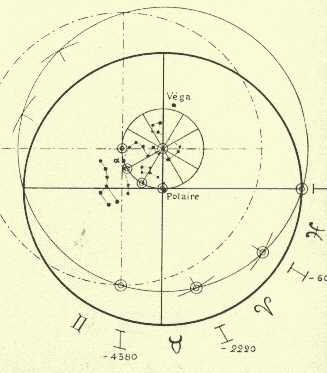
FIGURE 1
The dark-lined circle has its centre at the north celestial pole, marked today by the star Polaris in the Small Bear (Ursa Major). The faint-lined circle has its centre at the pole of the ecliptic at a spot within the constellation of Draco. Where the circles intersect are found the equinoxes. The north celestial pole and the vernal equinox will drift with time, denoted by the other small circles, but the pole of the ecliptic will remain relatively fixed.
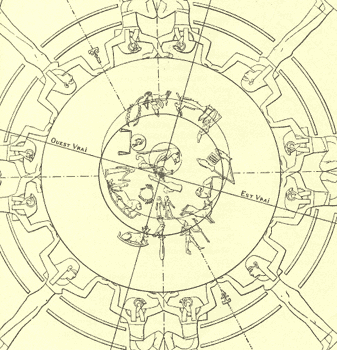
FIGURE 2
The Denderah Zodiac by Schwaller de Lubicz. Schwaller has the pole Of the ecliptic on the breast of the Hippopotamus (Draco) constellation, and The north celestial pole at the front feet of the Upuaut/Fox constellation (Ursa Minor).
In the 1970s the professor of the History of Science, Livio C. Stecchini, examined ancient Egyptian charts of the circumpolar constellations, showing the Hippopotamus (Draco) and the Thigh (Ursa Major or Great Bear) as well as a hawk-headed man, probably Horus, seen pointing a pole or spear at the head of the Bull [13].
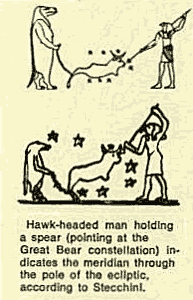
FIGURE 3
According to the Czechoslovakian Egyptologist Zybnek Zaba, the pole or spear held by the hawk-headed man indicated the meridian line passing through the north celestial pole. But Stecchini did not agree. He maintained that Zaba did not notice that the spear’s head divided the seven stars of the Thigh (Big Bear) constellation into groups of three and four stars. This line defined by the spear, argued Stecchini, does not indicate the meridian passing through the north celestial pole at all but the meridian passing through the pole of the ecliptic. According to Stecchini, the ancient Egyptians not only understood the precession of the equinoxes but also knew that the true meridian is the one passing through the pole of the ecliptic. Another point that seems to have escaped both Zaba and Stecchini, however, is the peculiar way the standing Hippopotamus holds a rope with its right hand that is attached to the lower end of the Thigh constellation. In my opinion the position of the ‘right hand’ seems very much to denote the actual position of the pole of the ecliptic onto which the Thigh (Great Bear) constellation seems to be ‘moored’ to or ‘anchored’ with a rope.
Notes:
- See Appendices 1 and 2 in The Orion Mystery.
- L’Astrologie Grecque, Paris 1899 reprinted 1963; also Hamlet’s Mill, D.R. Godine Publishers, Boston 1969, p.143, fn. 11.
- Hamlet’s Mill, p.239.
- Peter Tompkins, Secrets of the Pyramid, Allen Lane, London 1973, p. 172-3.
- Ibid. p.174.
THE GREAT MOORING-POST OF THE SKY
There are many references to a mysterious object called the ‘Great Mooring-post’ in the Pyramid Texts, often found alongside passages that are clearly astronomical in character [14].
“The Great Mooring post calls to you… you ascend here as a star, the Morning Star. He comes to you his father, he comes to you, O Geb; take his hand and let him sit on the great throne that he may join the two ‘Hrmt’ [?] of the sky. ” PT 2014
“The doors of the sky are open for you, the mourning-woman summons you as Isis, the Great Mooring-post calls to you as Nephtys, you have appeared upon the causeway…” PT 2232
It is clear that the ‘Great Mooring-post’ is somehow to be regarded as being associated to the sky ascent of Osiris, the form of the defunct king who is assisted by his sisters, Isis and Nephtys. Now it is well-known that Osiris in his stellar form is the constellation of Orion. Not surprisingly, therefore, there are other references in the Pyramid Texts to the Great Mooring-post which appear in passages where Orion is specifically mentioned. For example:
“O King, you are this great star, the companion of Orion, who traverses the sky with Orion, who navigates the Netherworld with Osiris… the Great Mooring-post cries out to you as to Osiris in his suffering.” PT 882-4
The Great Mooring-post calls out, because you are he who stands and will never tire in the midst of Abydos [Osiris?]… Betake yourself to the waterway, fare upstream to the Thinite Nome, travel about Abydos, in this spirit form of yours which the gods commanded belongs to you, may a stairway to the netherworld be set up for you to the place where Orion is…” PT 1711-7
Orion, however, is not a circumpolar or even a northern constellation but very much a southern constellation. Oddly, there are other passages which associate the Great Mooring-post to the ‘imperishable stars’, the northern circumpolar stars that never ‘die’ i.e. never set [15]:
“The doors of the sky are opened for you, the doors of the firmament are thrown open for you… the Mooring-post cries to you, the sun-folk call you, the Imperishable Stars wait on you…” PT 876
“The Great Mooring-post calls to you… may you remove yourself upon your iron throne, may you cross the lake, may your face be [cleansed?] in the north of the sky…” PT 1012-6
It has long been accepted by Egyptologists that the imagined skyward ascent of the king’s soul was either in the north of the sky among the ‘Imperishable Stars’ or in the south of the sky amongst the stars of Orion [16]. This specific belief is materialised in the Great Pyramid of Giza by the so-called star-shafts emanating from the King’s Chamber, where one was targeted north to the circumpolar stars and the other targeted south to Orion [17]. In consideration of this, it is justified to wonder if the pyramids were not, in some symbolic way, ‘moored’ or ‘anchored’ not just to the circumpolar region of the sky in general but, more specifically, to the pole of the ecliptic, the true ‘pole’ of the sky ?
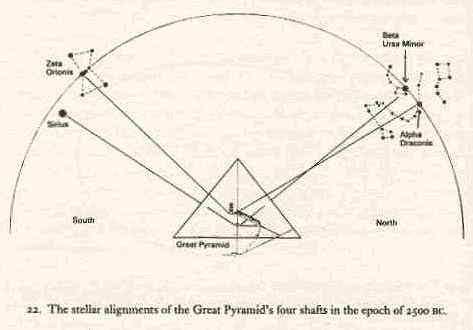
FIGURE 4
The shafts in the Great Pyramid: the southern shafts were directed to Orion’s belt and Sirius; the northern shafts to the circumpolar constellations of Ursa Minor and Draco. The mythological counterparts are Orion-Osiris; Sirius-Isis; Ursa Minor-Upuaut/Horus; Draco-Hippopotamus Goddess.
Notes:
- See PT 794; 863; 872;884;1012; 1366; 1711; 2013; 2232; 2239].
- R.O. Faulkner, The King and the Star-Religion in the Pyramid Texts, J.N.E.S. xxv, 1966, pp.153-161.
- I.E.S. Edwards, The Pyramids of Egypt, Penguin, London 1993, p. 285.
- E.C. Krupp, Echoes of the Ancient Skies, Oxford Univ. Press, 1983, p.102.
THE SLOPE OF THE PYRAMIDS
It is well known that the monumental Pyramids of the Old Kingdom in Egypt, from the 4th Dynasty (c. 2500 BC) to the 6th Dynasty (c.2100 BC), have slopes 52° +- 2°, with two notable exceptions being the two pyramids at Dashur, with the Red Pyramid having a slope of about 43° 22′ and the Bent Pyramid having half its height at slope of 54° 27′ and the top half at 43° 22′. Today there are still some 25 royal pyramids standing in the 25 kilometres strip of desert land adjacent to the west bank of the Nile Valley near modern Cairo. Most have their core masonry sufficiently intact to allow relatively accurate measurements of their slopes. A recent batch of slope measurements were provided by Jaromir Malek and John Baines in 1984 and Mark Lehner in 1997, of which 17 pyramids spanning from the 4th to the 6th Dynasties can by analysed. The first, a pyramid attributed to the relatively unknown pharaoh Huni of the 3rd Dynasty, is generally thought to have been ‘converted’ into a true, smooth-sloped pyramid by the founder of the 4th Dynasty, king Snefru, the father of the Khufu builder of the Great Pyramid at Giza. I have thus considered the Meidum pyramid as being part of the 4th Dynasty trend.
| PHARAOH | Dynasty | Location | Slopes (Malek & Baines) | Lehner |
| Huni | 3 | Meidum | 51° 50′ 35″ | 51° 50′ 35″ |
| Snefru | 4 | Dashur North | 43° 22′ 00″ | 43° 22′ 00″ |
| Snefru | 4 | Dashur South | 54° 27′ 44″ | 54° 27′ 44″ |
| Khufu | 4 | Giza | 51° 50′ 35″ | 51° 50′ 40″ |
| Djedefre | 4 | Abu Ruwash | 60° ~ | 52° ~ |
| Khafre | 4 | Giza | 53° 07′ 48″ | 53° 10′ 00″ |
| Menkaure | 4 | Giza | 51° 20′ 25″ | 51° 20′ 25″ |
| Userkaf | 5 | Saqqara | 53° 07′ 48″ | 53° 07′ 48″ |
| Sahure | 5 | Abusir | 50° 11′ 40″ | 50 11′ 40″ |
| Neferirkare | 5 | Abusir | 53° 07′ 48″ | 53° 07′ 48″ |
| Niussere | 5 | Abusir | 51° 50′ 35″ | 51° 50′ 35″ |
| Isezi | 5 | Saqqara South | 53° 07′ 48″ | 52° 00′ 00″ |
| Unas | 5 | Saqqara | 56° 18′ 35″ | 56° 18′ 35″ |
| Teti | 6 | Saqqara | 53° 07 48″ | 53° 07′ 48″ |
| Pepi I | 6 | Saqqara | 53° 07 48″ | 53° 07′ 48″ |
| Merenre | 6 | Saqqara | 53° 07 48″ | 53° 07′ 48″ |
| Pepi II | 6 | Saqqara | 53° 07′ 48″ | 53° 07′ 48″ |
| TABLE 2 | ||||
| Source: Atlas of Ancient Egypt by Jaromir Malek and John Baines (Adromeda Oxford 1984) and The Complete Pyramid by Mark Lehner (Thames and Hudson 1997). | ||||
No convincing explanation has, so far, been given as to why the Pyramid builders selected slopes of 52° +/- 2°. There are geometrical theories and also construction issues that have been proposed as an explanation in recent years, but none are very satisfactory. From table 1 we can see that the angle of slope most often encountered is 53° 07′ 48″, which occurs in nearly 50% of the Old Kingdom pyramids. This range of angles, from 54.5° to 51.7°, as can be seen from Table 1 above, bears a conspicuous correlation to the range of angles of the pole of the ecliptic of 54.5° to 51.5° at upper culmination as seen from across the pyramid fields of the Old Kingdom. In consideration of this, it is very tempting to inquire whether the ancient builders could have incorporated the angle of the pole of the ecliptic in their design of pyramids.
Let us examine this possibility.
A STAR RELIGION
There are many studies that show that the pyramid builders linked their religion, and consequently their pyramids, to the stars [18]. It is also known that the ancient pyramid builders observed the stars as they culminated at the meridian north and south. Special attention, too, was given to the rising of the stars in the east, especially at dawn. The dominant group of stars that have been identified from ancient Egyptian sources with certainty are Orion, Sirius and the circumpolar constellations of Draco, Ursa Major and Ursa Minor. These circumpolar stars were perceived as being ‘immortal’ and ‘indestructible’ because they never rise or set but perpetually revolve in concentric circles around the north celestial pole. This led many Egyptologists to assert that the ancient Egyptians gave special attention to this region of the sky. At the very least, this all shows that the pyramid builders were avid observers of the rising and culmination of the stars, and most probably recorded their positions over long periods of time. It is also reasonable to assume that observations of the circumpolar stars might have been made while also observing simultaneously other stars rising in the east and still others simultaneously culminating in the south. The opinion is unanimous among Egyptologists and astronomers that the square bases of the Old Kingdom pyramids were deliberately made to face the four cardinal directions, in some cases with remarkably high precision. This, when coupled with the ancient builders’ keen interest in the sky, would mean that the dominant alignments were an axis running east-west and another axis running north-south, forming an imaginary cross through the pyramid. The implications are, therefore, that the east-west axis served for the observation of the rising of celestial bodies in the east whereas the north-south axis served for the observation of the culmination of celestial bodies north and south at the meridian. Now, due-east defines the rising place of the equinoxes i.e. the positions occupied by the sun at the spring or autumn equinox. When an equinox is rising due-east on the horizon, the prime meridian or ‘great circle’ will loop directly above, passing through the north celestial pole and also through the pole of the ecliptic. Thus, by definition, the pole of the ecliptic is always on the prime meridian line when an equinox point is rising in the eastern horizon. However, the pole of the ecliptic will be at upper culmination at the meridian (about 53.5° altitude) only when the vernal point (spring equinox) is rising due-east. When this happens, all the main ‘stations’ (or ‘collures’) of the sky –the two equinoxes and the two solstices– will be found in the four cardinal directions of the celestial landscape.
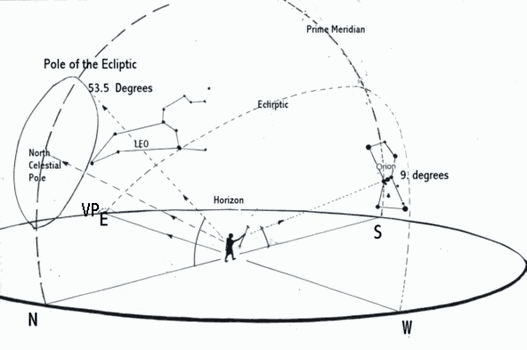
FIGURE 5
An observer at Giza at epoch c. 10,500 BC. When the vernal point (VP) is on the rise due east, the prime meridian loops directly overhead and passes through the north celestial pole, the pole of the ecliptic and the star Zeta Orionis in Orion’s belt.
Thus if the ancient pyramid builders had wished to design a symbolic representation of this very special moment in time when the sky can be truly said to be in perfect order around the pole of the ecliptic, they would have selected a time when Orion was sitting due-south at the same time as the pole of the ecliptic was sitting due-north and the vernal point was sitting due-east.
When was that time?
Notes:
DEFINING THE ‘BEGINNING’ AND COSMIC ORDER OF THE WORLD
By using astronomical software to scan the epochs, we find, interestingly, that the only one time in human history when this arrangement could have happened was c. 10,500 BC. Even more interestingly is the fact that the architectural simulacra defined by the Giza necropolis appears to ‘freeze’ that moment in immutable stone monuments:
- The central pyramid, with its slope of 53 07′ 48′ is less than 1 degree away from the upper culmination of the pole of the ecliptic.
- The three pyramids are set along the north-south ‘collure’ i.e. along the prime meridian of the sky.
- The general pattern of the three pyramids correlates with the general pattern of the three central stars of Orion i.e. Orion’s belt.
- The vernal point is in alignment with the Great Sphinx as well as the constellation of Leo.
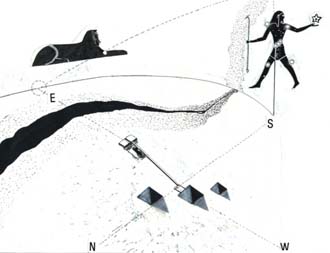
FIGURE 6
The sky in 10,500 BC of the Giza necropolis with mythological figures superimposed on the constellation of Leo and Orion.
This astronomical conjunction, which only occurs in c. 10,500 BC, does not, of course, mean that the monuments themselves were constructed in that remote epoch. What it does is suggest that the ancient pyramid builders of Giza wanted to define the ‘beginning’ and the cosmic order of the world in a grandiose architectural symbolic plan. It also adds more cogency to the argument that the ancient Egyptians not only observed and recorded the stars over vast periods of time, but that they were well-aware of the effects of Precession.