



Geographic Relationships
The Great Pyramid is aligned with Machupicchu, the Nazca lines and Easter Island along a straight line around the center of the Earth, within a margin of error of less than one tenth of one degree of latitude. Other sites of ancient construction that are also within one tenth of one degree of this line include:
Perseopolis, the capital city of ancient Persia; Mohenjo Daro, the ancient capital city of the Indus Valley; and the lost city of Petra. The Ancient Sumarian city of Ur and the temples at Angkor Wat are within one degree of latitude of this line. The alignment of these sites is easily observable on a globe of the Earth with a horizon ring. If you line up any two of these sites on the horizon ring, all of the sites will be right on the horizon ring. 3-D world atlas software programs can also draw this line around the Earth. Start on the Equator, at the mouth of the Amazon River, at 49° 17′ West Longitude; go to 30° 18′ North Latitude, 40° 43′ East Longitude, in the Middle East, which is the maximum latitude the line touches; then go to the Equator at 130° 43′ East Longitude, near the Northwest tip of New Guinea; then to 30° 18′ South Latitude, 139° 17′ West Longitude, in the South Pacific; and then back to 49° 17′ West Longitude, at the Equator.
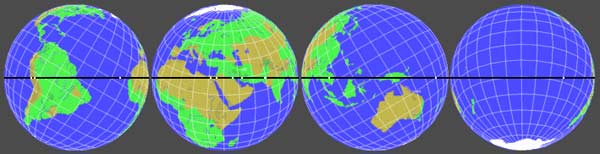 |
|||
| Centered on: | |||
| 0.00° N 49° 17′ W | 30° 18′ N 40° 43′ E | 0.00° N 130° 43′ E | 30° 18′ S 139° 17′ W |
| Images © On Top of the World | |||
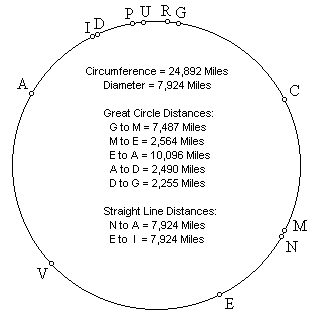
The circumference of this line around the center of the Earth is 24,892 miles. Along this line, the great circle distance from the Great Pyramid to Machupicchu is 7,487 miles, 30.0% of the circumference. Machupicchu is 2,564 miles from Easter Island, 10.3%. Easter Island is 10,096 miles from Angkor Wat, 40.6%. Angkor Wat is 2,490 miles from Mohenjo Daro, 10.0%. Mohenjo Daro is 2255 miles from from the Great Pyramid, 9.1%. In addition to calculating the distances between these sites as a percentage of the circumference of the Earth, the distances may also be calculated in degrees of the 360° circumference, by multiplying the percentage by 3.6. For example, the Great Pyramid is 108° away from Machupicchu.
Angkor Wat and Angkor Thom were constructed at a time when 72 temples were built across the Angkor Plain. The Angkor temple at
Prassat Preah Vihear, 90 miles Northeast of Angkor Wat, is within one tenth of one degree of the line. Like Machupicchu, the temple at Prassat Preah Vihear was built on the edge of a mountaintop. The first temples built around Angkor are near the city of
Rolous, Southeast of Angkor Wat. The temples near Rolous are also thought to have been built on foundations constructed at a much earlier time.
Halfway between Angkor Wat and the Great Pyramid is the Indus Valley, the city of Mohenjo Daro, and the unexcavated city of
Ganweriwala, which is East of Mohenjo Daro, and thought to be just as large. Both of these sites are on the line between Angkor and the Great Pyramid. The Indus Valley is also antipodal to Easter Island. It is an interesting coincidence concerning these two sites, opposite each other on Earth, that of the few ancient written languages of the world that remain undeciphered, two are Indus Valley Script and Rongorongo, the written language of ancient Easter Island. The world’s first known written languages, Egyptian Hieroglyphics and Sumerian Cuneiform, were also developed along this line of ancient sites. The Jewish, Christian, Muslim, Hindu, Brahman and Buddhist religions, as well as ancient Egyptian and Peruvian religions, were also developed along this line.
Anatom Island is the southernmost Island in the new Republic of Vanuatu, formerly known as the New Hebrides. Anatom Island is exactly halfway between Easter Island and Angkor Wat 5,048 miles each way, or 20.3% of the circumference of the Earth. Stone ruins on Anatom Island once housed the largest missionary church in the southern hemisphere.
The line crosses over the source and the mouth of the Amazon, the mouth of the Nile, the mouth of the Tigris-Euphrates, the Indus River and the Bay of Bengal near the mouth of the Ganges.
The line also crosses over a number of areas of the world that are largely unexplored or unexcavated, including the Sahara Desert, the Brazilian Rainforest, the highlands of New Guinea, and underwater areas of the North Atlantic Ocean, the South Pacific Ocean and the South China Sea. For example, the midway point between the Great Pyramid and Machupicchu is in the North Atlantic Ocean, approximately one degree south of the Cape Verde Islands. This is also the midway point between Easter Island and the Indus Valley. Although the Cape Verde Islands were found to be uninhabited when they were rediscovered in 1460 A.D., maps and geographical descriptions for the past 2000 years have shown this location to be the home of ancient island civilizations, including maps showing this location to be the site of Atlantis. In Plato’s account of Atlantis, there was a mountainous region north of the city. Are the higher elevations of those mountains now the Cape Verde Islands?
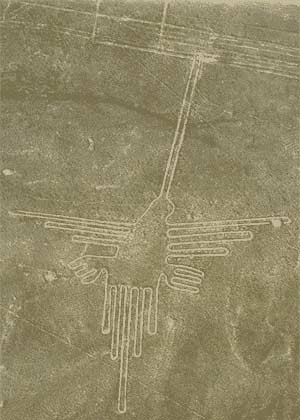
The Hummingbird
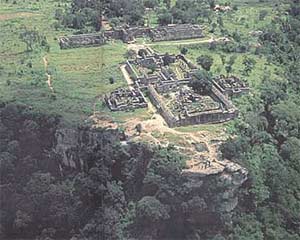
Angkor Prassat Preah Vihear
Angkor Wat is 4,745 miles from the Great Pyramid and the Great Pyramid is 7,677 miles from Nazca. This is a precise expression of Ø, the Golden Section:

4,745 x 1.618 = 7,677
Ninety miles northeast of Angkor Wat are the Angkor temples at Prassat Preah Vihear. Prassat Vihear is 4754 miles from the Great Pyramid. The line of ancient sites crosses over the Great Pyramid and Angkor Vihear.
Twenty five miles northwest of the city of Nazca is a figure known as the Hummingbird. The Hummingbird is 7,692 miles from the Great Pyramid. The line of ancient sites also crosses over the Hummingbird.
The relationship between the distances from Angkor Vihear to the Great Pyramid, and from the Great Pyramid to the Hummingbird at Nazca, is also a precise expression of Φ:
4,754 x 1.618 = 7,692
Because the distance from the Hummingbird to Angkor Vihear is one-half of the circumference of the earth, two Golden Section relationships between these sites are shown by the circumference of the earth along the line of ancient sites:
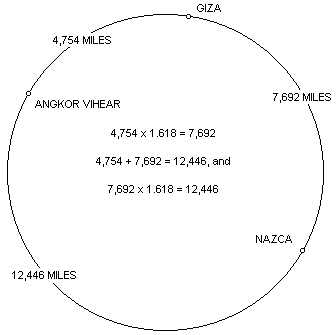
These Golden Section relationships may also be diagramed on a straight line:

The line of ancient sites is a line, from the perspective of the illustration in Part One, and it is a circle, from the perspective of the illustration in Part Six. The line and the circle are found in the greek letter Ø and the number 10. Zero and one are also the first two numbers and the only two numbers in the binary code. The phi relationships between these sites are reflected repeatedly in the first 500 fibonacci numbers. The first three prime numbers, 2, 3 and 5, approximate the intervals along the circumference of 20%, 30% and 50%, between these three sites.
This same percentage of the circumference relationship, accurate to three digits, is found in fibonacci numbers 137-139:
| Percentage of circumference: | First three digits of fibonacci numbers: |
| Angkor to Giza: 19.1% | #137: 191… (Prime) |
| Giza to Nazca: 30.9% | #138: 309… |
| Nazca to Angkor: 50.0% | #139: 500… |
The next prime fibonacci number after #137 is #359. The distances between these sites, in miles, is reflected by fibocacci numbers 359-361, accurately to five digits:
| Distance between sites: | First five digits of fibonacci numbers: |
| Angkor to Giza: 4,754 miles | #359: 47542… (Prime) |
| Giza to Nazca: 7,692 miles | #360: 76924… |
| Nazca to Angkor: 12,446 miles | #361: 12446… |
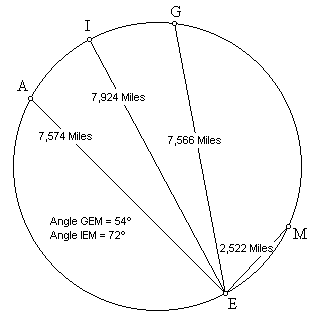

The ratio of the base to the slant height of the Great Pyramid is exactly two times the ratio of the base to the height of the triangle formed by through the earth straight lines connecting the Great Pyramid, Angkor and Easter Island.
LINES THROUGH THE CIRCLE
The line of ancient sites may be viewed as a circle because all of the sites are on a straight line around the center of the Earth. The intervals between the sites are based on their great circle distances from each other.
The circle is oriented so that the two points where the circle crosses the equator are on the horizontal axis, and the two points where the circle reaches its greatest latitudes are on the vertical axis.
| G = The Great Pyramid C = Cape Verde Islands M = Machupicchu N = Nazca E = Easter Island V = Anatom Island |
A = Angkor Wat I = Indus Valley D = Mohenjo Daro P = Perseopolis U = Ur R = Petra |
Straight lines may be drawn through the Earth, connecting Easter Island to Machupicchu, the Great Pyramid, Angkor Wat, and the Indus Valley (antipodal to Easter Island).
The straight line distance, through the Earth, from Angkor Wat to Easter Island (7,574 miles), plus the straight line distance from Easter Island to Macchupicchu (2,522 miles), equals the great circle distance from Angkor Wat to Easter Island (10,096 miles).
The straight line distance from the Great Pyramid to Easter Island (7,566 miles) is three times the straight line distance from Easter Island to Machupicchu (2,522 miles).
The straight line distance from Easter Island to its antipodal point in the Indus Valley (7,924 miles), which is also the diameter of the Earth, is 3.1416 times the straight line distance from Easter Island to Machupicchu (2,522 miles), a precise expression of π.
Since the circumference of the Earth is also 3.1416 times the diameter of the Earth, the straight line distance from Easter Island to Machupicchu times π² equals the circumference of the Earth.
The angle formed by the lines from Easter Island to Machupicchu, and to the Indus Valley, is 72°. The angle formed by the lines from Easter Island to Machupicchu, and to the Great Pyramid, is 54°.
Lines connecting Easter Island, the Great Pyramid, and the Angkor temples near Rolous, form an isosceles triangle with base angles of 72.9°. The base of this triangle (AG) is 4462 miles long. The height of this triangle (HE) is 7220 miles long. The length of the base of the triangle times φ equals the height of the triangle:
4462 miles x 1.618 = 7220 miles
The length of the base of each face of the Great Pyramid is 755.6 feet. The slant height of each face is 611 feet. One half of the length of the base times φ equals the slant height of the Great Pyramid:
755.6 feet ÷ 2 = 377.8 feet
377.8 feet x 1.618 = 611 feet
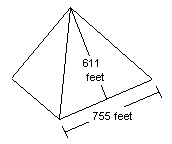
Because the distance between the Great Pyramid and Angkor is very nearly 20% of the circumference, they are very nearly 72° apart, along the circle. Because the distance from the Great Pyramid to Easter Island is very nearly 40% of the circumference, and the distance from Angkor to Easter Island is very nearly 40% of the circumference, the Great Pyramid and Angkor are both very nearly 144° away from Easter Island, along the circle.
The number 72, and to a lesser extent the numbers 54, 108, and 144, have been associated with the designs of these sites, particularly at the Great Pyramid and Angkor. The ratio of the height and the perimeter of the Great Pyramid, to the size of the Earth, is a multiple of 72. The number of temples built around Angkor is 72, and the number 54 is reflected in the numbers of statuary in the temples at Angkor. The use of these numbers is also prevalent in ancient writings and folklore surrounding these sites. The number 54 is itself a factor of 72, in that 72 plus ½ of 72, or 36, equals 108, which divided by two equals 54.
The number 72 is also associated with the astronomical phenomenon known as precession, because 72 years is the length of time it takes for the constellations to move one degree due to precession. This has been offered as an explanation for the use of these numbers, suggesting that the builders of these sites were aware of the precession of the equinoxes. In the 2nd century B.C., the Greek mathematician, Archimedes, wrote an article entitled The Sand Reckoner, in which he cited earlier Greek mathematicians (like Archimedes, they had studied in Alexandria and Heliopolis) who had calculated that the Sun occupied 1/720 of the circle of the constellations. This may be an additional, or alternative, explanation for the prevalence of the number 72, and its multiples and factors, found in these sites. In any event, the existence of these numbers in the geometric relationships between these sites is complementary to the use of these numbers in their internal designs.
THE GREAT PYRAMID AND THE 30th PARALLEL
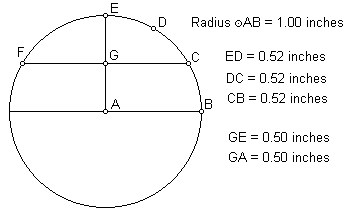
This circle has a different orientation than the previous diagrams and is two inches in diameter. The horizontal axis is the Equator, FC is the 30th parallel, D is 60° North latitude and E is the North Pole. The 30th parallel is exactly one-third of the great circle distance from the Equator to the North Pole, and it is located at exactly one-half of the height of the Northern Hemisphere. Like the Great Pyramid, the maximum latitude of the line of ancient sites is very close to the 30th parallel.
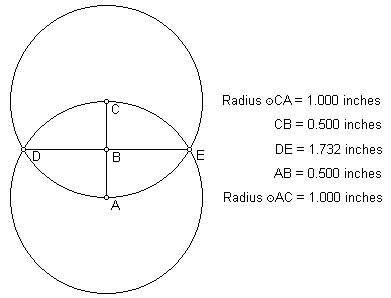
This diagram illustrates that the relationship of the 30th parallel to the circumference of the Earth is the geometric relationship known as the Vesica Pisces. In relation to the lower circumference, DE is at 30° N latitude. In relation to the upper circumference, DE is at 30° S latitude. The ratio between the straight line distance of the 30th parallel and the radius of the Earth is 1.732 to one. 1.732 is the square root of three.
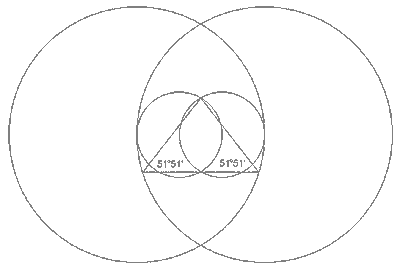
Paul Michell and Charles Henry have noted the relationship between the Great Pyramid and the Vesica Pisces. The small circles in this diagram are one inch in diameter, and the large circles are three inches in diameter, forming a small Vesica Pisces circumscribed by a larger one. The triangle in this diagram has the same angular dimensions as the Great Pyramid.
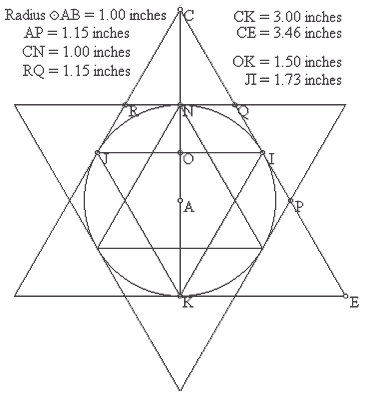
The circle in this diagram also represents the circumference of the Earth with the poles on the vertical axis. The radius of the circle is 1.00 inch. The exterior and interior equilateral triangles touch the circle only at the 30th parallels and the poles. The height of each equilateral triangle is 87% of the length of each of it’s sides:
3.00 ÷ 3.46 = .87
1.50 ÷ 1.73 = .87
1.00 ÷ 1.15 = .87
The length of each of the sides of the interior triangles, including the straight line distance through the earth at the 30th parallel, is also 87% of the diameter of the Earth:
1.73 ÷ 2.00 = .87
The radius of the Earth is also 87% of the distance from the center of the Earth to the point of the exterior triangles’ intersections (AP, AQ, AR, etc.):
1.00 ÷ 1.15 = .87
The mile, which is thought to have been developed before the size and shape of the Earth was known, is 87% of the length of the nautical mile, which was developed specifically in relation to the size of the Earth. The nautical mile equals one minute of latitude, so 60 nautical miles equals one degree of latitude and 5,400 nautical miles equals the 90 degrees of latitude between the Equator and the poles. The distance from the Equator to the poles is 6,215 miles:
5,400 ÷ 6,215 = .87
The Greek foot is thought to have been developed independently from the foot, and also before the size and shape of the Earth was known. The foot is 87% of the length of the Greek foot.
ALIGNMENTS OF THE NAZCA LINES & FIGURES
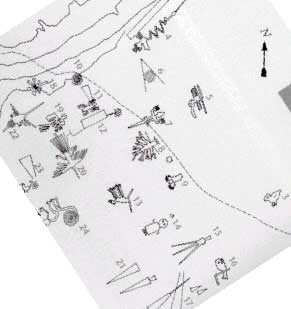
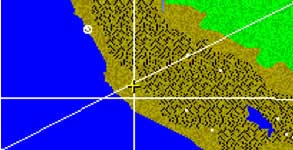
The glyphs and lines at Nazca are oriented along the line of ancient sites. This image of the glyphs at Nazca, with a compass bearing, is available on the internet, but it is usually oriented away from the cardinal points so that the figures are roughly horizontal and vertical. Rotating this image so that the north-south axis is vertical, aligns the figures and geometric drawings to the line of ancient sites as it crosses Nazca.
 |
| Image © On Top of the World |
Nazca is marked by the yellow cross on the illustration. The vertical line in the center of the picture is 75° West Longitude. The horizontal line is 15° South Latitude. The white dot touching the north side of the line on the upper right side of the illustration is Machupicchu.
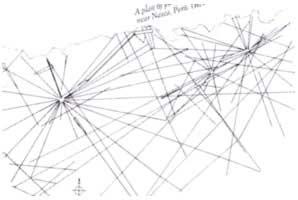
This illustration of the Nazca lines has also been rotated so that the north-south axis is vertical, and shows the primary orientation of the lines is from Southwest to Northeast, along the line of ancient sites.
THE AXIS POINTS
Just as every point along the equator is 6,215 miles from both the North and South Poles, every point along the line of ancient sites is 6,215 miles from two axis points on Earth. The axis point in the Northern Hemisphere is near the Southeastern coast of Alaska, at 59° 42′ N 139° 17′ W, 25 miles Northeast of Yakutat, Alaska
The North and South Poles have not always been in their present locations. Several theories have been offered to explain observed and suspected movements of the poles in relation to the surface of the Earth. Plate tectonics, the prevailing theory, suggests gradual movements of the surface of the Earth. This theory has been called into question by recent measurements of relative movements of the earth’s surface, and by accumulating seismological data. Alternative theories include: Axial shifts; polar wander; and a catastrophic form of polar wander known as Earth crust displacement.
 |
| Image © Cosmi 3-D World Atlas |
Charles Hapgood advocated the Earth crust displacement theory in a book entitled The Path of the Poles. Hapgood supported this theory with geomagnetic and carbon dated evidence. In a book entitled When the Sky Fell, Rose and Rand Flem-Ath also advocate the Earth crust displacement theory, with additional geological and archeological evidence. Both of these works conclude that the North Pole was located in the Yukon, at 63° N 135° W, approximately 80,000 to100,000 years ago.
This is about 250 miles Northeast of the axis point for the line of ancient sites at 59° 42′ N 139° 17′ W. It is interesting to note that some of the heaviest remaining glaciation in all of North America is on the Southeastern coast of Alaska, surrounding Yakutat.
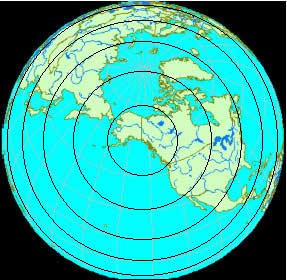
If 59° 42′ N 139° 17′ W was the location of the North Pole, then the line of ancient sites would have been the equator at that time. The concentric circles in the diagram represent lines of latitude from 59° 42′ N 139° 17′ W. The circle closest to the center of the diagram is 75°N, followed by 60°N, 45°N, 30°N and 15°N. The line of ancient sites is just beyond the horizon.
Since many of the sites along the line are precisely oriented to the present North and South Poles, it is not suggested that they were constructed when the poles were in a prior location. However, if this line had previously been the equator, the placement of these sites on this line would be a remarkable coincidence.
In a book entitled Atlantis Blueprint, Rand Flem-Ath and Colin Wilson have listed some of these sites, and a number of other sites, in relation to their calculation of the North Pole in the Yukon, including sites that would have been on the equator during this prior polar alignment. A line around the center of the earth, with the Yukon Pole as it’s axis point, approaches and crosses over the line of ancient sites at antipodal points in Peru and Cambodia. Along the line of ancient sites, the sites in these two areas are close to being equally distant from the Yukon Pole and from the Yakutat axis point.
None of the theories offered to explain the motions of the surface of the Earth, relative to the poles, can pinpoint exact prior polar positions. The round number coordinates that are used by Hapgood and the Flem-Aths for the Yukon Pole indicate that they are approximations. If the line of ancient sites was originally selected because of its equatorial relationship with a prior polar alignment, the most accurate way to determine the location of the prior alignment is to simply calculate it from the location of the line of ancient sites.
THE GREAT PYRAMID, PERU & PYTHAGORAS
 |
| Image © On Top of the World |
 |
The Great Pyramid precisely expresses the 2π relationship between the circumference and the radius of the Earth. The height of the Great Pyramid is 481.4 feet. The perimeter of the Great Pyramid (the length of all four sides at the base of the pyramid) is 3,023 feet. The height of the Great Pyramid times 2π (6.28) is 3,023 feet.
The relationship of the distances between the Great Pyramid, Nazca, and the axis point of the line of ancient sites, precisely expresses this same 2π relationship.
Inspired by Charles Hapgood’s Earth crust displacement theory, Jim Bowles, a retired NASA engineer, wrote The Gods, Gemini, and the Great Pyramid. In his book, Bowles provides a scientific explanation for the causes of Earth crust displacements. He also discusses many similarities between the lines and figures at Nazca, the Great Pyramid and ancient Egyptian hieroglyphic texts. Bowles observes that the Great Pyramid and the Nazca lines and figures would have been on the equator if the North Pole had been in southeastern Alaska, and in a lengthy proof using coordinate derivations and spherical trigonometry he demonstrates the 2π relationship between the three sites. Of course, this 2π relationship exists between the Great Pyramid, Nazca and the axis point for the line of ancient sites, regardless of whether or not the axis point was once the North Pole.
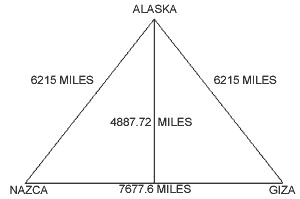
This relationship may also be demonstrated by diagramming the great circle distances between the three sites on a flat surface. Along the line of ancient sites, the distance from the Great Pyramid to the Nazca lines is 7,677.6 miles. The distance from the line of ancient sites to the axis point in southeastern Alaska is 6,215 miles. This triangle, with a base of 7,677.6 miles and sides of 6,215 miles, forms an isosceles triangle with base angles of 51° 51′ and a height of 4,887.72 miles. The height of the triangle is calculated using Pythagoras‘ theory (a² + b² = c²). The height of the triangle times 2π equals the base of the triangle times four.
3.1416 x 2 = 6.2832
4,887.72 miles x 6.2832 = 30,710.4 miles
7,677.6 miles x 4 = 30,710.4 miles
Another special triangular relationship, found in the dimensions of the King’s Chamber in the Great Pyramid, is the 3-4-5 right triangle that elegantly expresses Pythagoras’ theory (3² + 4² = 5²). In the King’s Chamber, the diagonal length of the east wall is 309″, the length of the chamber is 412″, and the long central diagonal is 515″. The stone over the entrance to the King’s Chamber is the only stone in the walls that is two courses high. This stone also expresses a 3-4-5 right triangle relationship by its measurements of 124″L x 93″H x 155″ diagonal.
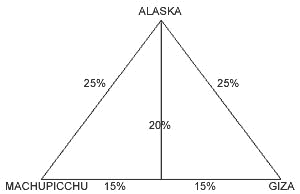
The distances between the Great Pyramid, Machupicchu, and the axis point of the line of ancient sites, express this same 3-4-5 relationship. The distance from the Great Pyramid to Machupicchu (7,487 miles) is exactly 30.0% of the circumference of the Earth. The distance from the Great Pyramid and from Machupicchu to the axis point for the line of ancient sites is exactly 25% of the circumference of the Earth. Dividing this isosceles triangle by it’s height forms two 15%-20%-25% right triangles.
PART 8 – EASTER ISLAND SYNCHRONICITY
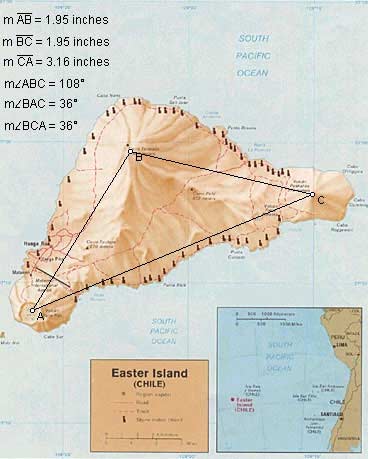
The three volcanic peaks on Easter Island form an isosceles triangle with base angles of 36°. The relationship between the length of the base of this triangle and the lengths of the sides precisely expresses Φ:
1.95 x 1.618 = 3.16.
The Great Pyramid is 10,055 miles from the Southwestern volcano on Easter Island. A triangle formed by the great circle distances between Easter Island, the Great Pyramd, and the axis point for the line of ancient sites in S. E. Alaska, has the same angular dimensions as the triangle formed by the volcanic peaks on Easter Island, and also precisely expresses Φ:
6, 215 x 1.618 = 10,055
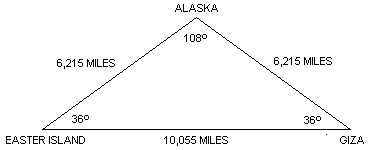
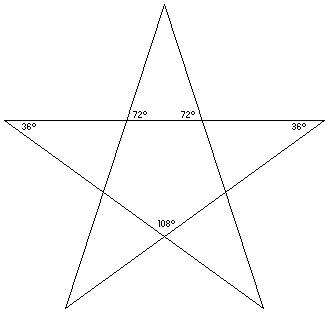
The large triangles in five pointed stars have these same angular dimensions, and express the same Ø relationship. All of the angles in five pointed stars, 36°, 72° and 108°, are numbers that have been associated with the precession of the equinoxes, as well as the internal designs of the Great Pyramid and other ancient sites around the world.
There are 72 major monuments at Angkor, 108 stone figures surround Angkor Thom, and the highest terraces of Angkor Thom house 72 Buddhas in latticework stupas.
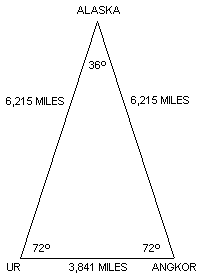
The great circle distances between Angkor Thom, the ziggurat at Ur, and the axis point of the line of ancient sites, forms an isosceles triangle with base angles of 72°. The small triangles in five pointed stars have these same angular dimensions, also precisely expressing Ø:
3,841 x 1.618 = 6,215.
These relationships are also clearly demonstrated by the metric system, which is based on a distance of 10,000 kilometers from the North Pole to the Equator. The distance from Easter Island to the Great Pyramid is 16,180 kilometers and the distance from Ur to Angkor is 6,180 kilometers:
6,180 x 1.618 = 10,000.
10,000 x 1.618 = 16,180.
PART 9 – SINE LANGUAGE
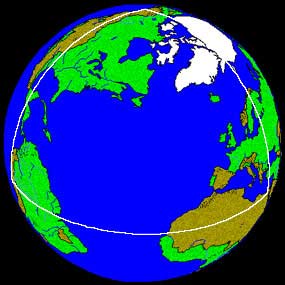
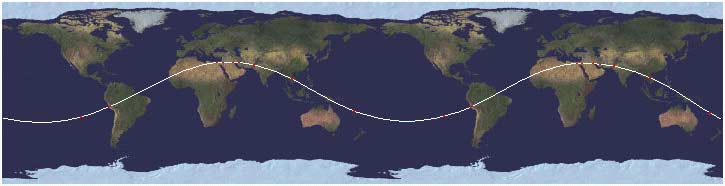
As the Earth rotates on it’s axis, the Equator remains aligned, but the line of ancient sites describes a sine wave as a result of it’s tilt relative to the Equator. The line of the ecliptic may be observed describing a similar wave by spinning a globe that has a line of the ecliptic. The wave may also be visualized by drawing the line of ancient sites on a flat projection of the Earth.
 |
| Image © Cosmi 3-D World Atlas |
Harmonics, electricity, and many other aspects of nature are based on sine waves. Because this particular wave repeats with each full rotation of the earth, the frequency of the wave is equal to the circumference of the Earth. The amplitude of this wave, measured from the middle of the wave (the equator), is 30° of latitude. Recall that the 30th parallels are ½ of the height of each hemisphere, or ½ of the radius of the Earth.
Since the height of the wave is equal to ½ of the Earth’s radius, the ratio between the frequency of the wave and it’s amplitude is 4π. Measuring the amplitude from the top of the wavelength to the bottom (from 30° N to 30° S), the amplitude is equal to the radius of the Earth, and the ratio between the frequency and the amplitude of the wave is 2π.
CONCLUSION
Many similarities between these sites have been well documented, including the use of perfectly cut and precisely placed monolithic stones, exact orientations to the cardinal points and astronomical orientations. The prevailing view of world history dismisses these similarities as coincidental developments of separate stone age cultures. Unless it is also a coincidence that these sites are located at mathematically and geometrically significant points on a single line around the center of the Earth, it may be time to reconsider the idea that Europeans of the present era were the first to know the size and shape of the Earth.
If the locations of all of these sites is not a coincidence, and if there are sites yet to be discovered along the line, one good place to look might be halfway between the Great Pyramid and Machupicchu, just south of the Cape Verde Islands.
Another good place to look might be halfway between the Great Pyramid and Easter Island, at 4° 19′ North Latitude, 41° 30′ West Longitude, also under the North Atlantic Ocean:
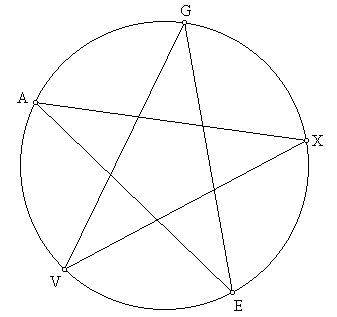 |
G = Great Pyramid A = Angkor Wat V = Anatom Island E = Easter Island X = Atlantis? |
The distance from the Great Pyramid to Easter Island is approximately 40% of the circumference of the Earth. The X in the diagram is halfway between the two, 20% each way. Machupicchu is halfway between the X in the diagram and Easter Island, 10% each way. The Distance from the Great Pyramid to Angkor Wat is approximately 20% of the circumference, and the Indus Valley is halfway between the two, 10% each way. The Distance from Easter Island to Angkor Wat is approximately 40% of the circumference, and Anatom Island is halfway between them, 20% each way. These sites are located in multiples of 10% of the circumference of the Earth, and particularly at 20% intervals. Although there are no islands near the location of the X in the diagram, it is interesting to note that the famous Piri Reis map shows a large island in this location, and the geology of recent core samples, taken from the ocean floor in this area, is of continental rather than oceanic type rock.
COORDINATES, CALCULATION OF ALIGNMENT, AND LINKS TO ANCIENT SITES
| Links: | Latitude | Longitude | Distance To: 59°42’N 139°17’W |
Distance To: Line of Ancient Sites |
| The Great Pyramid | 29° 59′ N | 31° 09′ E | 6,215 miles | 0 miles |
| Machupicchu | 13° 06′ S | 72° 35′ W | 6,218 miles | 3 miles |
| Nazca | 14° 25′ S | 75° 20′ W | 6,215 miles | 0 miles |
| Easter Island | 27° 04′ S | 109° 22′ W | 6,224 miles | 9 miles |
| Anatom Island | 20° 10′ S | 169° 48′ E | 6,215 miles | 0 miles |
| Angkor Vihear | 14° 25′ N | 104° 40′ E | 6,215 miles | 0 miles |
| Angkor Wat | 13° 27′ N | 103° 53′ E | 6,300 miles | 85 miles |
| Mohenjo Daro | 27° 15′ N | 68° 17′ E | 6,222 miles | 7 miles |
| Perseopolis | 29° 50′ N | 52° 52′ E | 6,209 miles | 6 miles |
| Ur | 30° 57′ N | 46° 07′ E | 6,167 miles | 48 miles |
| Petra | 30° 09′ N | 35° 47′ E | 6,218 miles | 3 miles |
A SECOND ALIGNMENT WITH EASTER ISLAND AND MOHENJO-DARO
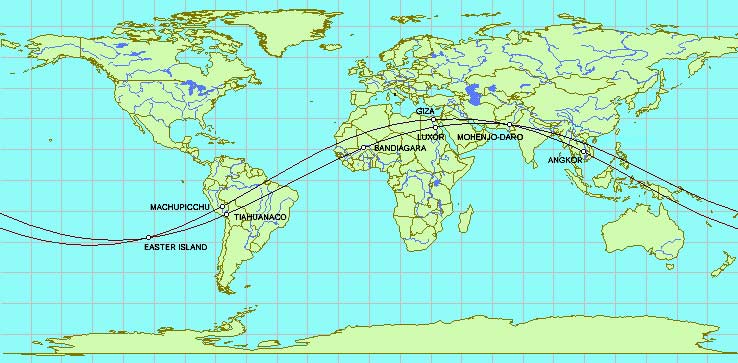
In Global Sacred Alignments, Terry Walsh diagrams several alignments of ancient sites on straight lines around the center of the earth, and mentions several others. He addresses the alignment of the Great Pyramid with Easter Island, Machupicchu and Perseopolis, and he diagrams an alignment of Easter Island with Tiahuanaco, Luxor, Varanasi and Bandiagara, the ancient capital city of the Dogons. This second alignment also crosses over Mohenjo Daro and Ganweriwali in the Indus Vallley.
 |
| Image © Cosmi 3-D World Atlas |
The total circumference of this second alignment is 24,880 miles. The great circle distance from Easter Island to Tiahuanaco is 2,703 miles, 10.8% of the total circumference. The distance from Tiahuanaco to Bandiagara is 4,930 miles, 19.8%. The distance from Bandiagara to Luxor is 2,473 miles, 9.9%. The distance from Luxor to Easter Island’s antipodal point in the Indus Valley near Ganweriwali is 2,363 miles, 9.5%.
Because Easter Island, Machupicchu, the Great Pyramid, the Indus Valley and Angkor are also aligned at 10% intervals around the earth, there is a high coincidence of paired sites along these two alignments. In addition to the convergence of the two alignments at Easter Island and Mohenjo-Daro, Machupicchu is paired with Tiahuanaco and the Great Pyramid is paired with Luxor. If the pairing of these sites along these two alignments is not a coincidence, two good places to look for other ancient sites would be in the Sahara Desert, near the border between Mali and Mauritania, at 21° N, 7° 40′ W, 2,488 miles southwest of the Great Pyramid, and in the shallow water of the South China Sea, just off the coast of Vietnam, at 18° 43′ N, 106° 27′ E, 2,488 miles southeast of Mohenjo-Daro.
Coordinates, Calculations of Alignments, and Links to Ancient Sites
| Links: | Latitude | Longitude | Distance To Axis Point: 59°42’N 139°17’W |
Distance To: Great Circle |
| Easter Island | 27° 04′ S | 109° 22′ W | 6,224 miles | 9 miles |
| Machupicchu | 13° 08′ S | 72° 30′ W | 6,218 miles | 3 miles |
| The Great Pyramid | 29° 59′ N | 31° 09′ E | 6,215 miles | 0 miles |
| Petra | 30° 09′ N | 35° 47′ E | 6,218 miles | 3 miles |
| Perseopolis | 29° 50′ N | 52° 52′ E | 6,209 miles | 6 miles |
| Mohenjo Daro | 27° 15′ N | 68° 17′ E | 6,222 miles | 7 miles |
| Angkor Vihear | 14° 25′ N | 104° 40′ E | 6,220 miles | 0 miles |
| Links: | Latitude | Longitude | Distance To Axis Point: 62° 30′ N 123° 10′ W |
Distance To: Great Circle |
| Easter Island | 27° 04′ S | 109° 22′ W | 6,216 miles | 1 mile |
| Tiahuanaco | 16° 32′ S | 68° 42′ W | 6,187 miles | 28 miles |
| Bandiagara | 14° 21′ N | 3° 37′ W | 6,228 miles | 13 miles |
| Luxor | 25° 43′ N | 32° 35′ E | 6,208 miles | 7 miles |
| Mohenjo-Daro | 27° 15′ N | 68° 17′ E | 6,216 miles | 1 mile |
| Varanasi | 25° 21′ N | 82° 58′ E | 6,210 miles | 5 miles |
A SECOND ALIGNMENT WITH THE GREAT PYRAMID
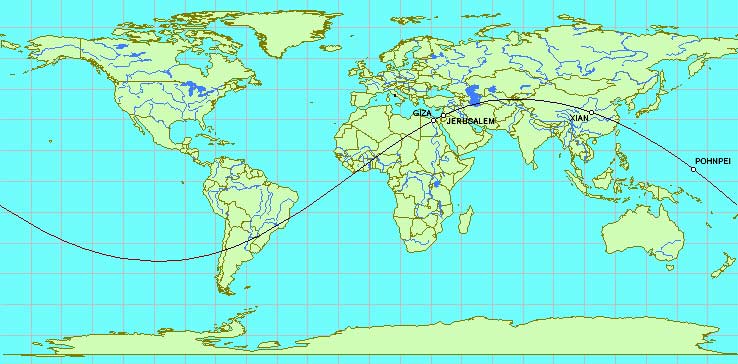
The Great Pyramid is aligned with the Temple Mount in Jerusalem; the Chinese city of Xian, site of the terracotta soldiers, the unexcavated tomb of Qin Shi Huang, the first Emperor of China, and numerous other pyramids and burial mounds; and the underwater ruins of Nan Madol that surround Pohnpei Island.
 |
| Image © Cosmi 3-D World Atlas |
Coordinates, Calculations of Alignments, and Links to Ancient Sites
| Links: | Latitude | Longitude | Distance to: 50° 40’N 103° 30’W |
Great Circle |
| The Great Pyramid | 29° 59′ N | 31° 09′ E | 6217 miles | 2 miles |
| Jerusalem | 31° 44′ N | 35° 13′ E | 6213 miles | 2 miles |
| Xian | 34° 22′ N | 109° ‘E | 6236 miles | 21 miles |
| Pohnpei | 6° 56′ N | 158° 09 ‘E | 6216 miles | 1 mile |
A SECOND ALIGNMENT WITH MACHUPICCHU
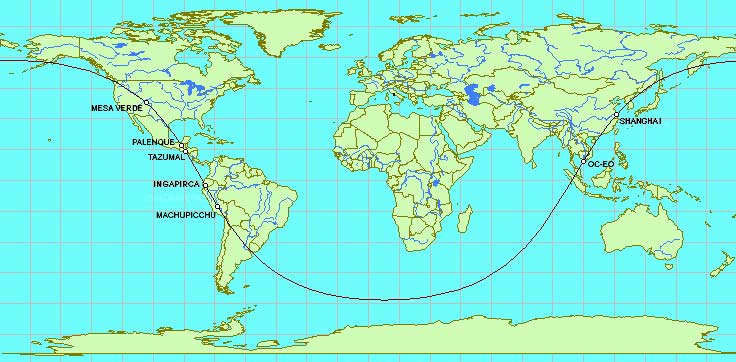
Machupicchu, Ollantaytambo, Saqsaywaman and Cusco are aligned with Ingapirca; Tazumal, Mixco Viejo, Bonampak, Palenque, and La Venta; Mesa Verde and Chaco Canyon; Shanghai; and the partially submerged ancient capital city of Oc-Eo in the Mekong Delta.
 |
| Image © Cosmi 3-D World Atlas |
This alignment also crosses over the source of the Amazon River; the mouth of the Parana River at Buenos Aires; the mouth of the Mekong River at Oc-Eo; the mouth of the Xi river at Macau; the mouth of the Yangtze River at Shanghai; and the mouth of the Rio Grande River at Matamoros.
Coordinates, Calculations of Alignments, and Links to Ancient Sites
| Links: | Latitude | Longitude | Distance to: 31° 50′ S 170° 40′ W |
Great Circle |
| Cusco | 13° 31′ S | 71° 59′ W | 6229 miles | 14 miles |
| Ollantaytambo | 13° 15′ S | 72° 16′ W | 6223 miles | 8 miles |
| Machupicchu | 13° 06′ S | 72° 35′ W | 6214 miles | 1 miles |
| Ingapirca | 2° 31’S | 78° 49’W | 6239 miles | 24 miles |
| Tazumal | 13° 59′ N | 89° 33′ W | 6224 miles | 9 miles |
| Mixco Viejo | 14° 58′ N | 90° 32′ W | 6207 miles | 8 miles |
| Bonampak | 16° 52′ N | 92° 15′ W | 6237 miles | 22 miles |
| Palenque | 17° 32′ N | 91° 58′ W | 6216 miles | 1 mile |
| La Venta | 18° 00′ N | 92° 55′ W | 6190 miles | 25 miles |
| Chaco Canyon | 36° 03′ N | 107° 59′ W | 6203 miles | 12 miles |
| Mesa Verde | 37° 09′ N | 108° 31′ W | 6215 miles | 0 miles |
| Shanghai | 31° 14′ N | 121° 27′ E | 6222 miles | 7 miles |
| Oc-Eo | 10° 01′ N | 105° 06′ E | 6249 miles | 34 miles |
A SECOND ALIGNMENT WITH PERSEOPOLIS
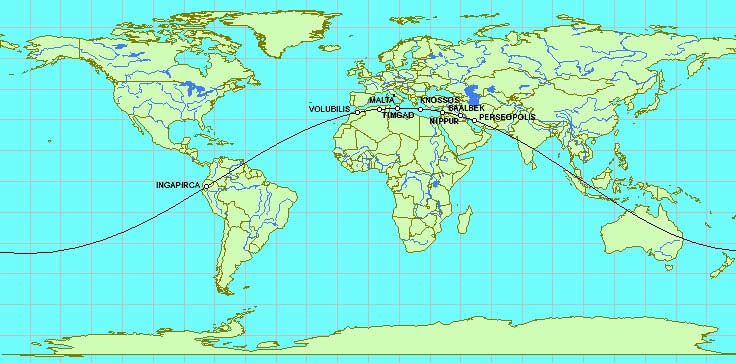
Perseopolis is aligned with the ancient Sumarian/Babylonian/Assyrian center at Nippur; Baalbek and the ancient Phoenician city of Byblos; the ancient cities of Palaikastro and Knossos on the Island Of Crete; the Island of Malta; the North African sites of ancient Roman construction at Volubilis and Timgad; and the Incan and Pre-Incan fortress, temples and astronomical observatories at Ingapirca.
Coordinates, Calculations of Alignments, and Links to Ancient Sites
| Links: | Latitude | Longitude | Distance to: 54° 05’N 165° 20’W |
Great Circle |
| Ingapirca | 2° 31′ S | 78° 49′ W | 6,221 miles | 6 miles |
| Volubilis | 34° 51′ N | 5° 33′ W | 6,226 miles | 11 miles |
| Timgad | 35° 27′ N | 6° 38′ E | 6,233 miles | 18 miles |
| Malta | 35° 53′ N | 14° 31′ E | 6,215 miles | 0 miles |
| Knossos | 35° 17′ N | 25° 09′ E | 6,228 miles | 13 miles |
| Palaikastro | 35 14′ N | 26° 16′ E | 6,227 miles | 12 miles |
| Byblos | 34 08′ N | 35 38′ E | 6,215 miles | 0 miles |
| Baalbek | 34° N | 36° 13′ E | 6,217 miles | 2 miles |
| Nippur | 32 05′ N | 45 10′ E | 6,212 miles | 3 miles |
| Perseopolis | 29° 50′ N | 52° 52′ E | 6,208 miles | 7 miles |
A SECOND ALIGNMENT WITH LUXOR AND PALENQUE
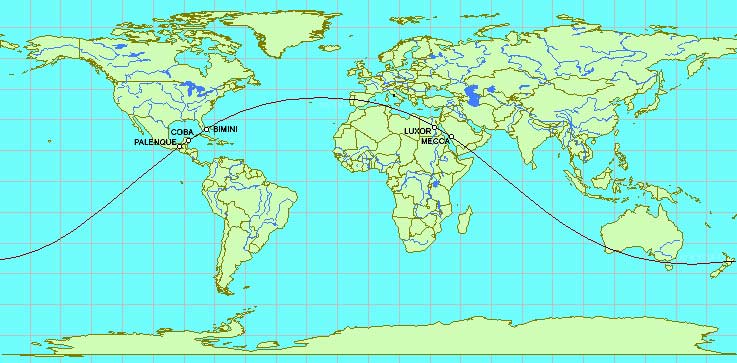
In Global Sacred Alignments, Terry Walsh diagrams the alignment of Palenque, Bimini, Luxor and Mecca. The large Mayan city of Coba, site of the tallest Mayan pyramid, is also on this alignment.
 |
| Image © Cosmi 3-D World Atlas |
Coordinates, Calculations of Alignments, and Links to Ancient Sites
| Links: | Latitude | Longitude | Distance to: 49° 52′ S 23° 45′ W |
Great Circle |
| Palenque | 17° 32′ N | 91°58’W | 6,222 miles | 7 miles |
| Coba | 20° 31’N | 87° 39′ W | 6,218 miles | 3 miles |
| Bimini | 25° 46′ N | 79° 15′ W | 6,213 miles | 2 miles |
| Luxor | 25° 43′ N | 32° 35′ E | 6,211 miles | 4 miles |
| Mecca | 21° 26′ N | 39° 53′ E | 6,221 miles | 6 miles |
ANOTHER LOOK AT AN OLD DESIGN
 |
| Image © On Top of the World |
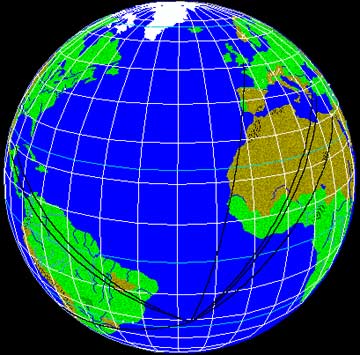
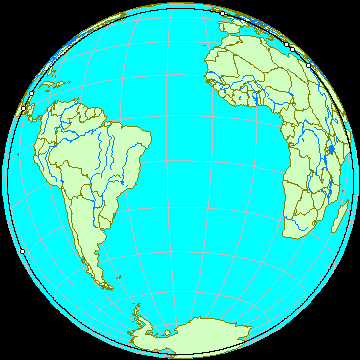
The Great Pyramid, Easter Island, Palenque, Dzibilchatun, Stonehenge, the Acropolis, and what remains of the Island of Thera are all equally distant from a point in the South Atlantic Ocean located at 20°55’S 26°10’W.
 |
| Image © Cosmi 3-D World Atlas |
A circle drawn around 20°55’S 26°10’W with a great circle radius of 5,180 miles crosses over all of these sites. It is interesting to note that the distance from the North Pole to 15° north latitude is also exactly 5,180 miles. Thus, the circumference of this circle is the same as the circumference of the 15th parallels.
Northwest of the Acropolis, Delphi is close to the circle. Northwest of the Great Pyramid, the ancient capitals of Alexandria and Sais in Egypt are close to the circle. Several pyramids and other sites of ancient construction are south-south-east of the Great Pyramid and close to the circle. Likewise, a number of Mayan and Olmec sites between Palenque and Dzibilchitun on the Yucatan Peninsula are close to the circle. Similarly, in addition to Stonehenge, a number of megalithic sites in Southern England, Southern Ireland and Northern France are close to the circle.
 |
| Image © VectorGlobe |
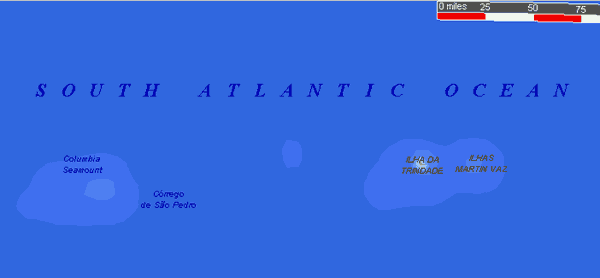
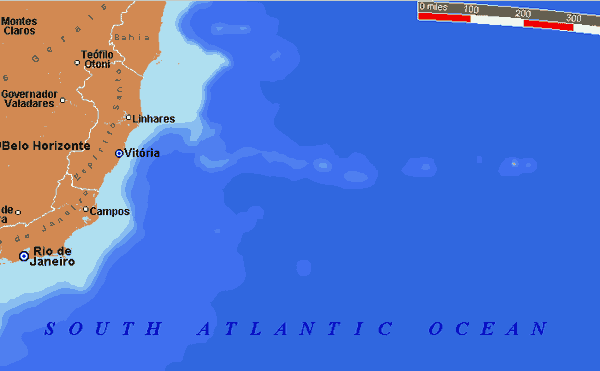
Tiny Ilhas Martin Vaz, the last link in an old island chain running east from the coast of Brazil, is located at 20°28’S 28°51’W, just over two degrees west of 20°55’S 26°10’W. Ilhas de Trindade is the next to last island in the chain, located at 20°30’S 29°19’W. The British astronomer, Richard Halley, once took over Trindade on behalf of the British Crown. Trindade is famous for a UFO sighting that was photographed in 1958. In addition to the two locations that were suggested as possible sites for the submerged island of Atlantis in A New Look at an Old Design, another good place to look is just East of Ilhas Martin Vaz, at 20°55’S 26°10’W.
 |
| Image © VectorGlobe |
| Links: | Latitude | Longitude | Distance to: 20°55’S 26°10’W |
Circle |
| The Great Pyramid | 29°59’S | 31°09’E | 5,175 miles | 5 miles |
| Easter Island | 27°04S | 109°22’W | 5,182 miles | 2 miles |
| Palenque | 17°32’N | 91°58’W | 5,185 miles | 5 miles |
| Dzibilchatun | 21°10’N | 89°38’W | 5,172 miles | 8 miles |
| Stonehenge | 51°08’N | 1°49’W | 5,175 miles | 5 miles |
| The Acropolis | 37°57’N | 23°42’E | 5,185 miles | 5 miles |
| Thera | 36°22’N | 25°22’E | 5,182 miles | 2 miles |
UTILITIES
- On Top of the World, 3-D world atlas shareware, is freely available in demo versions on the internet, and will precisely draw the line around the center of the Earth with good distance measurement and zoom features.
- VectorGlobe is an easy to navigate 3-D world atlas with excellent topographical, bathymetric and political features, and a huge database of sites.
- The Cosmi 3-D world atlas is easy to navigate and offers very wide angle views of the Earth. Also contains a selection of flat projection maps.
- The NASDA/MITI website has satellite images of the world’s rainforests, with an easy to navigate image browser.
- The Geometer’s Sketchpad is freely available in demo versions on the internet, and will draw diagrams with distance and angle measurements.
- How far is it is a freely available internet utility that provides great circle distances from cities or lat-long coordinates.
LINKS TO RELATED SITES AND SUBJECTS
- Graham Hancock has authored or co-authored several books that discuss alignments and many other remarkable and related aspects of these sites, including: Fingerprints of the Gods; Keeper of Genesis, with Robert Bauval; and Heaven’s Mirror, with Santha Faiia.
- Terry Walsh has authored a wonderful booklet entitled Global Sacred Alignments, that describes several great circle alignments, including the alignment of Easter Island, Machupicchu, Giza and Perseopolis. This booklet is available through the Sacred Geometry Group, Library of Avalon, 2 – 4 High Street, Glastonbury, Somerset BA6 9DU.
- Carrie Kozikowski has authored a letter and an article entitled Geological History Recorded by Missing Ancient Civilizations, that describes the alignment of the North Pole in Southern Alaska and discusses the alignment of sites along the Equator and the Tropic of Cancer, with the North Pole in Southern Alaska.
- Jim Bowles has authored a book entitiled The Gods, Gemini, and the Great Pyramid that discusses the scientific causes of Earth crust displacements, and the similarities between the lines and figures at Nazca, the Great Pyramid, and ancient Egyptian hieroglyphic texts. Bowles also demonstrates a geographic/geometric relationship between the Great Pyramid and Nazca that is also found in the dimensions of the Great Pyramid itself.
- Jean-Pierre Lacroix has authored an article entitled The Mapmakers from the Ice Age, that demonstrates the alignment of several of these and other sites, and discusses astronomical relationships of these alignments.
- Rand Flem-Ath has co- authored two books (When the Sky Fell with Rose Flem-Ath, and Atlantis Blueprint with Colin Wilson) about the Earth crust displacement theory. Some of these sites and others are discussed, ancient writings and folklore about the origins of some of these sites is reviewed, and evidence of the existence and location of Atlantis is examined.
- Andrew Collins‘ new book, Gateway to Atlantis, reviews evidence of contacts around the world in ancient times, and examines ancient to recent evidence regarding the existence and location of Atlantis. Andrew Collins’ Website also explores these issues and includes links to related sites.
- This large Atlantis website discusses marine geology and includes extensive discussions of the related myths and folklore of ancient cultures. The Bay of Bengal at the Mouths of the Ganges River and the South China Sea are proposed as Atlantis sites. It is interesting to note that the line of ancient sites crosses over both of these locations (see map) and the Bay of Bengal is halfway between Angkor and the Indus Valley.
- The Mid Atlantic Geomancy website has a section entitled Sacred Geometry that discusses pi, phi, and the square roots of 2, 3 and 5. This website also has extensive links to related subjects.
- Charles Johnson’s Earth/matriX website includes essays on the geometry of ancient sites, including some of these sites and other ancient sites. He has also written several books about ancient sites and ancient science that are described in his website.
- Dan Shaw’s Earthstar maps website describes relationships between many ancient sites around the world.
- Raphiem’s Earth Grid Harmonics website has extensive links to various theories involving the geographic relationships between ancient sites.
- Dan Winter’s Website discusses sacred geometry and earth grid harmonics, with extensive links to related subjects.
- Crichton Miller’s website discusses the Celtic Cross and other crosses found in ancient myths, writings and artifacts. The use of the Working Celtic Cross for precise surveying and navigation is also demonstrated.
- Edgar Cayce gave several descriptions of Atlantis in his readings. Also in his readings is a spiritual explanation of the origins of mankind that could explain how the ancients were able to align and construct ancient sites.
- The UNESCO World Heritage List includes many of these sites. This website by Lynn Salmon is interactive and has links to many of the heritage sites as well as an interactive world map of the heritage sites.
- The official UNESCO website has extensive links to many ancient sites.
- The Ancient Atlas is a large website with excellent maps and descriptions of ancient sites and the ancient world.
- Ellie Crystal’s Crystalinks website has extensive links to Ancient and Lost Civilizations and to Sacred Places.
- Morgana’s Observatory has extensive links to websites that discuss myths and folklore about ancient sites as well as extensive links to websites that discuss the astroarcheological significance of ancient sites.
- Alaa Ashmawy’s Forgotten Wonders website has links to many of these sites, and an interactive map of the sites.
- The Labyrinthina has lots of photographs and articles on Machupicchu, Nazca, and other sites in and around Peru that are close to the line of ancient sites. This website also has extensive links to related sites.
- The Ancient World Web has extensive links to sites, theories and other information about the ancient world.
- Fusion anomaly is an interesting website that has a lot of information about the mathematical and geometric relationships found in the Great Pyramid.
- Martin Gray’s Website has photographs and descriptions of many of these sites. This website also has photographs and descriptions of other sites in Burma, Thailand, India, Africa and the Middle East, that are close to the line of ancient sites.
- Archimedes’ work, The Sand Reckoner, as well as Euclid’s works on geometry, and other works on the origins of mathematics and geometry as we know it, are contained in the Great Books collection by Britannica, and elsewhere.
Hi there Mr. Hancock!
There are megalithic stones in Brazil, at Paraíba State:
https://images.app.goo.gl/wkzMSee1ygpScxFP7
Hello Jim Alison,
I’ve read this entire article with growing interest and admiration.
I would like to know if you are still active on the GHMB, because if you are then we would have a lot to talk about.
I have published a series of 28 Messages under the subject title 144,000 Seconds.
Please, answer me if you’re interested in the exchange of some in-depth prehistoric astronomical information, for I see a great many shared insights, be it from different angles and perspectives.
Don Odijk (SCEPSIS 7920)